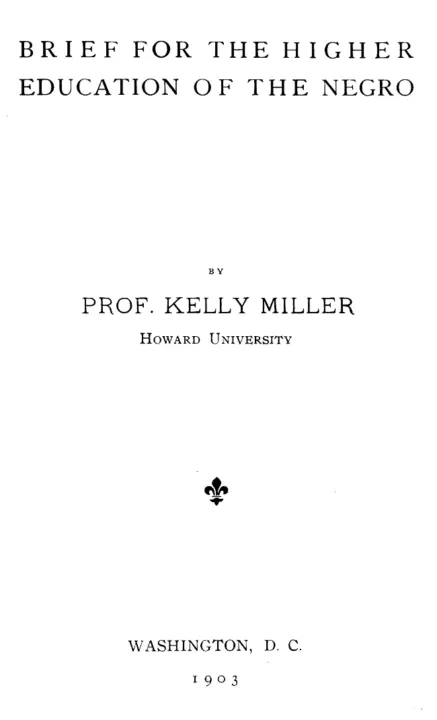
Brief for the higher education of the negro
Kelly Miller
THE CLASSIC COLLECTION · 1919
"Kelly Miller's History of the World War for Human Rights" by Kelly Miller is a historical account written in the early 20th century. This work provides a detailed exploration of World War I with a particular focus on the contributions of Black soldiers in the conflict and the broader implications for human rights and democracy. The book aims to highlight the pivotal roles played by African American troops and the significance of their service in the context of fighting against autocracy and for freedom. The opening of the book sets the tone for an extensive examination of the war and its impact, discussing the far-reaching changes it wrought on civilization. It introduces the main theme of the Negro's involvement in the war, particularly asserting their loyalty and bravery throughout the conflict. Miller plans to present a logical and passionate analysis of the Black contribution to the war, suggesting that their actions during this pivotal historical moment would influence future discussions surrounding civil rights and citizenship in America. By outlining the historical context and highlighting the valor of Black soldiers, the text immediately frames the significance of their contributions against the backdrop of a global struggle for democracy and human rights.
Introduction adapted from the source catalogue; source summaries may be automatically generated.
Free to read · English · 194,149 words · No account needed
MAKE TIME FOR A GOOD BOOK
On by default. Untick to stop anonymous reading totals. Each page counts after 10 seconds in view. How this works.
Anonymous counting is on unless you have switched it off.
The little army of Montenegro is a permanent body of about 35,000 men. There are no trained reserve forces, but there is an available fighting population of 68,000, outside of the army, to call upon.
Recent events throw some doubt on the figures regarding China's military resources, but the last available figures credited the great Republic of the East with a force of 400,000 men, augmented by 300,000 reserves. With this total war strength of 700,000 soldiers, estimates of the available unorganized fighting material reaches the stupendous figure of 63,000,000.
Brazil has a peace strength of 33,000, with more than 500,000 reserves, with more than 4,000,000 unorganized available material.
As relating to the armed strength of the nations abroad, some reference to the system of fortifications which protect the various countries is interesting at this point. Following years--in fact, centuries--of study, Central Europe has been strongly fortified with a system of embattlements which have reached the limits of human ingenuity.
In the east of France, along the frontier where France, Switzerland and Germany meet, there are the first-class fortresses of Belfort, Epinal, Toul and Verdun in the first line, reinforced by Besancon, Dijon, Langres, Rheims, La Fere and Maubeuge in the second line, with smaller fortifications close to the German frontier at Remirement, Luneville, Nancy and other points. Along the Italian frontier the fortresses are situated at Grenoble, Briancon and Nice, with Lyons in the rear. There are strong forts at all naval harbors, the defense of Paris consisting of 97 bastions, 17 old forts and 38 forts of an advanced type, the whole forming entrenched camps at Versailles and St. Denis.
On that line of the German frontier which faces France there are the fortresses of Neu-Breisach, Strassburg, Metz and Diedenhofen, in the first line, with Rastatt, Bitsch and Saarlouis in the second line, and Germershein in the rear. Situated opposite Luxemburg is Mainz, with Coblentz and Cologne opposite Belgium and Wesel opposite Holland.
All along the northern coast, from Wilhelmshafen to Memmel, the German coast is strongly fortified. Memmel is the pivot point of the northern and eastern frontier, the latter frontier being protected by Konigsberg and Allenstein, of the first line, and Danzig, Dirschau, Graudenz, Thorn and the Vistula Passages, of the second line. South of this point are Posen, Glogau and Breslau, which face Poland, while beginning at Neisse the strong defense against Austria consists of fortifications at Glatz, Ingolstadt and Ulm, the approaches to Berlin being guarded by Magdeburg, Spandau and Kustrin.
Your reading position is saved on this browser. Take it to another device with a library code. Reading pages adapt to text, rather than matching a printed edition.
Kelly Miller
Kelly Miller
BEHIND THE BOOK
This eBook is for the use of anyone anywhere in the United States and most other parts of the world at no cost and with almost no restrictions whatsoever. You may copy it, give it away or re-use it under the terms of the Project Gutenberg License included with this eBook or online at www.gutenberg.org. If you are not located in the United States, you will have to check the laws of the country where you are located before using this eBook. Read the source licence.
The original source file, including credits and licence, is retained by this library. Request an original-format copy at no charge. Please include the book title and Project Gutenberg identifier #19179.
KEEP YOUR CURIOSITY GOING
Cécile Tormay

Moritz Busch
John L. Ransom
Frances Wright
Cécile Tormay

Mabel Potter Daggett