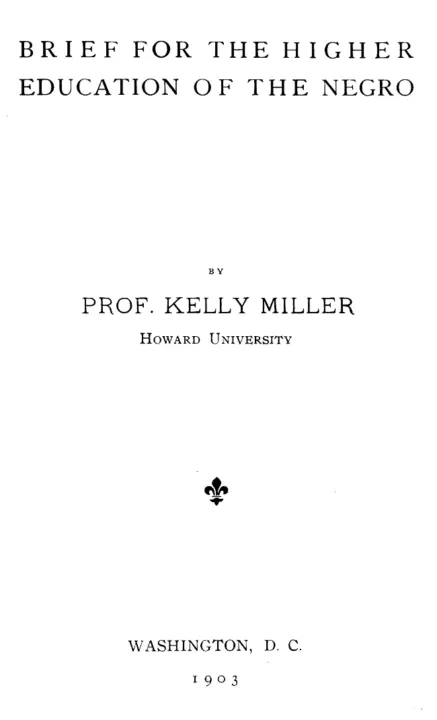
Brief for the higher education of the negro
Kelly Miller
THE CLASSIC COLLECTION · 1919
"Kelly Miller's History of the World War for Human Rights" by Kelly Miller is a historical account written in the early 20th century. This work provides a detailed exploration of World War I with a particular focus on the contributions of Black soldiers in the conflict and the broader implications for human rights and democracy. The book aims to highlight the pivotal roles played by African American troops and the significance of their service in the context of fighting against autocracy and for freedom. The opening of the book sets the tone for an extensive examination of the war and its impact, discussing the far-reaching changes it wrought on civilization. It introduces the main theme of the Negro's involvement in the war, particularly asserting their loyalty and bravery throughout the conflict. Miller plans to present a logical and passionate analysis of the Black contribution to the war, suggesting that their actions during this pivotal historical moment would influence future discussions surrounding civil rights and citizenship in America. By outlining the historical context and highlighting the valor of Black soldiers, the text immediately frames the significance of their contributions against the backdrop of a global struggle for democracy and human rights.
Introduction adapted from the source catalogue; source summaries may be automatically generated.
Free to read · English · 194,149 words · No account needed
MAKE TIME FOR A GOOD BOOK
On by default. Untick to stop anonymous reading totals. Each page counts after 10 seconds in view. How this works.
Anonymous counting is on unless you have switched it off.
In 1913 the Netherlands had in its standing army 1,543 officers and 21,412 men and 152 guns. On a war footing it could probably be raised to 270,000 men. The small arm is the Mannlicher rifle and carbine, the field gun is the same as that of Belgium.
Servia has 10 divisions, divided into 4 army corps. The peace footing is 160,000, and the war strength about 380,000. The rifle is the Mauser model of 1899, and the field piece a quick-firing gun of the French Schneider-Canet system.
Bulgaria has a peace army of about 3,900 officers and 56,000 men. It is armed with the Mannlicher magazine rifle, the Mannlicher carbine, the Schneider quick-fire gun and a light Krupp for the mountain batteries. On a war footing the country musters 4 army corps and 550,000 men.
Roumania's army is about 5,460 officers and 98,000 men. On a war footing it has 5 army corps and 580,000 men. The infantry uses the Mannlicher magazine rifle and the cavalry the Mannlicher carbine. The field and horse batteries are armed with the Krupp quick-fire gun of the model of 1903.
In 1912 Greece had a peace establishment of 1,952 officers and 23,268 men, but the recent war has caused her to augment them to 3 army corps, and her war footing is not far from 250,000 men. The infantry is armed with the Mannlicher-Schonauer rifle of the 1903 model and the field artillery with Schneider-Canet quick-fire guns.
Japan has a peace strength of 250,000 men, with a reserve of 1,250,000, and a total war strength of 1,500,000 men, out of a total available force capable of fighting of approximately 8,239,372 men.
The standing army of Spain is 132,000 men. The reserves are estimated at 1,050,000, and the total war strength at 1,182,000. The total available unorganized force is 2,889,197 men.
The army of Denmark on a peace footing is 13,725 men, with a reserve of 71,609. The total war strength is a little more than 85,000 men, and the total fighting population is approximately 470,000.
Sweden has a peace strength in excess of 75,000 men, and a reserve of more than 500,000, giving an estimated war strength of 600,000 men. The total available unorganized force is about 500,000.
Norway has a standing army a little larger than that of Denmark--about 18,000 men--with 90,000 reserves, giving a total war strength of about 110,000 men. The unorganized force available is about 360,000 men.
Portugal has a peace strength of 30,000 men, with a reserve of 225,000, making a total war strength of more than one-quarter of a million. The unorganized fighting material is more than 800,000.
Turkey, which reorganized its forces within recent years, has a peace strength of 210,000 men, about 800,000 reserves, giving a war strength of over a million, and has a total available unorganized force to call upon of more than 3,000,000.
Your reading position is saved on this browser. Take it to another device with a library code. Reading pages adapt to text, rather than matching a printed edition.
Kelly Miller
Kelly Miller
BEHIND THE BOOK
This eBook is for the use of anyone anywhere in the United States and most other parts of the world at no cost and with almost no restrictions whatsoever. You may copy it, give it away or re-use it under the terms of the Project Gutenberg License included with this eBook or online at www.gutenberg.org. If you are not located in the United States, you will have to check the laws of the country where you are located before using this eBook. Read the source licence.
The original source file, including credits and licence, is retained by this library. Request an original-format copy at no charge. Please include the book title and Project Gutenberg identifier #19179.
KEEP YOUR CURIOSITY GOING
Cécile Tormay

Moritz Busch
John L. Ransom
Frances Wright
Cécile Tormay

Mabel Potter Daggett