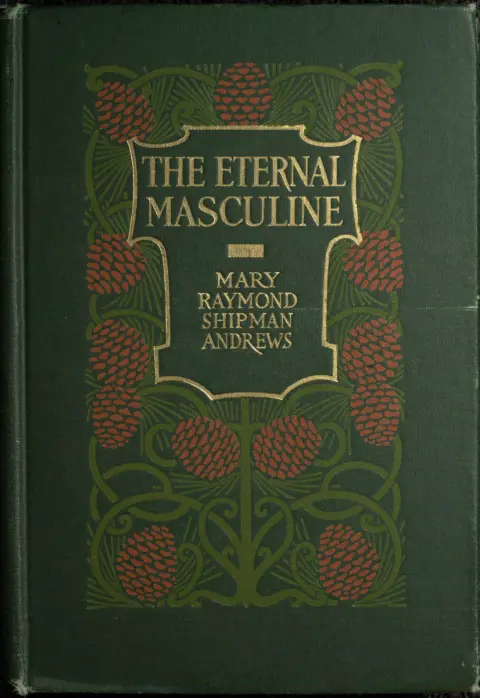
The eternal masculine
Mary Raymond Shipman Andrews
THE CLASSIC COLLECTION · 1919
"Joy in the Morning" by Mary Raymond Shipman Andrews is a novel likely written in the early 20th century. The narrative addresses the aftermath of World War I, focusing on themes of sacrifice, valor, and the enduring impact of war on the lives of ordinary people. The opening portion introduces a poignant dialogue about the experiences of American soldiers, particularly through the lens of a soldier dying in a trench, while also weaving in reflections on historical events and acting as a tribute to those who served. The beginning of the story unfolds in a wartime trench, depicting a dying American soldier grappling with the horrors of battle and the weight of loss. In his delirium, he recalls memories of home, his mother, and the futility he feels about the war, expressing a longing for a normal life that has been overshadowed by violence. Through a mix of memories and dreams, the narrative captures the contrast between the innocence of youth and the grim reality of war, reinforcing the emotional cost of conflict. This sets a reflective tone that continues as the narrative progresses, delving into the legacies of those who fought and how their sacrifices resonate in the world that follows.
Introduction adapted from the source catalogue; source summaries may be automatically generated.
Free to read · English · 57,798 words · No account needed
MAKE TIME FOR A GOOD BOOK
On by default. Untick to stop anonymous reading totals. Each page counts after 10 seconds in view. How this works.
Anonymous counting is on unless you have switched it off.
The colonel, too astonished to answer, stared. The voice, trembling, old, went on. "The second man waked and one was obliged to strangle him also. One brought the brace to the captain at the end of the carabine--rifle."
"In heaven's name who are you?" demanded the colonel.
From where old Rafael had been, bowed and limp in his humble, worn clothes, stepped at a stride a soldier, head up, shoulders squared, glittering eyes forward, and stood at attention. It was like magic. One hand snapped up in a smart salute.
"Who are you?" whispered the colonel.
"If the colonel pleases--l'Hirondelle."
I heard the colonel's breath come and go as he peered, leaning forward to the soldierly figure. "Nom de Ciel," he murmured, "I believe it is." Then in sharp sentences: "You were reported killed. Are you a deserter?"
The steady image of a soldier dropped back a step.
"My colonel--no."
"Explain this."
Rafael--l'Hirondelle--explained. He had not been killed, but captured and sent to a German prison-camp.
"You escaped?" the colonel threw in.
"But yes, my colonel."
The colonel laughed. "One would know it. The clumsy Boches could not
hold the Swallow."
"But no, my colonel."
"Go on."
"One went to work before light, my colonel, in that accursed prison-camp. One was out of sight from the guard for a moment, turning a corner, so that on a morning I slipped into some bushes and hid in a dugout--for it was an old camp--all day. That night I walked. I walked for seven nights and lay hid for seven days, eating, my colonel, very little. Then, v'la, I was in front of the French lines."
"You ran across to our lines?"
"But not exactly. One sees that I was yet in dirty German prison clothes, and looked like an infantryman of the Boches, so that a poilu rushed at me with a bayonet. I believed, then, that I had come upon a German patrol. Each thought the other a Hun. I managed to wrest from the poilu his rifle with the bayonet, but as we fought another shot me--in the side."
"You were wounded?"
"Yes, my colonel."
"In hospital?"
"Yes, my colonel."
"How long?"
"Three months, my colonel."
"Why are you not again in the army?"
The face of the erect soldier, Hirondelle, the dare-devil, was suddenly the face of a man grown old, ill, and broken-hearted. He stared at the stalwart French officer, gathering himself with an effort. "I--was discharged, my colonel, as--unfit." His head in its old felt hat dropped into his hands suddenly, and he broke beyond control into sobs that shook not only him but every man there.
Your reading position is saved on this browser. Take it to another device with a library code. Reading pages adapt to text, rather than matching a printed edition.
Mary Raymond Shipman Andrews
Mary Raymond Shipman Andrews

Mary Raymond Shipman Andrews
Mary Raymond Shipman Andrews
BEHIND THE BOOK
This eBook is for the use of anyone anywhere in the United States and most other parts of the world at no cost and with almost no restrictions whatsoever. You may copy it, give it away or re-use it under the terms of the Project Gutenberg License included with this eBook or online at www.gutenberg.org. If you are not located in the United States, you will have to check the laws of the country where you are located before using this eBook. Read the source licence.
The original source file, including credits and licence, is retained by this library. Request an original-format copy at no charge. Please include the book title and Project Gutenberg identifier #15796.
KEEP YOUR CURIOSITY GOING
Cécile Tormay

Moritz Busch
Coulson Kernahan
John L. Ransom

Maurice Baring
Frances Wright