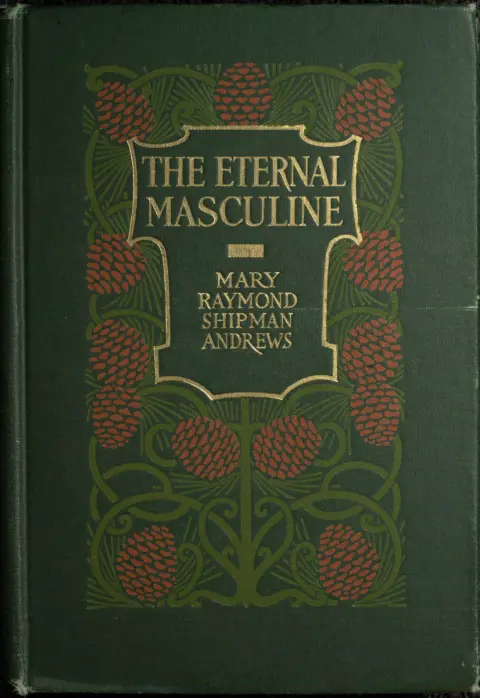
The eternal masculine
Mary Raymond Shipman Andrews
THE CLASSIC COLLECTION · 1919
"Joy in the Morning" by Mary Raymond Shipman Andrews is a novel likely written in the early 20th century. The narrative addresses the aftermath of World War I, focusing on themes of sacrifice, valor, and the enduring impact of war on the lives of ordinary people. The opening portion introduces a poignant dialogue about the experiences of American soldiers, particularly through the lens of a soldier dying in a trench, while also weaving in reflections on historical events and acting as a tribute to those who served. The beginning of the story unfolds in a wartime trench, depicting a dying American soldier grappling with the horrors of battle and the weight of loss. In his delirium, he recalls memories of home, his mother, and the futility he feels about the war, expressing a longing for a normal life that has been overshadowed by violence. Through a mix of memories and dreams, the narrative captures the contrast between the innocence of youth and the grim reality of war, reinforcing the emotional cost of conflict. This sets a reflective tone that continues as the narrative progresses, delving into the legacies of those who fought and how their sacrifices resonate in the world that follows.
Introduction adapted from the source catalogue; source summaries may be automatically generated.
Free to read · English · 57,798 words · No account needed
MAKE TIME FOR A GOOD BOOK
On by default. Untick to stop anonymous reading totals. Each page counts after 10 seconds in view. How this works.
Anonymous counting is on unless you have switched it off.
Lance admitted it and got the note and read it while Jackson, knowing his Family intimately, knew that something pleasant and surprising was afoot and assisted with a discreet regard. When he saw that the note was finished, Jackson confidently put in his word. "Cyar's waitin', sir. Orders is I was to tote you to de house."
Lance's eyes glowered as he looked up. "Tell me one thing," he demanded.
"Yes, sir," grinned Jackson, pleased with this young gentleman from a
very poor neighborhood, who quite evidently was, all the same,
"quality."
"Are you," inquired Lance, "are you any relation to Aunt Basha?"
Jackson, for all his efficiency a friendly soul, forgot the dignity of his livery and broke into chuckles. "Naw, sir; naw, sir. I dunno de lady, sir; I reckon I ain't, sir," answered Jackson.
"All right, then, but it's the mistake of your life not to be. She's the best on earth. Wait till I brush my hair," said Lance, and did it.
Inside three minutes he was in the big Pierce-Arrow, almost as unfamiliar, almost as delightful to him as to Aunt Basha, and speeding gloriously through the streets. The note had said that some kinspeople had just discovered him, and would he come straight to them for lunch.
Mrs. Cabell and Eleanor crowded frankly to the window when the car
stopped.
"I can't wait to see David's boy," cried Mrs. Cabell, and Eleanor, wise of her generation, followed with:
"Now, don't expect much; he may be deadly."
And out of the limousine stepped, unconscious, the beautiful David, and
handed Jackson a dollar.
"Oh!" gasped Mrs. Cabell.
"It was silly, but I love it," added Eleanor; and David limped swiftly up the steps, and one heard Ebenezer, the butler, opening the door with suspicious promptness. Everyone in the house knew, mysteriously, that uncommon things were doing.
"Pendleton," spoke Mrs. Cabell, lying in wait for her son, the great doctor, as he came from his office at lunch time, "Pen, dear, let me tell you something extraordinary." She told, him, condensing as might be, and ended with; "And oh, Pen, he's the most adorable boy I ever saw. And so lonely and so poor and so plucky. Heartbroken because he's lame and can't serve. You'll cure him. Pen, dear, won't you, for his country?"
The tall, tired man bent down and kissed his mother. "Mummy, I'm not God Almighty. But I'll do my damdest for anything you want. Show me the paragon."
The paragon shot up, with the small unevenness which was his limp, and faced the big doctor on a level. The two pairs of eyes from their uncommon height, looked inquiringly into each other.
Your reading position is saved on this browser. Take it to another device with a library code. Reading pages adapt to text, rather than matching a printed edition.
Mary Raymond Shipman Andrews
Mary Raymond Shipman Andrews
Mary Raymond Shipman Andrews
Mary Raymond Shipman Andrews
BEHIND THE BOOK
This eBook is for the use of anyone anywhere in the United States and most other parts of the world at no cost and with almost no restrictions whatsoever. You may copy it, give it away or re-use it under the terms of the Project Gutenberg License included with this eBook or online at www.gutenberg.org. If you are not located in the United States, you will have to check the laws of the country where you are located before using this eBook. Read the source licence.
The original source file, including credits and licence, is retained by this library. Request an original-format copy at no charge. Please include the book title and Project Gutenberg identifier #15796.
KEEP YOUR CURIOSITY GOING
Cécile Tormay

Moritz Busch
Coulson Kernahan
John L. Ransom

Maurice Baring
Frances Wright