THE CLASSIC COLLECTION✦My diaries, being a personal narrative of events 1888-1914, Part 2 (1900-1914)CLASSIC FREE BOOKS
My diaries, being a personal narrative of events 1888-1914, Part 2 (1900-1914)
Wilfrid Scawen Blunt
THE CLASSIC COLLECTION · 1902
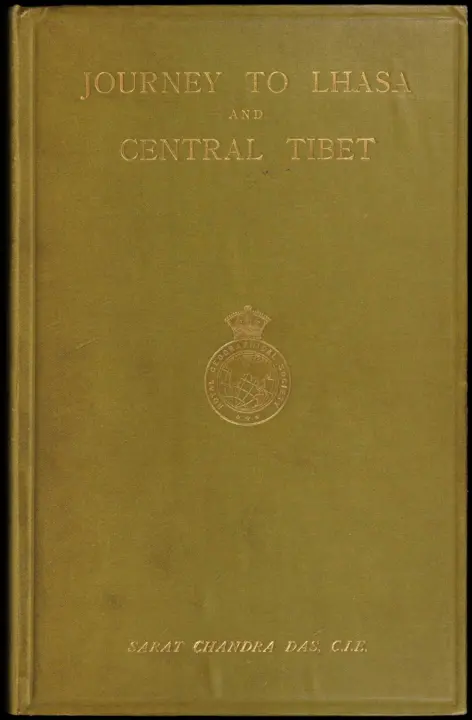
"Journey to Lhasa and Central Tibet" by Sarat Chandra Das is a travelogue published in 1902. The book chronicles Das's second expedition to Tibet in 1881, undertaken under British colonial orders. Das ventures into the forbidden Tibetan capital and central regions, documenting his observations as both explorer and covert agent. Contemporary reviews praised it as the most authentic account of Tibet available, highlighting Das's courage and keen insight into this mysterious land.
Introduction adapted from the source catalogue; source summaries may be automatically generated.
Free to read · English · 110,516 words · No account needed
MAKE TIME FOR A GOOD BOOK
On by default. Untick to stop anonymous reading totals. Each page counts after 10 seconds in view. How this works.
Anonymous counting is on unless you have switched it off.
[332] Huc, op. cit., vol. ii. p. 338, tells us of the pleasure the Regent of Lhasa found in learning from him the Roman alphabet. I myself have found it the one subject which never failed to interest Tibetans, lamas, and laymen.—(W. R.)
[333] On this ceremony of burnt-offering, chin (sbyin), “alms;” sreg, “to burn up,” see Emil Schlagintweit, ‘Buddhism in Tibet,’ p. 249 et sqq.; and Waddell, op. cit., p. 498.
[334] See supra, p. 66.
[335] Ding means something like “village.” It is a very common termination to names of places throughout Tibet.—(W. R.)
[336] Daba, or Draba, is the name applied to all lamas irrespective of rank. The word lama is only used when speaking of some high dignitary in the church, or of a gelong, or “priest.”—(W. R.)
[337] The Gyade country, which extends from the high-road from Nagchukha to Hsi-ning in Kansu and to Chamdo, is not under the rule of Lhasa, it is a purely Bonbo country. I traversed this region from west to east in 1892. Khams Gyarong refers to the Chin chuan, a small region on the Upper Ta-tung river, in North-west Sze-chuen, where this religion has many adherents.—(W. R.)
[338] The present Bonbo religion is hardly distinguishable from Tibetan Buddhism, except in a few peculiar reversals of lamaist customs, and in the names of the gods. See ‘Land of the Lamas,’ p. 217. Schiefner, Sarat Chandra, and Laufer have published translations and texts of some Bonbo works.—(W. R.)
[339] Not a very intelligible or satisfactory explanation. See Waddell,
op. cit., p. 287.
[340] The little water-bottle carried by gelongs, and with which they moisten their mouths in the forenoon when they are not allowed to eat or drink. Waddell, op. cit., 201.—(W. R.)
[341] The Sham-tab is a plaited petticoat of red pulo; it is worn by all lamas. The tongu is the upper shawl.
[342] By which he means, I suppose, the Chang tang Bonbos of Gyade.—(W.
R.)
[343] This is also done among Buddhists, as in the Palti lake country.
See supra, p. 139.
[344] Moorcroft, ‘Travels,’ ii. 68, refers to Bonbo lamas when he describes the lamas of Pin (in Ladak), who allow their hair to grow and become matted, and who wear black. Nain Singh makes mention of the Bonbo country of North Tibet, which he calls “the Ombo, or Pembo country,” Journal of the Royal Geographical Society, xlvii. p. 107.—(W. R.)
[345] I have heard of Chinese claims to the discovery of the telephone, but never before of Tibetan. I fancy the lama had heard of the Morse transmitter, which may have been taken for a little hammer struck on a board.—(W. R.)
[346] Visited by Ugyen-gyatso in 1883.
Your reading position is saved on this browser. Take it to another device with a library code. Reading pages adapt to text, rather than matching a printed edition.
BEHIND THE BOOK
This eBook is for the use of anyone anywhere in the United States and most other parts of the world at no cost and with almost no restrictions whatsoever. You may copy it, give it away or re-use it under the terms of the Project Gutenberg License included with this eBook or online at www.gutenberg.org. If you are not located in the United States, you will have to check the laws of the country where you are located before using this eBook. Read the source licence.
The original source file, including credits and licence, is retained by this library. Request an original-format copy at no charge. Please include the book title and Project Gutenberg identifier #68898.
KEEP YOUR CURIOSITY GOING
Wilfrid Scawen Blunt
Wilfrid Scawen Blunt

E. W. (Edgar Watson) Howe
Francis Greenleaf Allinson & Anne C. E. (Anne Crosby Emery) Allinson
Cyrenus Cole

John Martineau