THE CLASSIC COLLECTION✦My diaries, being a personal narrative of events 1888-1914, Part 2 (1900-1914)CLASSIC FREE BOOKS
My diaries, being a personal narrative of events 1888-1914, Part 2 (1900-1914)
Wilfrid Scawen Blunt
THE CLASSIC COLLECTION · 1902
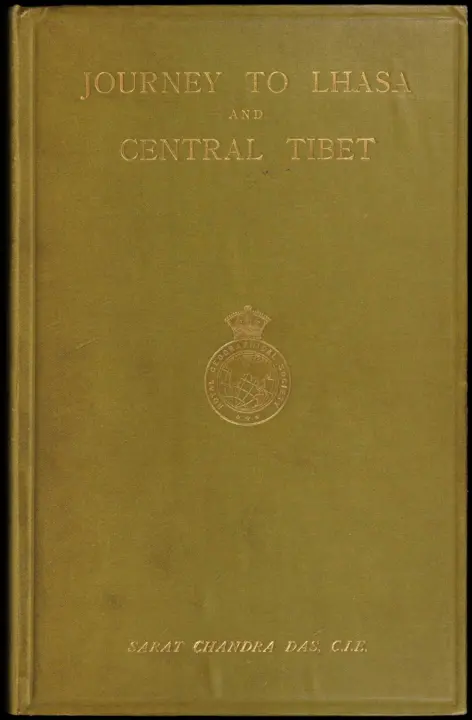
"Journey to Lhasa and Central Tibet" by Sarat Chandra Das is a travelogue published in 1902. The book chronicles Das's second expedition to Tibet in 1881, undertaken under British colonial orders. Das ventures into the forbidden Tibetan capital and central regions, documenting his observations as both explorer and covert agent. Contemporary reviews praised it as the most authentic account of Tibet available, highlighting Das's courage and keen insight into this mysterious land.
Introduction adapted from the source catalogue; source summaries may be automatically generated.
Free to read · English · 110,516 words · No account needed
MAKE TIME FOR A GOOD BOOK
On by default. Untick to stop anonymous reading totals. Each page counts after 10 seconds in view. How this works.
Anonymous counting is on unless you have switched it off.
[293] In this connection the following is interesting: “Some few years ago the Grand Council of Lhasa (Caphyn) was composed of three men, named Semeling, Tengeling, and Kunduling. A man of influence named Sape Satya complained to the Emperor of China of the oppressive and inefficient rule of these men. The Chinese commissioner, ‘Kissen,’ came from China, apprehended Semeling, and took him off as a prisoner to China.”—Ashley Eden, ‘Report on the State of Bootan,’ p. 131; cf. Huc., op. cit., ii. 287 et sqq.
[294] He is also called Chyi-lon Hutuketu. He is Chancellor of the Exchequer; the Chinese Amban is his colleague, and his approval of any expenditure is necessary.—(W. R.)
[295] See Huc., op. cit., ii. 286.
[296] Our author’s informant must have written ja tsag, meaning “tea-strainer”; but Chasag is spelt rgyal tsab, and means “viceroy.” The Lhasa Amban is in like manner called Gong-ma tsab, “the Emperor’s deputy.”—(W. R.)
[297] Cf. Jour. Roy. Asiat. Soc., xxiii. pp. 11, 220, 239, 242. The
nominees to these positions are confirmed by the Emperor of China.—(W.
R.)
[298] This button is given them by the Emperor (or rather the Amban). The lama minister does not wear one. According to Chinese authorities, the Kalon have only 3rd class, or blue, buttons. The coral button belongs to the 1st class.—(W. R.)
[299] On the Dungkhor, see Jour. Roy. Asiat. Soc., xxiii. pp. 220, 243.
[300] Our author forgets the “squeezes,” which swell all salaries to very respectable sizes.—(W. R.)
[301] A lama (Tse-dung) and a layman.—(S. C. D.)
[302] On the military inspections made by the Amban, see Peking Gazette, January 24, 1886, and Jour. Roy. Asiat. Soc., xxiii, p. 216.
[303] Of course most of the Djongpon only attend to a very few of these duties. They squeeze the people under them, exact as much service as possible, and, together with the lamas, get everything they can out of them, and only stop when their exactions appear likely to cause serious trouble.—(W. R.)
[304] In Chinese, called Liang-tai. On the Chinese military establishment in Tibet, see Jour. Roy. Asiat. Soc., xxiii, p. 275 et sqq.; and on the Amban’s duties, ibid., p. 7 et sqq.
[305] In the Anglo-Tibetan war there were four Magpons or Mafeas, and
eight Dahpons.
[306] Thos. Manning (Markham, ‘Tibet.,’ p. 274) says, “It is very bad policy thus perpetually to send men of bad character to govern Tibet. It no doubt displeases the Grand Lama and Tibetans in general, and tends to prevent their affections from settling in favour of the Chinese Government. I cannot help thinking, from what I have seen and heard, that they would view the Chinese influence in Tibet overthrown without many emotions of regret.”—(W. R.)
Your reading position is saved on this browser. Take it to another device with a library code. Reading pages adapt to text, rather than matching a printed edition.
BEHIND THE BOOK
This eBook is for the use of anyone anywhere in the United States and most other parts of the world at no cost and with almost no restrictions whatsoever. You may copy it, give it away or re-use it under the terms of the Project Gutenberg License included with this eBook or online at www.gutenberg.org. If you are not located in the United States, you will have to check the laws of the country where you are located before using this eBook. Read the source licence.
The original source file, including credits and licence, is retained by this library. Request an original-format copy at no charge. Please include the book title and Project Gutenberg identifier #68898.
KEEP YOUR CURIOSITY GOING
Wilfrid Scawen Blunt
Wilfrid Scawen Blunt

E. W. (Edgar Watson) Howe
Francis Greenleaf Allinson & Anne C. E. (Anne Crosby Emery) Allinson
Cyrenus Cole

John Martineau