THE CLASSIC COLLECTION✦My diaries, being a personal narrative of events 1888-1914, Part 2 (1900-1914)CLASSIC FREE BOOKS
My diaries, being a personal narrative of events 1888-1914, Part 2 (1900-1914)
Wilfrid Scawen Blunt
THE CLASSIC COLLECTION · 1902
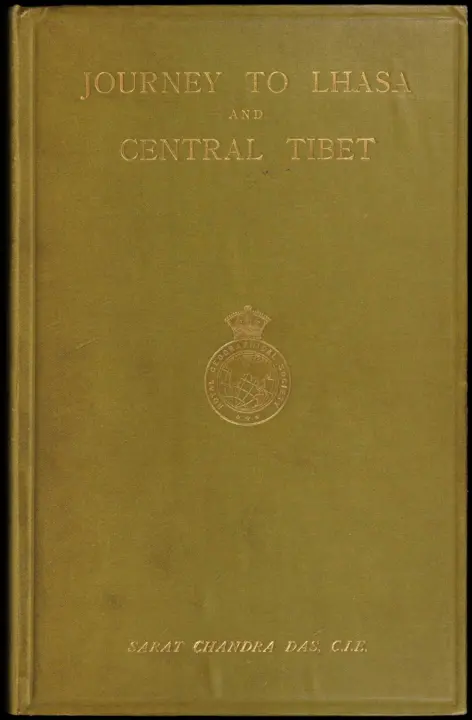
"Journey to Lhasa and Central Tibet" by Sarat Chandra Das is a travelogue published in 1902. The book chronicles Das's second expedition to Tibet in 1881, undertaken under British colonial orders. Das ventures into the forbidden Tibetan capital and central regions, documenting his observations as both explorer and covert agent. Contemporary reviews praised it as the most authentic account of Tibet available, highlighting Das's courage and keen insight into this mysterious land.
Introduction adapted from the source catalogue; source summaries may be automatically generated.
Free to read · English · 110,516 words · No account needed
MAKE TIME FOR A GOOD BOOK
On by default. Untick to stop anonymous reading totals. Each page counts after 10 seconds in view. How this works.
Anonymous counting is on unless you have switched it off.
[200] Lha-sre is the usual title of sons of very high officials. It means, literally, “son of a god,” but may be conveniently translated by “prince.”—(W. R.)
[201] See note 1, p. 115.
[202] The “presiding deity” was probably Dorje sempa or Vajrasattva. The Kala Chakra mysticism and its standard work in the Tibetan Tanjur, called ‘Dus-gi khorlo,’ which I once tried to read, have remained beyond my comprehension. Emil Schlagintweit, ‘Buddhism in Tibet,’ pp. 46–57, and p. 242 et sqq., gives many details on the subject. See also Waddell, op. cit., 15, 144, 397.—(W. R.)
[203] This official is referred to, p. 94.—(W. R.)
[204] Chandra Das’s experience recalls to my mind the prophecy made me in 1889 by an incarnate lama in the Tsaidam. ‘Land of the Lamas,’ pp. 164, 165.
[205] Rong usually means a fertile valley where cultivation is possible, or which is cultivated.—(W. R.)
[206] Gab zi on the maps. It must be the same as A. K.’s Upsi village, where, he says, there is a large Chinese stage-house.—(W. R.)
[207] Called Shetot on the map.—(W. R.)
[208] A. K. says that there is also at this village a large Chinese post station. These post stations are called tang in Chinese; the building itself is a kung kuan. On the Dugpa sect, see Waddell, op. cit. He says it originated in the XIIth century.—(W. R.)
[209] Also known as Ralung la, according to A. K.—(W. R.)
[210] Jaeschke, Dict., s.v. o-ma., says that this name designates the plain on which Lhasa stands. Georgi, op. cit., p. 451, mentions between Gyantse and Nangartse, Lhomar and Lhamentung. The first place I do not find on any maps at my disposal. The latter, however, corresponds with the Langma of the maps. According to the maps, the Karo la is 16,600 feet high.—(W. R.)
[211] On such religious services, see Waddell, op. cit., 353, 494 et
sqq.—(W. R.)
[212] The name is written Bsam-lding, meaning, apparently, “fancy floating.” It was founded, according to Chandra Das’s authorities, by Shon-nu drupa.—(W. R.)
[213] Tibetan, Mongol, and Chinese doctors ask their patients but few, if any, questions. They are supposed to diagnose the disease by the general appearance of the patient and by his pulse and the condition of his urine.—(W. R.)
[214] Khyab-gong and Khyab-gong rinpoche are titles given all the higher incarnate lamas. The word means “protector.”—(W. R.)
[215] Such pills are usually called mani rilbu. On the ceremonies performed in making them, I must refer the reader to my paper on the subject in Proceedings of the American Oriental Society, October, 1888, p. xxii. On the subject of “general teas,” see Huc, ‘Souvenirs,’ vol. ii. p. 122; ‘Land of the Lamas,’ p. 104; and Waddell, ‘Buddhism of Tibet,’ p. 191.—(W. R.)
Your reading position is saved on this browser. Take it to another device with a library code. Reading pages adapt to text, rather than matching a printed edition.
BEHIND THE BOOK
This eBook is for the use of anyone anywhere in the United States and most other parts of the world at no cost and with almost no restrictions whatsoever. You may copy it, give it away or re-use it under the terms of the Project Gutenberg License included with this eBook or online at www.gutenberg.org. If you are not located in the United States, you will have to check the laws of the country where you are located before using this eBook. Read the source licence.
The original source file, including credits and licence, is retained by this library. Request an original-format copy at no charge. Please include the book title and Project Gutenberg identifier #68898.
KEEP YOUR CURIOSITY GOING
Wilfrid Scawen Blunt
Wilfrid Scawen Blunt

E. W. (Edgar Watson) Howe
Francis Greenleaf Allinson & Anne C. E. (Anne Crosby Emery) Allinson
Cyrenus Cole

John Martineau