THE CLASSIC COLLECTION✦My diaries, being a personal narrative of events 1888-1914, Part 2 (1900-1914)CLASSIC FREE BOOKS
My diaries, being a personal narrative of events 1888-1914, Part 2 (1900-1914)
Wilfrid Scawen Blunt
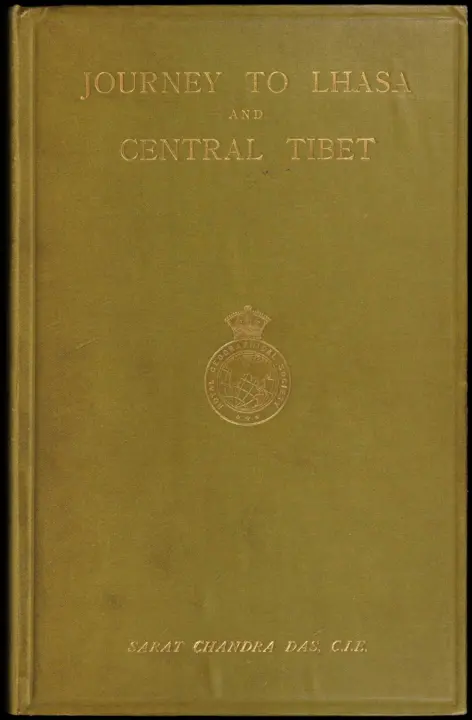
THE CLASSIC COLLECTION · 1902
"Journey to Lhasa and Central Tibet" by Sarat Chandra Das is a travelogue published in 1902. The book chronicles Das's second expedition to Tibet in 1881, undertaken under British colonial orders. Das ventures into the forbidden Tibetan capital and central regions, documenting his observations as both explorer and covert agent. Contemporary reviews praised it as the most authentic account of Tibet available, highlighting Das's courage and keen insight into this mysterious land.
Introduction adapted from the source catalogue; source summaries may be automatically generated.
Free to read · English · 110,516 words · No account needed
MAKE TIME FOR A GOOD BOOK
On by default. Untick to stop anonymous reading totals. Each page counts after 10 seconds in view. How this works.
Anonymous counting is on unless you have switched it off.
[181] Speaking of the dances of Tibet, our author says elsewhere that Padma Sambhava, in the eighth century, A.D., is the reputed originator of religious dances in Tibet. He introduced the war-dance and the famous masqued dance, or bag chams (hbag hchams), the former being but a modification of the latter. At present the great religious dance of Tibet is the black-hat dance (Dza nag cham), which was introduced in the eleventh century, A.D., to commemorate the assassination of the iconoclast King Langdarma by Lama Lhalun Paldor, the murderer having disguised himself in black when seeking to approach the king. The ordinary dance of Tibet (dzabs bro) is performed by men and women on all or any occasion of rejoicing. Sometimes they dance in pairs, sometimes in a ring, and at others the women hand-in-hand on one side, the men in like fashion on the other. (S. C. D.) Cf. Markham, ‘Tibet,’ p. 92; E. F. Knight, ‘Where Three Empires Meet,’ p. 202 et sqq.; Waddell, ‘Buddhism of Tibet,’ pp. 34, 477, 515 et sqq.
[182] Cf. infra, p. 116.
[183] The office here mentioned is well known in Sikkim. See the Sikhim Gazetteer, p. 304, vi. The amged, as colloquially pronounced, is the active ruler of the monastery, and often a very important person.
[184] This Chinese Buddhist monk (or ho-shang) came to Tibet in the reign of King Srong-btsan gambo (A.D. 629–698). He is usually called Mahadeva, not Dharmatala.—(W. R.)
[185] Geo. Bogle, op. cit., p. 106, witnessed a somewhat similar dance at Tashilhunpo on New Year’s Day. An effigy of the devil was likewise burnt. Tibetans use the word atsara much as the Chinese do yang kuei-tzŭ, or “foreign devils,” though it was originally the name given to learned Indian pilgrims. The word is Sanskrit, acharya.—(W. R.)
[186] See Captain Samuel Turner, ‘Embassy,’ p. 314.
[187] According to Chinese authorities, this, or a similar feast, is celebrated at Lhasa in the second moon of the year. Another analogous festival is held on the 30th day of the sixth moon. See J.R.A.S., xxiii. pp. 212, 213.—(W. R.)
[188] The Chang-tang is not an uninhabited desert, for numerous tribes of Drupa pasture their herds there the year long, and keep up a considerable trade with Lhasa and Shigatse, which they supply with salt. It has been repeatedly crossed by European explorers.—(W. R.)
[189] Cf. the legend of the miraculous tree sprung from the hair of Tsongkhapa, and still growing in the courtyard of Kumbum gomba. ‘The Land of the Lamas,’ pp. 67, 68.
[190] On the new year festivities, see Waddell, op. cit., p. 513.
[191] On lamaist monachism, see Sarat Chandra Das’s ‘Indian Pundits in the Land of Snow,’ and Waddell, op. cit., pp. 169 et sqq.
Your reading position is saved on this browser. Take it to another device with a library code. Reading pages adapt to text, rather than matching a printed edition.
BEHIND THE BOOK
This eBook is for the use of anyone anywhere in the United States and most other parts of the world at no cost and with almost no restrictions whatsoever. You may copy it, give it away or re-use it under the terms of the Project Gutenberg License included with this eBook or online at www.gutenberg.org. If you are not located in the United States, you will have to check the laws of the country where you are located before using this eBook. Read the source licence.
The original source file, including credits and licence, is retained by this library. Request an original-format copy at no charge. Please include the book title and Project Gutenberg identifier #68898.
KEEP YOUR CURIOSITY GOING
Wilfrid Scawen Blunt
Wilfrid Scawen Blunt

E. W. (Edgar Watson) Howe
Francis Greenleaf Allinson & Anne C. E. (Anne Crosby Emery) Allinson
Cyrenus Cole

John Martineau