THE CLASSIC COLLECTION✦My diaries, being a personal narrative of events 1888-1914, Part 2 (1900-1914)CLASSIC FREE BOOKS
My diaries, being a personal narrative of events 1888-1914, Part 2 (1900-1914)
Wilfrid Scawen Blunt
THE CLASSIC COLLECTION · 1850
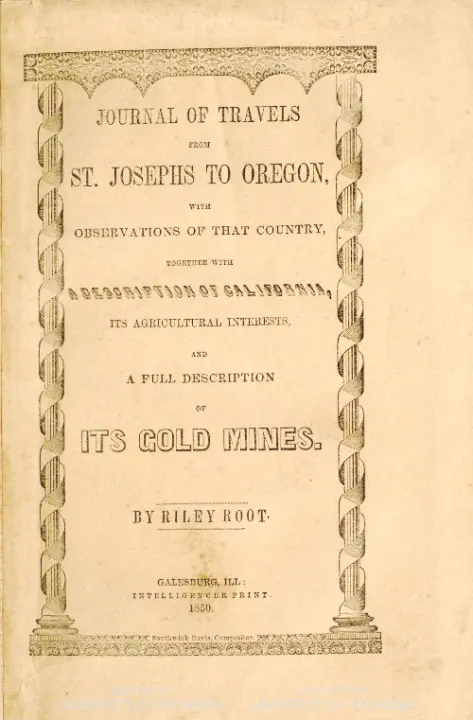
"Journal of Travels From St. Josephs to Oregon" by Riley Root is a historical account written in the mid-19th century. This work chronicles the author's expedition from St. Josephs, Missouri, to Oregon, detailing observations of the landscapes, settlements, and challenges faced by emigrants during this significant period in American expansion. The author shares firsthand insights, making the journey vividly relatable to readers interested in the westward migration and the experiences of early pioneers. The opening of the journal introduces the reader to Root's journey, beginning with his departure from Knox County, Illinois, and his travels down the Mississippi and up the Missouri River to St. Josephs. He reflects on various towns he passes, particularly Nauvoo, the Mormon community, and provides a glimpse into the American landscapes he encounters, including the muddy waters of the Missouri River and the budding town of St. Josephs itself. Root then prepares to embark into the Indian territories with other emigrants, setting the stage for the arduous journey ahead as they seek out new opportunities in the American West, facing uncertainty and the wild beauty of the untamed land.
Introduction adapted from the source catalogue; source summaries may be automatically generated.
Free to read · English · 49,268 words · No account needed
MAKE TIME FOR A GOOD BOOK
On by default. Untick to stop anonymous reading totals. Each page counts after 10 seconds in view. How this works.
Anonymous counting is on unless you have switched it off.
25th—13 miles, over a miserably poor and uneven country, to Quesnell’s creek. Down the creek one mile, in order to obtain water, where camp is located.
26th—Staid at camp. Morning cold. Found there was ice in our cooking vessels, though weather became warm during the day.
27th—Returnd up the creek to the crossing, though on the west side of the flat. From the east side of the flat, to-day’s reckoning commences, and crosses over to Beaver fork of John Day’s river, a distance of 20½ miles. No camp can be had between the two places, though a small spring exists, two miles east of camp. Most of the way to-day, the road has been good, through a long, level valley.
28th—7 miles to crossing of John Day’s river. Way down Beaver fork, very rocky, and road crosses it 4 times.
29th—Down John Day’s river, half a mile. Then ascended the bluff, about one mile, up a narrow, winding, rocky ravine, the worst we had ever traveld. On the top of this bluff, the road divides, one leading to the Columbia river. The other, at the left, is the one we took. From the top of this bluff, the road, the remainder of the day, was smooth to camp, at a lone spring among the bluffs. Distance to-day, about fifteen miles. Grass enough for a small band. No wood. About two miles east, up a ravine a short distance to the left, there are two small springs, where a small party might camp for the night. No wood.
30th—25 miles to camp, on the western declivity of the dividing ridge, between John Day’s and Deshutes river, at the upper end of a ravine, where was a little grass, but no wood, and no water for cattle. We staid through the night, without supper, and left next morning, without breakfast.
31st—Traveld about 5 miles, to the crossing of Deshutes or Fall river. Here, we breakfasted in a deep chasm, almost as difficult of descent and ascent, as the valley of Sindbad the sailor, with nearly precipitous rocks, from 1000 to 1500 feet high, on every side. Afternoon employd in calking wagon-boxes, to ferry our goods across the river.
Friday, Sept. 1st—All day employd in getting our goods across the river, with the help of several Indians. River at the crossing, about seven rods wide, with considerable current.
2d—Whilst watching some of our wagons on the bank of the river, till others could be taken up the bluffs, I was led to the following reflections upon the miserable condition of the poor, degraded-looking Indians at this place—
Your reading position is saved on this browser. Take it to another device with a library code. Reading pages adapt to text, rather than matching a printed edition.
BEHIND THE BOOK
This eBook is for the use of anyone anywhere in the United States and most other parts of the world at no cost and with almost no restrictions whatsoever. You may copy it, give it away or re-use it under the terms of the Project Gutenberg License included with this eBook or online at www.gutenberg.org. If you are not located in the United States, you will have to check the laws of the country where you are located before using this eBook. Read the source licence.
The original source file, including credits and licence, is retained by this library. Request an original-format copy at no charge. Please include the book title and Project Gutenberg identifier #62155.
KEEP YOUR CURIOSITY GOING
Wilfrid Scawen Blunt
Wilfrid Scawen Blunt

E. W. (Edgar Watson) Howe
Cécile Tormay

Moritz Busch
John L. Ransom