THE CLASSIC COLLECTION✦My diaries, being a personal narrative of events 1888-1914, Part 2 (1900-1914)CLASSIC FREE BOOKS
My diaries, being a personal narrative of events 1888-1914, Part 2 (1900-1914)
Wilfrid Scawen Blunt
THE CLASSIC COLLECTION · 1850
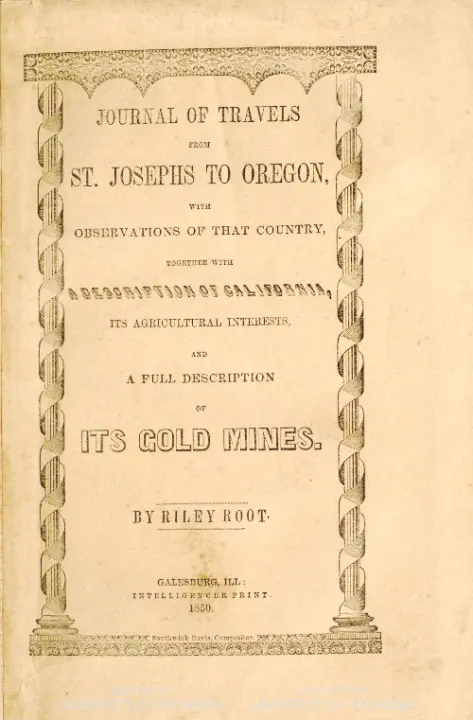
"Journal of Travels From St. Josephs to Oregon" by Riley Root is a historical account written in the mid-19th century. This work chronicles the author's expedition from St. Josephs, Missouri, to Oregon, detailing observations of the landscapes, settlements, and challenges faced by emigrants during this significant period in American expansion. The author shares firsthand insights, making the journey vividly relatable to readers interested in the westward migration and the experiences of early pioneers. The opening of the journal introduces the reader to Root's journey, beginning with his departure from Knox County, Illinois, and his travels down the Mississippi and up the Missouri River to St. Josephs. He reflects on various towns he passes, particularly Nauvoo, the Mormon community, and provides a glimpse into the American landscapes he encounters, including the muddy waters of the Missouri River and the budding town of St. Josephs itself. Root then prepares to embark into the Indian territories with other emigrants, setting the stage for the arduous journey ahead as they seek out new opportunities in the American West, facing uncertainty and the wild beauty of the untamed land.
Introduction adapted from the source catalogue; source summaries may be automatically generated.
Free to read · English · 49,268 words · No account needed
MAKE TIME FOR A GOOD BOOK
On by default. Untick to stop anonymous reading totals. Each page counts after 10 seconds in view. How this works.
Anonymous counting is on unless you have switched it off.
20th—We descended the western declivity of the Blue mountains, part of the way over volcanic scoria, to camp, on Umatilla river. About 12 miles of the first part of this day’s route, was through a timberd district of pine, hemlock and fir, loaded, many of them, with pendant moss. On leaving the timber, we ascended a hill, a mile or more, to Mount Prospect, the last high point before descending the bluffs to the river. I name the hill, from its commanding a view of the whole western horizon, to a great distance around.
On Prospect hill is a cluster of rocks, which, with a little help of the imagination, can be easily construed into Vulcan’s blacksmith shop, where all the cinders so profusely spread over the Blue mountains, were made. On retiring, he left his forge loaded with the cinders of his last blast, as a memorial of his great ambition.
Three and a half miles more, down the bluffs, brought us to camp, making in all, this day, 16½ miles.
21st—Down Umatilla river, near to crossing, 10 miles. Country here entirely prairie, and very undulating.
22d—Crossd the river, half a mile below camp, and passd about two miles on the flat. Ascended the bluff, and passd over the prairie about 14 miles, to the river, down the river two miles to camp, making in all 18½ miles. Prairie, to-day, uneven, and of poor soil.
23d—14½ miles to camp, on Alder creek. Five miles to second crossing of Umatilla, 8½ miles to Alder creek, up the same one mile to camp. Little grass, no wood but fine willows. In this day’s travel, two miles might have been savd, by crossing the river at camp, but to avoid sandy traveling, emigrants go down the river some farther. This is Whitman’s cut-off.
24th—18½ miles, over a poor tract of the Columbia River valley, to camp, at the foot of a hill, by a spring, calld Well spring, rising in the center of a large mound of decayd vegetation, and sinking suddenly again, within a few feet of where it issues. Noond, to-day, on the battle-ground of the 24th February, 1848, between Oregon soldiers and the Cayuse Indians. No grass nor water exists along this day’s route, where emigrants might refresh themselves and their weary teams. Fire wood is obtaind two miles east, in a hollow, where are a few scattering cedars. The spring at camp should be watchd during the night, by a strong guard, to keep thirsty cattle from falling into it, out of which they cannot extricate themselves.
Your reading position is saved on this browser. Take it to another device with a library code. Reading pages adapt to text, rather than matching a printed edition.
BEHIND THE BOOK
This eBook is for the use of anyone anywhere in the United States and most other parts of the world at no cost and with almost no restrictions whatsoever. You may copy it, give it away or re-use it under the terms of the Project Gutenberg License included with this eBook or online at www.gutenberg.org. If you are not located in the United States, you will have to check the laws of the country where you are located before using this eBook. Read the source licence.
The original source file, including credits and licence, is retained by this library. Request an original-format copy at no charge. Please include the book title and Project Gutenberg identifier #62155.
KEEP YOUR CURIOSITY GOING
Wilfrid Scawen Blunt
Wilfrid Scawen Blunt

E. W. (Edgar Watson) Howe
Cécile Tormay

Moritz Busch
John L. Ransom