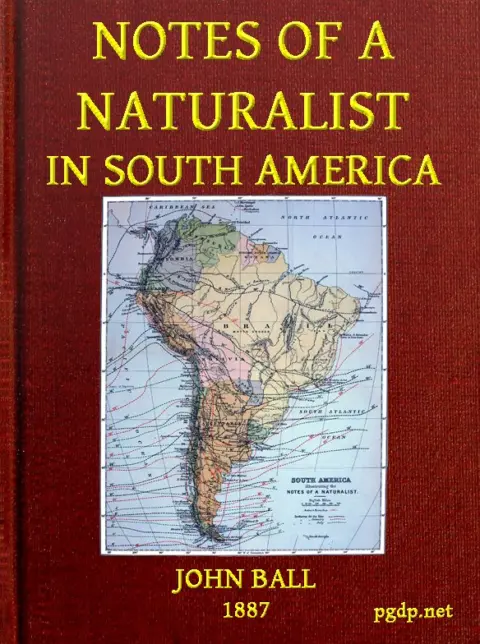
Notes of a naturalist in South America
John Ball
THE CLASSIC COLLECTION · 1878
"Journal of a Tour in Marocco and the Great Atlas" by Joseph Dalton Hooker and John Ball is an exploratory travelogue focused on botanical and geographical observations, likely written in the late 19th century. The narrative captures the authors' expedition in 1871 to the lesser-known regions of Marocco and the Great Atlas Mountains, aiming to document the vegetation and natural history of the area, which has remained largely unexplored by Europeans. The opening of the journal sets the stage for the expedition as the authors prepare to embark on their journey from England to Marocco, driven by a deep interest in the region's unique flora and geography. Through evocative descriptions, they detail their arrival in Tangier, highlighting the cultural and historical context of the town, their encounters with local officials, and their excitement to explore the largely uncharted territories of the Great Atlas. The narrative combines reflections on botanical discoveries with observations of the local environment, providing readers with an engaging blend of adventure, science, and the challenges faced during their travels.
Introduction adapted from the source catalogue; source summaries may be automatically generated.
Free to read · English · 171,328 words · No account needed
MAKE TIME FOR A GOOD BOOK
On by default. Untick to stop anonymous reading totals. Each page counts after 10 seconds in view. How this works.
Anonymous counting is on unless you have switched it off.
Once upon a time a fox met a lion, and the lion, addressing the fox, said, ‘Will you be my servant to catch sheep for me? The fox said, ‘I will, if you will give me my share.’ The lion said, ‘No, and if you eat a single bit, I will kill you.’ ‘Very well,’ said the fox, ‘if that is the bargain, I will agree to go hunt for you.’ So away went the fox and hunted about till he found some sheep, one of which he killed and ate. He then went off to the owner of the sheep and said, ‘The lion sent me to hunt your sheep for him, but I would not do so, and he came himself and ate one, and I have run to tell you.’ ‘Very well,’ said the shepherd, ‘you shall be the guard over my sheep, and let me know when the lion comes;’ and the fox said, ‘All right.’ So he waited till the evening, and then went to guard the sheep; and whilst on guard he killed and devoured two more, and afterwards, making a little wound in his own leg, he ran off to the shepherd, and said, ‘The lion has come and eaten two sheep, and wanted to eat me also; see the wound he made in my leg.’ The shepherd said, ‘I see it is true; I will put two men to assist you to guard.’ The fox said, ‘All right; I will go hunt for something to eat, and then return.’ So he went off in search for the lion, and meeting him, said, ‘I know where there are lots of sheep; they are in such a place, you come in the evening to eat them.’ The lion said, ‘All right.’ The fox then ran back to the shepherd, and said, ‘The lion is coming to-night,’ and directed the men who were to assist in guarding to conceal themselves, but before doing so to bring a big sack into which the fox put a great stone, and waited till the lion came. When the lion came he said to the fox, ‘Why have not you killed me a sheep?’ The fox said, ‘Because I was afraid of a great monster that none but you can master, and there he is in that sack; go in and kill him.’ The lion said, ‘All right,’ and went in, when the fox tied securely the mouth of the bag, so that the lion could not get out. The fox then said to the lion, ‘Have you found him?’ The lion replied, ‘No, no, I have not, and it is funny I cannot get out.’ The fox said, ‘Push away, try and get out.’ The lion said, ‘I cannot.’ The fox said, ‘Probably the monster holds you there.’ The fox said to the lion three times, ‘Can’t you get out?’ and three times the lion replied, ‘I cannot.’ The fox said, ‘He who wishes to kill me I catch him in a trap, and to him who does good to me I will do good in return.’ So he went away and called the guard, and said, ‘There he is, beat him;’ so they beat him, and beat him till they were tired; and at last broke his leg. The fox said to the guard, ‘Now let him out, he has broken his leg and cannot escape;’ and when the lion got out the fox, addressing him, said, ‘Now, which is master?’ The lion replied, ‘You are my master;’ and the fox said, ‘Whoever wishes to eat me at one time will try again,’ and turned to the men and ordered them to kill him. After which the fox said, ‘Now that we have killed the lion, good-bye;’ and the men replied, ‘Good-bye.’ He went away, and waiting till evening, and returning at supper time, he wounded the leg of each remaining sheep, and ran off to the owner and said, ‘A monster bigger than the last has come and wounded all your sheep.’ Previous to this the fox went to the market, and bought a suit of clothes, and sprinkled them with the blood of the sheep, and made it appear as if the big monster of whom he spoke had also killed a man. He then said to the owner, ‘All your sheep are spoiled; we had better kill them and make a feast.’ So the shepherd killed the rest of the sheep, and ate them with the fox; and when they had finished, the fox filled a bowl with dirty water. The owner after he had finished his breakfast, said, ‘What am I to do now? The sheep are killed.’ The fox said, ‘Now I will tell you how it all happened.’ The man said, ‘How?’ The fox said, ‘Not till you open that door so that the light is let in;’ and then said quickly, ‘It is I who killed your sheep;’ he then threw the dirty water in his face, and made off.
Your reading position is saved on this browser. Take it to another device with a library code. Reading pages adapt to text, rather than matching a printed edition.
John Ball
Joseph Dalton Hooker
Joseph Dalton Hooker
Joseph Dalton Hooker
BEHIND THE BOOK
This eBook is for the use of anyone anywhere in the United States and most other parts of the world at no cost and with almost no restrictions whatsoever. You may copy it, give it away or re-use it under the terms of the Project Gutenberg License included with this eBook or online at www.gutenberg.org. If you are not located in the United States, you will have to check the laws of the country where you are located before using this eBook. Read the source licence.
The original source file, including credits and licence, is retained by this library. Request an original-format copy at no charge. Please include the book title and Project Gutenberg identifier #70700.
KEEP YOUR CURIOSITY GOING
Wilfrid Scawen Blunt
Wilfrid Scawen Blunt

E. W. (Edgar Watson) Howe
Francis Greenleaf Allinson & Anne C. E. (Anne Crosby Emery) Allinson
Cyrenus Cole

John Martineau