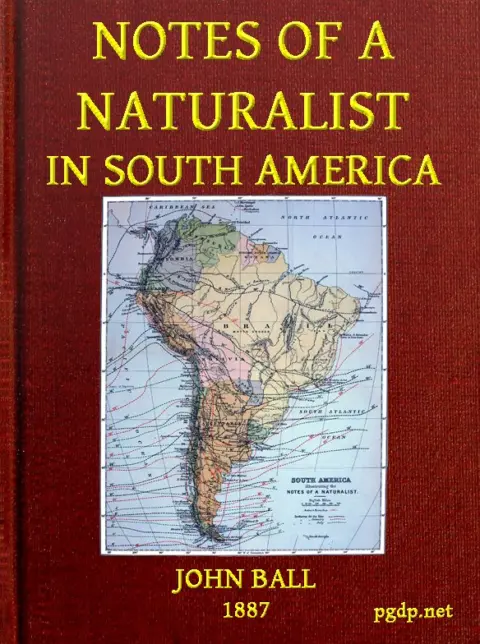
Notes of a naturalist in South America
John Ball
THE CLASSIC COLLECTION · 1878
"Journal of a Tour in Marocco and the Great Atlas" by Joseph Dalton Hooker and John Ball is an exploratory travelogue focused on botanical and geographical observations, likely written in the late 19th century. The narrative captures the authors' expedition in 1871 to the lesser-known regions of Marocco and the Great Atlas Mountains, aiming to document the vegetation and natural history of the area, which has remained largely unexplored by Europeans. The opening of the journal sets the stage for the expedition as the authors prepare to embark on their journey from England to Marocco, driven by a deep interest in the region's unique flora and geography. Through evocative descriptions, they detail their arrival in Tangier, highlighting the cultural and historical context of the town, their encounters with local officials, and their excitement to explore the largely uncharted territories of the Great Atlas. The narrative combines reflections on botanical discoveries with observations of the local environment, providing readers with an engaging blend of adventure, science, and the challenges faced during their travels.
Introduction adapted from the source catalogue; source summaries may be automatically generated.
Free to read · English · 171,328 words · No account needed
MAKE TIME FOR A GOOD BOOK
On by default. Untick to stop anonymous reading totals. Each page counts after 10 seconds in view. How this works.
Anonymous counting is on unless you have switched it off.
c. Tropical and South African types in the Canaries. Of these the most noticeable are two forest trees, belonging to the large tropical genus Myrsine. One of these, M. excelsa (Heberdenia excelsa, Banks) is also found in Madeira; the other, M. canariensis, is confined to the island whose name it bears. The tropical order Sapotaceæ, to which Argania belongs, has no representative in the Canaries, but has one in the Sideroxylon Mermulana of Madeira.
The only almost exclusively South African genus[10] in the Canaries is a species of Lyperia, of which there are numerous Cape of Good Hope species, and one doubtful one in the Somali country (North-East Africa). The widely diffused Cape shrub, Myrsine africana, is found in the Azores and in Abyssinia, but not in the Canaries, Cape de Verdes, Madeira, or Marocco. The two singular shrubs Phyllis and Plocama, consisting each of a single species, of which the Phyllis is found also in Madeira, are representatives of the Anthospermeæ, a very large and conspicuously South African and Australian tribe of Rubiaceæ, and of which the only Maroccan representative is Putoria, a Mediterranean genus of a single species, and which is not Canarian.
The Oreodaphne fœtens of the Canaries and Maderia is now[11] referred to the American, Madagascar, and South African genus Ocotea, and is most nearly allied to a species found in the latter country.
The Maroccan flowering plants are thus grouped by Ball in his ‘Spicilegium Maroccanum’[12]:—
Total number of Maroccan species 1,627
Species widely diffused, temperate or tropical 467
Of which there are common to Marocco and the Islands 300
Maroccan, but not Insular 167
Mediterranean species in Marocco 995
Of which there are widely spread species common to the 254
Islands and Marocco
Confined to Marocco and the Islands 15
Mediterranean species in Marocco, but not in the 726
Islands
Maroccan species exclusively 165
The proportion of Monocotyledons to Dicotyledons is in Marocco 1 to 4·6, in the Canaries 1 to 6—a very great difference.
The leading natural orders in Marocco and the Canaries respectively
are:—
Marocco Canaries
Species Species
Compositæ 208 143
Leguminosæ 189 104
Gramineæ 134 77
Umbelliferæ 86 27
Labiatæ 81 59
Cruciferæ 73 29
Caryophylleæ 69 38
In each country these seven natural orders include nearly half the Dicotyledonous plants. But in the Canaries the Crassulaceæ with 31 species should replace the Cruciferæ, and the Umbelliferæ be excluded.
The natural orders which are indigenous to the three Archipelagos of the Canaries, Madeira, and the Azores, but which are absent in Marocco, and the reverse are:—
In the Archipelago, but not | In Marocco, but not in the
in Marocco. | Archipelago.
|
Simarubeæ (Cneorum) | Berberideæ
Pittosporeæ | Capparideæ
Ternstrœmiaceæ | Polygaleæ
Ilicineæ | Ampelideæ
Myrsineæ | Coriarieæ
Phytolacceæ (Bosea) | Saxifrageæ
Myriceæ | Apocyneæ
Commelyneæ (introduced?) | Lentibularieæ
| Nyctagineæ
| Ulmaceæ
| Cupuliferæ
| Ceratophylleæ
| Alismaceæ
| Juncagineæ
| Melanthaceæ
Your reading position is saved on this browser. Take it to another device with a library code. Reading pages adapt to text, rather than matching a printed edition.
John Ball
Joseph Dalton Hooker
Joseph Dalton Hooker
Joseph Dalton Hooker
BEHIND THE BOOK
This eBook is for the use of anyone anywhere in the United States and most other parts of the world at no cost and with almost no restrictions whatsoever. You may copy it, give it away or re-use it under the terms of the Project Gutenberg License included with this eBook or online at www.gutenberg.org. If you are not located in the United States, you will have to check the laws of the country where you are located before using this eBook. Read the source licence.
The original source file, including credits and licence, is retained by this library. Request an original-format copy at no charge. Please include the book title and Project Gutenberg identifier #70700.
KEEP YOUR CURIOSITY GOING
Wilfrid Scawen Blunt
Wilfrid Scawen Blunt

E. W. (Edgar Watson) Howe
Francis Greenleaf Allinson & Anne C. E. (Anne Crosby Emery) Allinson
Cyrenus Cole

John Martineau