THE CLASSIC COLLECTION✦An outlaw’s diary: the CommuneCLASSIC FREE BOOKS
An outlaw’s diary: the Commune
Cécile Tormay
THE CLASSIC COLLECTION · 1889
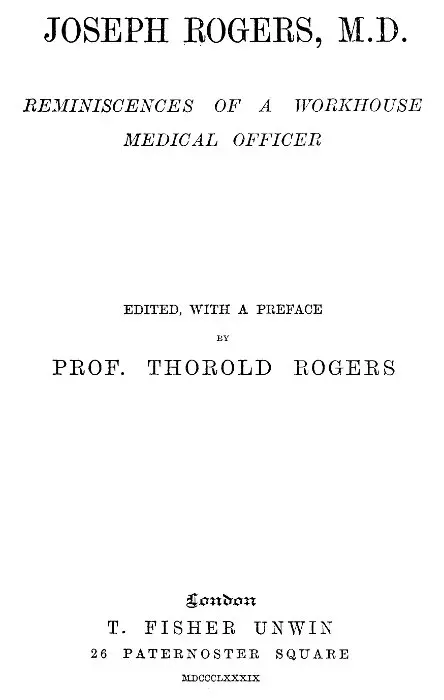
"Joseph Rogers, M.D.: Reminiscences of a Workhouse Medical Officer" by Joseph Rogers is a historical account written in the late 19th century. The memoir narrates the experiences and struggles of Dr. Joseph Rogers during his tenure as a medical officer at a workhouse, detailing the systemic issues he encountered in providing care for the sick poor. The book seeks to illuminate the realities of medical relief for the impoverished and the challenges faced by health professionals in advocating for reform. The opening of the memoir sets the stage for Dr. Rogers' career, highlighting his initial appointment to the Strand Workhouse in Soho during a cholera outbreak in the mid-1850s. He describes the deplorable conditions within the workhouse, including overcrowding, inadequate medical supplies, and an unqualified staff. Rogers conveys his determination to improve patient care against significant opposition from the Guardians of the Poor, illustrating the conflicts he had with authority while illustrating the hardship faced by the vulnerable populations he served. This introductory segment effectively captures the essence of his life's work and advocacy for reform in the treatment of the sick and the poor in Victorian London.
Introduction adapted from the source catalogue; source summaries may be automatically generated.
Free to read · English · 61,040 words · No account needed
MAKE TIME FOR A GOOD BOOK
On by default. Untick to stop anonymous reading totals. Each page counts after 10 seconds in view. How this works.
Anonymous counting is on unless you have switched it off.
About some two years after my appointment a woman, extremely ill, was brought from Vine Street Police Station. She was an unfortunate, as it is called, who had been taken ill in the cell. Repeated requests from her for attendance met with no attention. At last, her condition appearing desperate even to the constables, the divisional surgeon was sent for, who directed that she should at once be removed to the Workhouse. She was brought in on a stretcher, and I was summoned to attend her without delay. I found that she was dying, and not a long while afterwards she succumbed. A coroner's inquiry taking place I made a post mortem, when I found that she had died from the rupture on an aneurism of the abdominal aorta, which, giving way in the loins, had slowly infiltrated the tissues until, a vent being found, the whole thing gave way. There is no doubt that this rupture had been precipitated by the violence attending her arrest. The verdict, under the direction of the coroner, led to a censure of the police for their inhumanity and indifference. The ultimate result was to immensely add to my troubles, as will hereafter be shown.
Just at this time the old and sagacious surgeon of the division died, and his place was sought after by several medical men living in the neighbourhood of the two police stations in St. James's, some of whom were men of acknowledged position. The gift of the appointment was vested in the Chief Surgeon of Police, Mr. Timothy Holmes, of St. George's Hospital. He gave the office to one of his old pupils who at the time was non-resident, but who at once took a house in Jermyn Street. It was not very long before I experienced the result of the change. Case after case was sent into the House from the two stations with certificates that the persons were ill when they were undeniably and plainly drunk. At first I complained of this to the inspectors, but it led to no result. I then wrote to the Commissioners of Police, complaining of the annoyance. I got only an official reply. At last the nuisance became so great, for we were always called to these police cases sent in from the station in the small hours of the morning, that I again wrote to the Commissioners and requested an interview. This was granted. I took with me my assistant who had been principally called out of bed to attend to these cases, sometimes only to dress a wound which the police surgeon was too indolent to do himself although he was paid a fee for each visit. On arrival we stated our complaint, but, although the Commissioners listened to us attentively, not much benefit accrued. It is true they stated that an inquiry should be made and instructions given and that more care should be exhibited. Some time after this I happened to be at the gate when a constable brought a perfectly drunken woman, who, he said, had fallen down in a fit. I said, "Why, she is only drunk and incapable; take her away to the station;" and turning to the master I said, "Do not admit her." An entertainment was being held that evening which I had assisted to get up, and I went on into the dining-hall. About an hour afterwards the master came to me and said, "They have brought that woman back with a certificate from the doctor that she is dangerously ill." I went to see her. She was only a shade more under the influence of liquor than she was before, but, not caring to contest the subject any further, I directed that she should be sent to the receiving ward and put to bed. The next morning on seeing her she had got over the drunkenness, and she owned to me that she had been only drunk the night before. On going to my room I directed that a special messenger should take a letter from me to the station, telling the inspector on duty that the woman that had been sent in the night before alleged to be ill, had confessed to having been only drunk, and requesting him to send a constable and take her away. The constable came. In the after-part of the day, a constable of that division called at my house and said that Mr. Newton requested that I should attend the police court the next morning. I went, when I found the woman there and the divisional surgeon. The magistrate, before hearing a word from me, proceeded to inveigh against me for my action in the matter, and peremptorily ordered me to admit the woman at once. The divisional surgeon also jumped up and protested against my refusal to admit the woman, and stated, to my astonishment, that she had heart disease, and that she was a confirmed epileptic. I mildly replied that she was suffering under nothing of the kind, but Mr. Newton told me to leave the court. The woman did not come into the Workhouse until the evening, and she was then under the influence of drink.
Your reading position is saved on this browser. Take it to another device with a library code. Reading pages adapt to text, rather than matching a printed edition.
BEHIND THE BOOK
This eBook is for the use of anyone anywhere in the United States and most other parts of the world at no cost and with almost no restrictions whatsoever. You may copy it, give it away or re-use it under the terms of the Project Gutenberg License included with this eBook or online at www.gutenberg.org. If you are not located in the United States, you will have to check the laws of the country where you are located before using this eBook. Read the source licence.
The original source file, including credits and licence, is retained by this library. Request an original-format copy at no charge. Please include the book title and Project Gutenberg identifier #58454.
KEEP YOUR CURIOSITY GOING
Cécile Tormay

Moritz Busch
John L. Ransom
Frances Wright
Cécile Tormay

Mabel Potter Daggett