THE CLASSIC COLLECTION✦An outlaw’s diary: the CommuneCLASSIC FREE BOOKS
An outlaw’s diary: the Commune
Cécile Tormay
THE CLASSIC COLLECTION · 1889
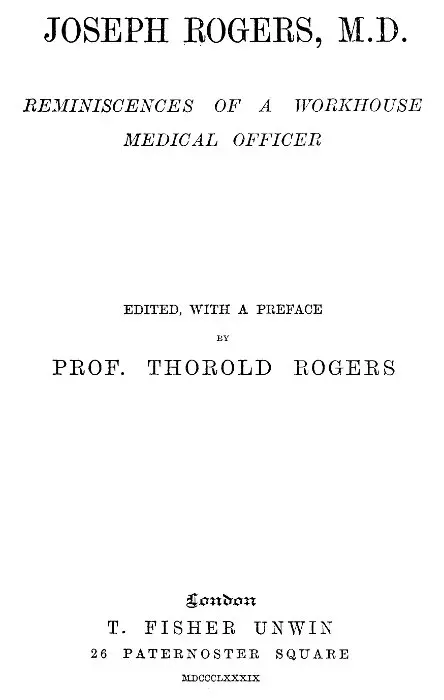
"Joseph Rogers, M.D.: Reminiscences of a Workhouse Medical Officer" by Joseph Rogers is a historical account written in the late 19th century. The memoir narrates the experiences and struggles of Dr. Joseph Rogers during his tenure as a medical officer at a workhouse, detailing the systemic issues he encountered in providing care for the sick poor. The book seeks to illuminate the realities of medical relief for the impoverished and the challenges faced by health professionals in advocating for reform. The opening of the memoir sets the stage for Dr. Rogers' career, highlighting his initial appointment to the Strand Workhouse in Soho during a cholera outbreak in the mid-1850s. He describes the deplorable conditions within the workhouse, including overcrowding, inadequate medical supplies, and an unqualified staff. Rogers conveys his determination to improve patient care against significant opposition from the Guardians of the Poor, illustrating the conflicts he had with authority while illustrating the hardship faced by the vulnerable populations he served. This introductory segment effectively captures the essence of his life's work and advocacy for reform in the treatment of the sick and the poor in Victorian London.
Introduction adapted from the source catalogue; source summaries may be automatically generated.
Free to read · English · 61,040 words · No account needed
MAKE TIME FOR A GOOD BOOK
On by default. Untick to stop anonymous reading totals. Each page counts after 10 seconds in view. How this works.
Anonymous counting is on unless you have switched it off.
About a twelvemonth after the Act was in operation I appealed, through the medical journals, to my brethren in the provinces as to the arrangements that had been made in their respective localities. A large number of letters from all parts of England and Wales were sent to me, and with the information thus furnished I prepared a paper which I called "Chaos," in which I turned into ridicule the arrangements that had been made, showing that the Department, faithful to its traditions, had made a complete mess of the administrative arrangements. This paper, read at the meeting of the British Medical Association at Sheffield, attracted a good deal of attention both in the medical and general Press. It materially acted in evolving order out of the chaos into which the subject had drifted, owing to the indifference and incompetence of those who had drafted the measure.
In the spring of 1872 I was informed that the alterations and enlargement of the old Workhouse of St. James's, commenced at the time when the Westminster Union was formed, were complete, and that Mr. French, who had been the medical officer of the workhouse and parish of St. James's for upwards of forty years, was about to retire on a superannuation allowance of £200 a year. I was told that the Chairman of the Board, a Mr. Bonthron, a Scotch baker living in Regent Street, had selected a fellow Scotchman, one Dr. S., as Mr. French's successor, and as Mr. Bonthron claimed to be omnipotent at the Board, this gentleman's appointment to the vacancy was considered to be certain. In the course of a few days I heard that a formidable opponent to Dr. S. had appeared in the person of Dr. M., who was also a Scotchman. In due course the election took place, when Dr. M. was elected. This resulted from a protest on the part of certain members of the Board who resented the predominance of Mr. Bonthron. When apprised of the result of the election, I remarked that Dr. M. could not take the office as he did not possess the necessary legal qualifications. On the following Saturday morning a member of the Board told me that a letter had been read at the meeting of the Guardians, held the previous evening, announcing that the election of Dr. M. was null and void, as he held no surgical qualifications. As his election had surprised all the Guardians, because it proved that the Chairman had not the influence he claimed, my informant advised me to apply for the office. At first I hesitated, but upon being urged again I assented. The same evening I called on Dr. M., told him of my intention, and asked him for the support of his friends. To my utter astonishment he told me he had made up his mind to try again. "Nonsense," I said; "how can you get a diploma from the College of Surgeons?" "Oh," he replied, "I have arranged all that; I have a splendid memory, and I remember all my anatomy and surgery." As I had every ground for the belief that he had never attended lectures on surgery, nor attended the surgical practice of an hospital, inasmuch as I had known him ever since he had come to London, I saw that, without collusion with some one in authority, it was impossible for it to be done; but, as he appeared determined, I left him. As soon as it was known that I seriously intended to compete for the appointment, testimonials in my favour were forwarded to me by several eminent physicians and surgeons, by Members of Parliament, among them one of a very flattering character from Mr. C. P. Villiers, M.P., the ex-President of the Poor Law Board, who strongly recommended me to the Board of Guardians, those lady visitors who had known me at the Strand, and others. Two days before the election took place I was surprised by a visit from Dr. M., who called to inform me that he had passed his examination at the College of Surgeons the night before, and now asked me to retire in his favour. On my declining to do as he wished, he said it was very hard I would not, as he had incurred an expense of upwards of £60 to get the diploma. Prior to the election my friends entered into a compact with his supporters to the effect that if I was in a minority on the show of hands my name was to be withdrawn, when they would support him, but if I was in the majority his friends would support me. This occurring, I was elected, to the great surprise of the Chairman, who looked on me as a dangerous person, seeing that I had taken an active part in bringing about the formation of the Union, whereby St. Anne's had been joined to St. James's, which had the effect of somewhat increasing his poor rate assessment in St. James's--for St. Anne's, a poor parish, had considerably improved its position by being put into union with St. James's, which was comparatively a rich one.
Your reading position is saved on this browser. Take it to another device with a library code. Reading pages adapt to text, rather than matching a printed edition.
BEHIND THE BOOK
This eBook is for the use of anyone anywhere in the United States and most other parts of the world at no cost and with almost no restrictions whatsoever. You may copy it, give it away or re-use it under the terms of the Project Gutenberg License included with this eBook or online at www.gutenberg.org. If you are not located in the United States, you will have to check the laws of the country where you are located before using this eBook. Read the source licence.
The original source file, including credits and licence, is retained by this library. Request an original-format copy at no charge. Please include the book title and Project Gutenberg identifier #58454.
KEEP YOUR CURIOSITY GOING
Cécile Tormay

Moritz Busch
John L. Ransom
Frances Wright
Cécile Tormay

Mabel Potter Daggett