THE CLASSIC COLLECTION✦An outlaw’s diary: the CommuneCLASSIC FREE BOOKS
An outlaw’s diary: the Commune
Cécile Tormay
THE CLASSIC COLLECTION · 1889
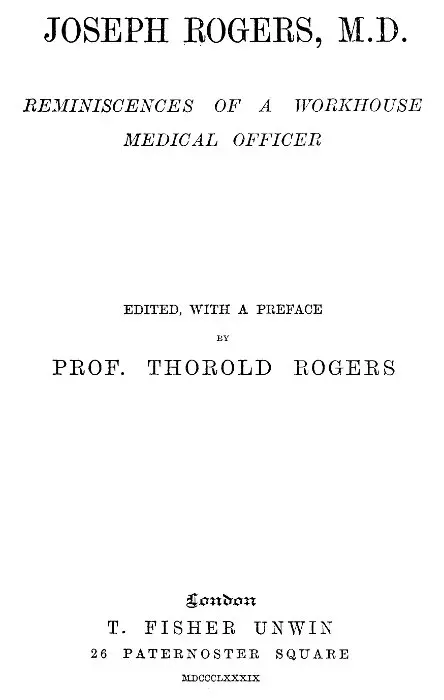
"Joseph Rogers, M.D.: Reminiscences of a Workhouse Medical Officer" by Joseph Rogers is a historical account written in the late 19th century. The memoir narrates the experiences and struggles of Dr. Joseph Rogers during his tenure as a medical officer at a workhouse, detailing the systemic issues he encountered in providing care for the sick poor. The book seeks to illuminate the realities of medical relief for the impoverished and the challenges faced by health professionals in advocating for reform. The opening of the memoir sets the stage for Dr. Rogers' career, highlighting his initial appointment to the Strand Workhouse in Soho during a cholera outbreak in the mid-1850s. He describes the deplorable conditions within the workhouse, including overcrowding, inadequate medical supplies, and an unqualified staff. Rogers conveys his determination to improve patient care against significant opposition from the Guardians of the Poor, illustrating the conflicts he had with authority while illustrating the hardship faced by the vulnerable populations he served. This introductory segment effectively captures the essence of his life's work and advocacy for reform in the treatment of the sick and the poor in Victorian London.
Introduction adapted from the source catalogue; source summaries may be automatically generated.
Free to read · English · 61,040 words · No account needed
MAKE TIME FOR A GOOD BOOK
On by default. Untick to stop anonymous reading totals. Each page counts after 10 seconds in view. How this works.
Anonymous counting is on unless you have switched it off.
There were several other very interesting persons I found on both sides of the ward. One was an old man who was said to be eighty-eight years old. On my morning visit he was always standing on the staircase smoking. He had lived many years in Australia, and his long white hair and beard, which reached to his waist, conjoined with a florid complexion and bright blue eyes, caused me to consider him one of the handsomest old men I had ever seen. One day I took two young ladies over the infirmary. We found the old man in his usual place. I jocularly introduced him to them as the Adonis of the House. The old man was terribly offended. As we walked away I heard him muttering aloud, "That's a pretty name to call a man--'Donis indeed!" He did not forgive me for a long while. I wonder what he thought the epithet really was intended to signify.
I also found in the male infirm ward an old French physician whom I had known by sight for a great many years when he was practising his profession in Soho. He was a tall, fine man when I first knew him. He always used to wear a very singular-looking broad-brimmed hat. He was in all externals a very gentlemanly-looking person. I had missed him for a long time, and was surprised and hurt to think that he should have drifted to a workhouse infirmary. On inquiring into the cause of his becoming an inmate of the House, for I always thought he was well-to-do, as he dressed exceedingly well, I learned that he had lived with a lady who was an employé at a French milliner's in Regent Street, that she was much younger than he was, and that he had given to her all his money, which she, in preparation for possible consequences, had put in the Funds, but in her own name only. Unfortunately for him she was taken suddenly ill, and being ignorant of English courts made no disposition of the property, simply telling him, on her deathbed, where it was. When she was dead, he found to his dismay that the money could not be obtained, as he could not establish any legal claim of ownership. Grief at the loss of his mistress and of all his money caused the complete break-down of the poor fellow, and he had come into the House utterly crushed. He was a very interesting old man, being the only son of a French noble family. His mother and father were both executed during the Reign of Terror, and when the family property was confiscated he was but a youth. When he grew up he studied medicine, and in the year 1802 entered Napoleon's army as a regimental surgeon. After serving with his regiment in Germany, Italy, and Austria, he was attached to the Army of England, as it was called, which was stationed on the heights of Boulogne. He was there some time. Suddenly an announcement came that the encampment would be broken up, and that the army would go to Russia. He traversed the whole of Europe, taking part in the various engagements on the road to Moscow, which he saw in flames. He was in the memorable retreat, and returned to France without a scratch. On the return from Elba he rejoined his old regiment, and, as its surgeon, fought against the English at Waterloo. After the peace his regiment was disbanded, and as the old soldiers of the empire were very much at a discount he elected to come to England, where he lived since 1816. He died at the age of ninety-five, retaining his faculties to the last. After his death I raised a fund to bury him, by writing a letter to The Times, in which I gave his history, heading my letter, "A Relic of the Grand Armée," and asking any friends of the first Napoleon to help me in burying him in some other place than a pauper's grave. My appeal having brought me £25, the Empress Eugenie being one of the subscribers, he was buried at the Catholic Cemetery at Kensal Green. There were two seamstresses who lived in Gilbert Street, Oxford Street, who were his countrywomen and his sole visitors, with the exception of the Catholic priest of the French chapel in Leicester Square. I asked them and the priest to accompany me to the funeral, which I attended as chief mourner. On our arrival at the mortuary chapel, the coffin was placed on a raised bier with three others. Presently two lads, wearing long black cloaks which reached to the ground, came from the altar. When they arrived at the spot where the coffin was resting, one lad suddenly produced from under his cloak a censer containing fire and proceeded to incense the quartette. How he ever carried the fiery thing without setting fire to himself was to me a wonder. He was immediately followed by the other lad, who, taking just as rapidly from under his cloak a vessel like a whitewash-pot, proceeded with a brush to throw holy water on the coffins. This being completed, the coffin was put on a truck and we hurried away as fast as we could go through the miry ground for a long distance to the grave. On reaching it, down went my two lady companions on their knees in the clay. My respect for the deceased did not carry me so far as that, especially as it was raining hard and the ground was a mere bog. Presently the acolyte produced his whitewash-pot and brush, and I was courteously asked to sprinkle the poor fellow's coffin with holy water, which I did. This having been also done by my companions, I was amused by a little girl about fourteen, who, suddenly taking the brush and pot from one of the young women, went to work sprinkling in grand style, and, what was rather alarming, let me in for more than I had expected. On our return journey the priest asked me to attend service in the Catholic Chapel, in Leicester Square, on the next Sunday. This I did. He was a very gentlemanly person. He thanked me very much for the little service I was enabled to render to the poor old French doctor, whom I missed very much, as it was my habit to sit beside the old man's bed and hear him fight his battles o'er again.
Your reading position is saved on this browser. Take it to another device with a library code. Reading pages adapt to text, rather than matching a printed edition.
BEHIND THE BOOK
This eBook is for the use of anyone anywhere in the United States and most other parts of the world at no cost and with almost no restrictions whatsoever. You may copy it, give it away or re-use it under the terms of the Project Gutenberg License included with this eBook or online at www.gutenberg.org. If you are not located in the United States, you will have to check the laws of the country where you are located before using this eBook. Read the source licence.
The original source file, including credits and licence, is retained by this library. Request an original-format copy at no charge. Please include the book title and Project Gutenberg identifier #58454.
KEEP YOUR CURIOSITY GOING
Cécile Tormay

Moritz Busch
John L. Ransom
Frances Wright
Cécile Tormay

Mabel Potter Daggett