THE CLASSIC COLLECTION✦An outlaw’s diary: the CommuneCLASSIC FREE BOOKS
An outlaw’s diary: the Commune
Cécile Tormay
THE CLASSIC COLLECTION · 1889
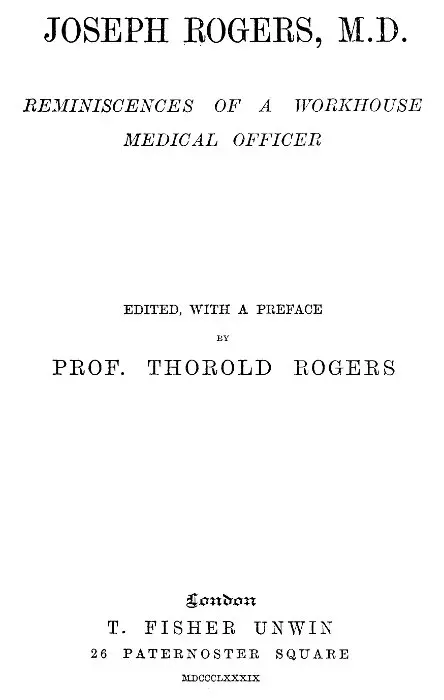
"Joseph Rogers, M.D.: Reminiscences of a Workhouse Medical Officer" by Joseph Rogers is a historical account written in the late 19th century. The memoir narrates the experiences and struggles of Dr. Joseph Rogers during his tenure as a medical officer at a workhouse, detailing the systemic issues he encountered in providing care for the sick poor. The book seeks to illuminate the realities of medical relief for the impoverished and the challenges faced by health professionals in advocating for reform. The opening of the memoir sets the stage for Dr. Rogers' career, highlighting his initial appointment to the Strand Workhouse in Soho during a cholera outbreak in the mid-1850s. He describes the deplorable conditions within the workhouse, including overcrowding, inadequate medical supplies, and an unqualified staff. Rogers conveys his determination to improve patient care against significant opposition from the Guardians of the Poor, illustrating the conflicts he had with authority while illustrating the hardship faced by the vulnerable populations he served. This introductory segment effectively captures the essence of his life's work and advocacy for reform in the treatment of the sick and the poor in Victorian London.
Introduction adapted from the source catalogue; source summaries may be automatically generated.
Free to read · English · 61,040 words · No account needed
MAKE TIME FOR A GOOD BOOK
On by default. Untick to stop anonymous reading totals. Each page counts after 10 seconds in view. How this works.
Anonymous counting is on unless you have switched it off.
I cannot but relate the close of Mr. George Catch's career.
I have already stated that after the enforced resignation of his appointment at Newington, this model master was selected by the Guardians of Lambeth, as the master of their Workhouse, notwithstanding that he had as opponents some respectable persons who had creditably filled similar appointments elsewhere. His election was due to the assistance he received from the clerk of the Strand Union, and his old friends at that Board. His appointment was challenged at the time, but in spite of the serious evidence afforded by the Newington inquiry, it was confirmed by the Department, but with this proviso--that a special report as to his conduct should be sent by the Guardians to the Poor Law Board at the end of six months.
It was not very long before the opponents of this man's appointment were fully justified in the course they took, as he speedily renewed his old course of cruelty to the inmates, and of quarrelling with the other officers. One of these acts was inquired into, and reported on by Dr. Markham. Although it was clear that the master was in the wrong, yet Dr. Markham, in his official report, managed to throw a doubt on the evidence of the medical officer, evidently to screen the master; but he was not saved for long, for shortly afterwards a young woman, who had been subjected to much harshness by Catch, ran away and hid herself, as it was supposed, in the chimney of one of the women's infirm wards, when the master, with the view of forcing her to come down, induced the junior resident medical officer, to bring from the surgery some substance, on which he poured some hydrochloric acid, whereby some extremely pungent gases were evolved, thinking thereby to compel her to come down; but as the young woman was not there (fortunately for Catch, for if she had been she would have been suffocated), the only effect was that all the old women in the ward, were set sneezing and coughing. This atrocious proceeding, having been reported to the Poor Law Board, Catch was called upon to resign. It will hardly be believed that certain of the Guardians memorialized the Poor Law Board to let him retain his office, when Mr. Shaen, the eminent solicitor, on the urgent representation of his wife, who was a lady visitor at the Workhouse, and knew a great deal of Catch's doings, took the matter up. Mr. Shaen saw me, and asked me whether I could tell him anything about Catch. I narrated the incident of the false charge which he, in connection with the clerk, had made against me when I was away in Scotland, and also told him the story of his behaviour in reference to the sick woman in the lying-in ward of the Strand Union which had led to his leaving that Workhouse. Mr. Shaen took down my statement, and subsequently he sent me a pamphlet of some two hundred pages, in which I found not only my own statement, but sundry others of a highly damaging character, but unfortunately these were so recklessly drawn, that it gave Catch the opportunity of bringing an action for libel. Its publication had induced Mr. Goschen to peremptorily call upon him to resign his office. Catch sent out an appeal to all the masters of workhouses to support him in his action, and a sufficient sum having been collected, the Attorney-General of the day, now Lord Chief Justice Coleridge, acted as his counsel. Having been asked by Mr. Shaen to support my statement in the Court of Queen's Bench, I attended. When called on, I went into the witness-box, and after giving my evidence-in-chief, was cross-examined by the Attorney-General in such a manner that three times during the cross-examination Lord Chief Justice Cockburn interfered to stop it, giving as his opinion that the Attorney-General was pressing me unfairly. As I was leaving the witness-box I turned round and thanked the Lord Chief Justice for his kindness in screening me. I was followed by the late porter of the Strand Workhouse, who was there to substantiate my evidence. A similar attempt to browbeat this witness afforded fine fun. The witness was an Irishman, and at every effort made by the counsel to confuse him, Pat was too much for the Attorney, and feeling that he could make nothing of him, he told him peremptorily to stand down, which he did in such a comical way as convulsed the court with laughter. Unfortunately Mr. Shaen failed to justify several of the libels, and the jury, after twelve days' trial, gave a verdict in favour of Catch for £600--an amount which the judge said was excessive, and for which he refused to certify, thereby affording Mr. Shaen the opportunity for asking for a fresh trial. Subsequently a compromise was effected at the instance of the Lord Chief Justice. In summing up the case to the jury, the judge said that my evidence, if it stood alone, was sufficient to stamp Catch as an improper person to hold the office of a Workhouse master. Mr. Goschen would not allow Catch to resume his office, and, having no resources whatever, he drifted downwards until ultimately, being without means and having tired out all his friends, he in a fit of despair threw himself in front of a Great Western train and was cut to pieces.
Your reading position is saved on this browser. Take it to another device with a library code. Reading pages adapt to text, rather than matching a printed edition.
BEHIND THE BOOK
This eBook is for the use of anyone anywhere in the United States and most other parts of the world at no cost and with almost no restrictions whatsoever. You may copy it, give it away or re-use it under the terms of the Project Gutenberg License included with this eBook or online at www.gutenberg.org. If you are not located in the United States, you will have to check the laws of the country where you are located before using this eBook. Read the source licence.
The original source file, including credits and licence, is retained by this library. Request an original-format copy at no charge. Please include the book title and Project Gutenberg identifier #58454.
KEEP YOUR CURIOSITY GOING
Cécile Tormay

Moritz Busch
John L. Ransom
Frances Wright
Cécile Tormay

Mabel Potter Daggett