THE CLASSIC COLLECTION✦An outlaw’s diary: the CommuneCLASSIC FREE BOOKS
An outlaw’s diary: the Commune
Cécile Tormay
THE CLASSIC COLLECTION · 1889
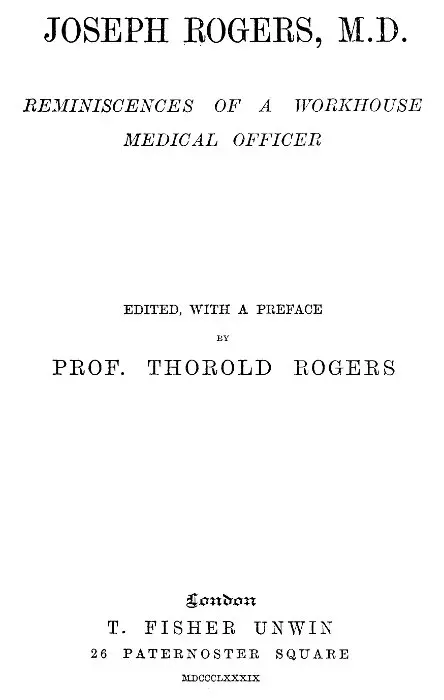
"Joseph Rogers, M.D.: Reminiscences of a Workhouse Medical Officer" by Joseph Rogers is a historical account written in the late 19th century. The memoir narrates the experiences and struggles of Dr. Joseph Rogers during his tenure as a medical officer at a workhouse, detailing the systemic issues he encountered in providing care for the sick poor. The book seeks to illuminate the realities of medical relief for the impoverished and the challenges faced by health professionals in advocating for reform. The opening of the memoir sets the stage for Dr. Rogers' career, highlighting his initial appointment to the Strand Workhouse in Soho during a cholera outbreak in the mid-1850s. He describes the deplorable conditions within the workhouse, including overcrowding, inadequate medical supplies, and an unqualified staff. Rogers conveys his determination to improve patient care against significant opposition from the Guardians of the Poor, illustrating the conflicts he had with authority while illustrating the hardship faced by the vulnerable populations he served. This introductory segment effectively captures the essence of his life's work and advocacy for reform in the treatment of the sick and the poor in Victorian London.
Introduction adapted from the source catalogue; source summaries may be automatically generated.
Free to read · English · 61,040 words · No account needed
MAKE TIME FOR A GOOD BOOK
On by default. Untick to stop anonymous reading totals. Each page counts after 10 seconds in view. How this works.
Anonymous counting is on unless you have switched it off.
In the early part of 1865 the Guardians appointed a superintendent nurse. She was a young, and very respectable-looking woman. The Guardians had been moved to do this by the evidence of Miss Twining before the Select Committee, and by the general feeling excited by the revelations made in Gibson's case in St. Giles's, and that of Timothy Daley in the Holborn, Union. In the winter of 1863 and 1864, and again in 1864 and 1865, as also in 1865 and 1866 the admissions had been so many, and the crowding so great, as to tax the resources of the establishment to the utmost, notwithstanding that I had moved the sick ward to the top of the building, and gained additional cubic space by removing the ceiling and re-ceiling the rafters; but I could not by any contrivance increase the area. The beds therefore were placed so close together that the patients had to get out at the end of their beds, there being no possibility of getting out at the side. It was a task beyond this young woman's strength to effectually supervise the numerous patients, but she could check some of the graver abuses connected with pauper nursing. This she did to the best of her ability. In the same spring that she was appointed--that of 1865--the late Dr. Francis Anstie called on me. He said he was deputed by the late Dr. Wakley to call and state that he had decided to appoint a commission for the purpose of investigating the state of London workhouses, and he thought I could suggest the best course to follow to obtain admission to them. I told him I would introduce him to the Chairman of the Board, who alone had the power to grant permission to a stranger to enter the Workhouse, unless special application had been made to Board, and leave given. He called on the Chairman, who gave him a letter to the master, authorizing his admission. Before he left, I told Dr. Anstie that when he went over the House I would accompany him. Some short time after, he wrote, making an appointment. I showed him through the whole House, pointing out the defects and shortcomings, and told him of my continued efforts to get the place improved, and of the determined hostility of the majority of the Board to any efforts I had made. I also showed him a list of the fever cases I had attended, and how constantly fever was developed when the numbers increased and the overcrowding was greatest. Dr. Anstie took careful notes of what I showed him, as the sequel proved. Some month or so after, I had a note from him, asking me to look in that week's Lancet for the report of his visit. I did so; when I found that he had exposed the rotten condition of things with marvellous clearness and fidelity, but as he had referred to me and my efforts to clear out this Augean stable, I was perfectly convinced that the least intelligent element of the Board would be incited by their clerk to charge me with having written the article in question. As I anticipated, this came to pass, for I heard that so it had been said at the Board meeting, and in consequence, a most insulting resolution was adopted, in which I was directly charged with trying to bring the Guardians--'who were my masters'--into contempt. So angry was their language and so bitter their hostility, that Dr. Anstie wrote to the Board, stating that he had been permitted by their Chairman to go over the House, and that the observations he had made were his own, and that I had not seen a line of his manuscript, or knew of his report, until it appeared in print; he further challenged the Board to show where, in his description, he had departed from the truth. The storm he had raised was, after a while, allayed. Dr. Anstie continued to visit other workhouses, the condition of which he similarly described. These reports, which appeared in The Lancet, were copied into, and commented upon, in sundry daily and weekly journals, and gradually produced a feeling of intense public indignation. Dr. Anstie had acted so generously towards me in screening me from the hostility of the worst elements of the Board, that I arranged a dinner-party, to meet and discuss workhouse abuses. Among the guests was Mr. John Storr, of King Street, Covent Garden, who was one of the wealthiest, as he was one of the most respectable, members of the Strand Board, and who, since his election two years before this, had proved to be my most able advocate and friend. When Dr. Anstie arrived, he brought with him Mr. Ernest Hart, whom he introduced as one of the staff of The Lancet, and as one interested in the question of workhouse administration. After dinner a discussion took place as regards the general condition of these establishments.
Your reading position is saved on this browser. Take it to another device with a library code. Reading pages adapt to text, rather than matching a printed edition.
BEHIND THE BOOK
This eBook is for the use of anyone anywhere in the United States and most other parts of the world at no cost and with almost no restrictions whatsoever. You may copy it, give it away or re-use it under the terms of the Project Gutenberg License included with this eBook or online at www.gutenberg.org. If you are not located in the United States, you will have to check the laws of the country where you are located before using this eBook. Read the source licence.
The original source file, including credits and licence, is retained by this library. Request an original-format copy at no charge. Please include the book title and Project Gutenberg identifier #58454.
KEEP YOUR CURIOSITY GOING
Cécile Tormay

Moritz Busch
John L. Ransom
Frances Wright
Cécile Tormay

Mabel Potter Daggett