THE CLASSIC COLLECTION✦An outlaw’s diary: the CommuneCLASSIC FREE BOOKS
An outlaw’s diary: the Commune
Cécile Tormay
THE CLASSIC COLLECTION · 1889
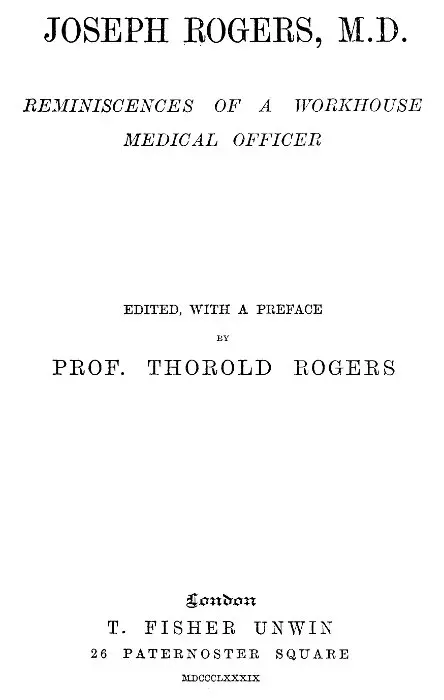
"Joseph Rogers, M.D.: Reminiscences of a Workhouse Medical Officer" by Joseph Rogers is a historical account written in the late 19th century. The memoir narrates the experiences and struggles of Dr. Joseph Rogers during his tenure as a medical officer at a workhouse, detailing the systemic issues he encountered in providing care for the sick poor. The book seeks to illuminate the realities of medical relief for the impoverished and the challenges faced by health professionals in advocating for reform. The opening of the memoir sets the stage for Dr. Rogers' career, highlighting his initial appointment to the Strand Workhouse in Soho during a cholera outbreak in the mid-1850s. He describes the deplorable conditions within the workhouse, including overcrowding, inadequate medical supplies, and an unqualified staff. Rogers conveys his determination to improve patient care against significant opposition from the Guardians of the Poor, illustrating the conflicts he had with authority while illustrating the hardship faced by the vulnerable populations he served. This introductory segment effectively captures the essence of his life's work and advocacy for reform in the treatment of the sick and the poor in Victorian London.
Introduction adapted from the source catalogue; source summaries may be automatically generated.
Free to read · English · 61,040 words · No account needed
MAKE TIME FOR A GOOD BOOK
On by default. Untick to stop anonymous reading totals. Each page counts after 10 seconds in view. How this works.
Anonymous counting is on unless you have switched it off.
I was constantly encountering odd stories and odd people--many of them profligates who had seen better days. One person in particular attracted my attention, as he had evidently been a gentleman; indeed, he assured me that he had once a large estate in Yorkshire, and was Master of the Hounds. I had no reason to doubt him. He did not live very long after his admission to the sick ward. After his death I received from five different solicitors written requests for a copy of my death certificate. It was accompanied in each case by a fee of a guinea. This poor fellow had insured his life in five different offices, and had sold the policies. It will be seen that I shared in the pecuniary advantages that sprang from his death.
The immediate successor of Mr. and Mrs. Catch did not stay very long. The matron's health broke down, and she had to resign. They were followed by Mr. and Mrs. Thorne, who remained master and matron until the death of the former some years afterwards. Mr. Thorne was a kind-hearted person, who had filled a position of responsibility in the parish of Marylebone; whilst Mrs. Thorne was a well-educated, ladylike woman. They managed the House well, and treated the inmates with kindness and consideration, but do as they would they could not alter the structural deficiencies of the building, make it larger, nor prevent the fearful over-crowding with its disastrous results, nor improve upon the wretched system of pauper nursing, which was the curse of that and all similar institutions, and which the powers that were in those days at Whitehall made no genuine effort to change.
Shortly after the collapse of his friend Catch, the proprietor of the à-la-mode beef shop ceased to be a Guardian, and a wholesale fruit-dealer in Covent Garden reigned in his stead. He was a far less satisfactory Chairman than his predecessor, as all thoughts, words, and deeds were actuated by the consideration of his personal and private interests, as will be shown by the following, among other instances that could be related. One of the earliest things very properly done by the new master was to find out the previous occupation of those who had come in sick, and to utilize them, when recovered, in the trade they had followed, for the improvement of the House. One day a middle-aged man came in very ill. He had evidently seen better days; in fact, he turned out to have been a highly-skilled decorator, especially in the representation of marble and in graining. As soon as he was well enough the master set him to work to decorate the entrance hall. This he did most admirably, and his work was much admired by the Guardians, and by visitors to the House. This employment coming to an end he was allowed, as a reward for his industry, to go in and out, ostensibly to look for work. I used frequently to meet this man on my daily visits. As he continued to go out in this manner, I one day stopped him and asked whether he had been successful in finding a job. His reply, in the negative, was accompanied by a look so significant, that I was induced to push my inquiries, when he told me that he was occupied in decorating the Chairman's house, and he had been engaged at it for some three weeks. To the further inquiry, "What have you got there?" pointing to a bag he was carrying, he replied, "That is my dinner, which I always take with me, from the House." "Oh, then," I said, "the Chairman does not find you your dinner even; does he give you any beer or any money?" He replied, "I have been working there all day long for the last three weeks, and he has never given me anything." As he shortly after disappeared, I made an inquiry as to what had become of him, when I learned that he had suddenly left the work he was doing for the Chairman, and gone off and drowned himself. This Chairman did not long continue to act as such, as some months after this he died suddenly of heart disease, the only evidence he had ever afforded that he possessed one. Having occasion just at that time to go to the Poor Law Board, I was waiting in an office for the gentleman I went to see, when one of the junior officials said to me, "You have lost your Chairman." "Yes," I replied, "but I do not feel his loss very acutely;" on which he said, "It is customary for the clerk of the Board to write and apprise us of the death of the Chairman, and we always send a sympathetic letter in reply. On the clerk's letter being read the question was asked, 'Should the usual reply be sent?' The official reply was grim enough: 'Write and say that we are delighted to hear it.'"
Your reading position is saved on this browser. Take it to another device with a library code. Reading pages adapt to text, rather than matching a printed edition.
BEHIND THE BOOK
This eBook is for the use of anyone anywhere in the United States and most other parts of the world at no cost and with almost no restrictions whatsoever. You may copy it, give it away or re-use it under the terms of the Project Gutenberg License included with this eBook or online at www.gutenberg.org. If you are not located in the United States, you will have to check the laws of the country where you are located before using this eBook. Read the source licence.
The original source file, including credits and licence, is retained by this library. Request an original-format copy at no charge. Please include the book title and Project Gutenberg identifier #58454.
KEEP YOUR CURIOSITY GOING
Cécile Tormay

Moritz Busch
John L. Ransom
Frances Wright
Cécile Tormay

Mabel Potter Daggett