THE CLASSIC COLLECTION✦An outlaw’s diary: the CommuneCLASSIC FREE BOOKS
An outlaw’s diary: the Commune
Cécile Tormay
THE CLASSIC COLLECTION · 1889
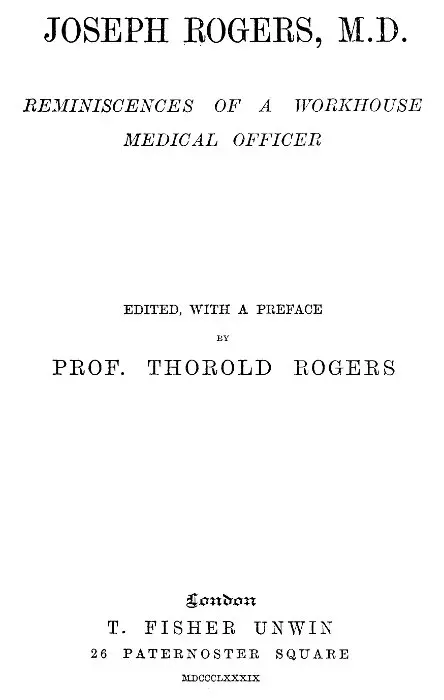
"Joseph Rogers, M.D.: Reminiscences of a Workhouse Medical Officer" by Joseph Rogers is a historical account written in the late 19th century. The memoir narrates the experiences and struggles of Dr. Joseph Rogers during his tenure as a medical officer at a workhouse, detailing the systemic issues he encountered in providing care for the sick poor. The book seeks to illuminate the realities of medical relief for the impoverished and the challenges faced by health professionals in advocating for reform. The opening of the memoir sets the stage for Dr. Rogers' career, highlighting his initial appointment to the Strand Workhouse in Soho during a cholera outbreak in the mid-1850s. He describes the deplorable conditions within the workhouse, including overcrowding, inadequate medical supplies, and an unqualified staff. Rogers conveys his determination to improve patient care against significant opposition from the Guardians of the Poor, illustrating the conflicts he had with authority while illustrating the hardship faced by the vulnerable populations he served. This introductory segment effectively captures the essence of his life's work and advocacy for reform in the treatment of the sick and the poor in Victorian London.
Introduction adapted from the source catalogue; source summaries may be automatically generated.
Free to read · English · 61,040 words · No account needed
MAKE TIME FOR A GOOD BOOK
On by default. Untick to stop anonymous reading totals. Each page counts after 10 seconds in view. How this works.
Anonymous counting is on unless you have switched it off.
We had, during the portion of the time I was at the Westminster Union, quite a little community of aged and, so far as I could ascertain, religious women, at any rate they struck me as being such, and I kept them together until the harmony of their daily life was rudely interfered with by the master and matron, Mr. John Bliss and Miss Heatley, neither of whom had any sympathy with, or kindly feeling for, decently conducted pauper women. Indeed they rendered the lives of these people so wretched by harsh interference, as to compel me to distribute them among other wards; some of them I even sent away to the sick asylum hospitals, so as to get them out of their way. It was a wonder to me that Miss Heatley, after all that was proved against her on the official inquiry, should ever have been allowed to continue matron of the Workhouse; but though spared by man's power, she was destined to perish by one of the most fearful diseases that can afflict any woman, being destined to die of cancer of a certain internal organ, and I have been told her sufferings were of the acutest possible character. It is very remarkable that, having had very large opportunities of witnessing the deaths of my fellow-creatures, I have constantly observed that some untimely fate has overtaken those who, exercising power in a workhouse, have exhibited a cruel use of that power; and of one thing I am absolutely certain from personal observation, repeated over and over again, that, "Blessed is he who considereth the poor and needy, the Lord shall deliver him in the time of trouble." It has often been asserted that the inmates of a workhouse are generally worthless people, but I demur to that conclusion entirely. Of this I am certain, that many a person who has died in the infirmary of the sick ward of a workhouse has gone as straight to Abraham's bosom as has ever passed from a bishop's palace, or the death-chamber of a king or queen, or however highly placed. During the thirty years that I was engaged in waiting on the sick poor, I never lost sight of the fact that they were my fellow-creatures who were accidentally placed in a humbler social position than myself. Though, in accordance with the custom adopted in the institution, they were stigmatized as paupers, I never allowed myself to make them feel I thought them such. After the departure of Mr. John Bliss and the disappearance (through illness) of Miss Heatley, the Guardians appointed as master and matron, Mr. and Mrs. Minter. I found them to be exceedingly respectable people, kind to the old and afflicted, and fair and kind to the general population of an urban workhouse. The sick poor were quietly attended to, whilst loud-mouthed swearing and blasphemy were banished from the place. Unfortunately, however, I began to break in health. Mounting up staircases day after day, which had gone on for nearly forty years, told upon me, aggravated as it was by repeated attacks of bronchitis. Then a heart affection, followed by its usual concomitants, proved too much for me, and I was compelled to resign the work I had done for so many years. What made the blow the greater to me was this, that in all other respects my professional life was a happy one. I had nothing to ask for from the Board of Guardians, as all my legitimate requirements were at once courteously met and complied with; a different atmosphere pervaded the establishment, and therefore it was a pleasure to me to meet my fellow-officers and to work with them. Looking back upon the change which had taken place from the day I first entered upon my duties in January, 1856, in the Old Strand Workhouse, till I finally left the Westminster Union in 1886, a period of thirty years, the change that occurred was enormous. Then there was hardly a paid nurse in any workhouse in London, the duties being performed by more or less infirm, drunken, and generally profligate inmates of the House. It was a miracle to find an honest one among them; they were a chance medley of Sairey Gamps and Betsy Prigs, who were selected at the will of master and matron, and who obeyed the orders of the medical officer just as much as, and no more than, their fancy led them. The scenes of untold misery which might have been witnessed by the Guardians of the Poor will never be fully exposed until the grave record of all things is opened to universal gaze. Fortunately, a change has come over the spirit of these things: in the present day the sick poor are housed in buildings which were never dreamed of twenty years ago; pauper nursing is now entirely a thing of the past; Lazarus now meets with careful, Christian consideration, and if it be possible to restore him to health, an opportunity is afforded him of resuming a position in society, useful, though it maybe humble. My readers will therefore fully understand with what great regret I took my pen and wrote the resignation of my office, especially when I recall to mind my having been twice suspended from my duties for the efforts I had made in bringing about the changes which I have above referred to, and that at last, when I was no longer able to do my work, I was constrained to sever my connection with the Board who had come to look upon me as one solely actuated by a sense of duty.
Your reading position is saved on this browser. Take it to another device with a library code. Reading pages adapt to text, rather than matching a printed edition.
BEHIND THE BOOK
This eBook is for the use of anyone anywhere in the United States and most other parts of the world at no cost and with almost no restrictions whatsoever. You may copy it, give it away or re-use it under the terms of the Project Gutenberg License included with this eBook or online at www.gutenberg.org. If you are not located in the United States, you will have to check the laws of the country where you are located before using this eBook. Read the source licence.
The original source file, including credits and licence, is retained by this library. Request an original-format copy at no charge. Please include the book title and Project Gutenberg identifier #58454.
KEEP YOUR CURIOSITY GOING
Cécile Tormay

Moritz Busch
John L. Ransom
Frances Wright
Cécile Tormay

Mabel Potter Daggett