THE CLASSIC COLLECTION✦An outlaw’s diary: the CommuneCLASSIC FREE BOOKS
An outlaw’s diary: the Commune
Cécile Tormay
THE CLASSIC COLLECTION · 1901
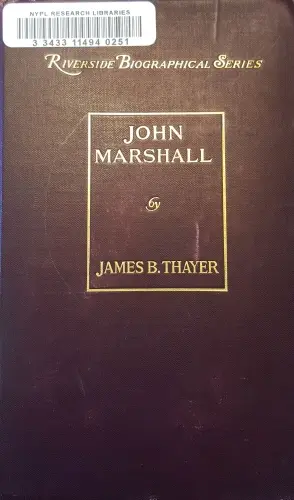
"John Marshall" by James Bradley Thayer is a historical account written in the early 20th century. The book focuses on the life and legacy of John Marshall, the fourth Chief Justice of the United States, emphasizing his contributions to American constitutional law and his character evolution. Through this work, the author aims to illuminate Marshall’s significant role in shaping the judicial system and the nation itself. The opening of the biography sets the stage by delving into Marshall's early life, detailing the context of his upbringing in Virginia and highlighting the profound influence of his father and the colonial atmosphere of the time. It provides insight into the formative experiences that shaped his character, including his education, military service during the Revolutionary War, and early legal career. Thayer crafts a rich narrative that paints Marshall not just as a prominent jurist but as a devoted family man and a curious intellectual, setting a foundation for understanding his later achievements as a pivotal figure in establishing the authority of the Supreme Court and the framework of American law.
Introduction adapted from the source catalogue; source summaries may be automatically generated.
Free to read · English · 28,253 words · No account needed
MAKE TIME FOR A GOOD BOOK
On by default. Untick to stop anonymous reading totals. Each page counts after 10 seconds in view. How this works.
Anonymous counting is on unless you have switched it off.
[17] “The masterly and conclusive argument of John Marshall in the House of Representatives. 8 Stat. 129; Wharton’s State Trials, 392; Bee [Reports], 286; 5 Wheat. appendix 3.”--Gray, J., speaking for the Supreme Court of the United States, in Fong Yue Ting v. U. S., 149 U. S. 698, 714. This speech is also found in Moore’s American Eloquence, ii. 7.
[18] The President had written to the Secretary of State from Quincy, May 21, 1799: “How far the President of the United States would be justified in directing the judge to deliver up the offender is not clear. I have no objection to advise, and request him to do so.” Wharton’s State Trials, 418.
[19] The short “autobiography” before referred to (ante, p. 10, n.) ends thus: “I have written no book except the ‘Life of Washington,’ which was executed with so much precipitation as to require much correction.”
[20] Van Santvoord, Lives of the Chief Justices, 343, n.
[21] Coxe, Jud. Power, 95-102; Thayer’s Cases on Constitutional
Law, i. 146-149.
[22] Eakin v. Raub, 12 Sergeant & Rawle, 330.
[23] What Pinckney said in 1799 was this: “Upon no subject am I more convinced than that it is an unsafe and dangerous doctrine in a republic ever to suppose that a judge ought to possess the right of questioning or deciding upon the constitutionality of treaties, laws, or any act of the legislature. It is placing the opinion of an individual, or of two or three, above that of both branches of Congress, a doctrine which is not warranted by the Constitution, and will not, I hope, long have many advocates in this country.” Wharton, State Trials, 412.
[24] 4 Amer. Jurist, 293; Story, Const. § 1579, n.
[25] Stuart v. Laird, 1 Cranch, 299.
[26] Marshall, when the act of 1802 restored the old system, stated to his associates his deliberate agreement with the opinion expressed by his predecessors above referred to, and proposed to refuse to sit in the circuit court. All his brethren agreed with his view on the constitutional point, but thought the question should be regarded as at rest, by reason of the earlier practice of the court, up to 1801. This view prevailed, and was soon afterwards, as above stated, judicially adopted by the court. This statement is made by Chancellor Kent in 3 N. Y. Review, 347 (1838).
For the knowledge of the authorship of this valuable article and of another related one in 2 ib. 372, I am indebted to the courtesy of Dr. J. S. Billings, the Director of the New York Public Library, and the investigations of Mr. V. H. Paltsits, one of the librarians in that institution.
[27] This construction, that the statute purported to authorize their acting in that capacity was afterwards, in 1794, held by the Supreme Court to be wrong. Yale Todd’s Case, 13 Howard, 52.
[28] Hayburn’s Case, 2 Dallas, 409.
[29] Volume v., p. 444 (Philadelphia edition, 1807).
Your reading position is saved on this browser. Take it to another device with a library code. Reading pages adapt to text, rather than matching a printed edition.
BEHIND THE BOOK
This eBook is for the use of anyone anywhere in the United States and most other parts of the world at no cost and with almost no restrictions whatsoever. You may copy it, give it away or re-use it under the terms of the Project Gutenberg License included with this eBook or online at www.gutenberg.org. If you are not located in the United States, you will have to check the laws of the country where you are located before using this eBook. Read the source licence.
The original source file, including credits and licence, is retained by this library. Request an original-format copy at no charge. Please include the book title and Project Gutenberg identifier #56088.
KEEP YOUR CURIOSITY GOING
Cécile Tormay

Moritz Busch
John L. Ransom
Frances Wright
Cécile Tormay

Mabel Potter Daggett