THE CLASSIC COLLECTION✦An outlaw’s diary: the CommuneCLASSIC FREE BOOKS
An outlaw’s diary: the Commune
Cécile Tormay
THE CLASSIC COLLECTION · 1901
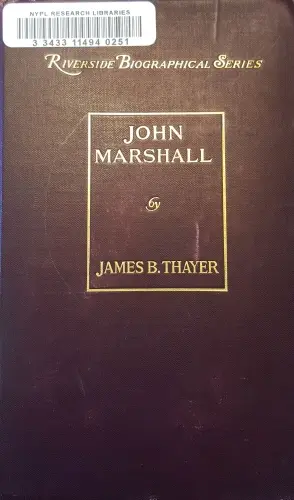
"John Marshall" by James Bradley Thayer is a historical account written in the early 20th century. The book focuses on the life and legacy of John Marshall, the fourth Chief Justice of the United States, emphasizing his contributions to American constitutional law and his character evolution. Through this work, the author aims to illuminate Marshall’s significant role in shaping the judicial system and the nation itself. The opening of the biography sets the stage by delving into Marshall's early life, detailing the context of his upbringing in Virginia and highlighting the profound influence of his father and the colonial atmosphere of the time. It provides insight into the formative experiences that shaped his character, including his education, military service during the Revolutionary War, and early legal career. Thayer crafts a rich narrative that paints Marshall not just as a prominent jurist but as a devoted family man and a curious intellectual, setting a foundation for understanding his later achievements as a pivotal figure in establishing the authority of the Supreme Court and the framework of American law.
Introduction adapted from the source catalogue; source summaries may be automatically generated.
Free to read · English · 28,253 words · No account needed
MAKE TIME FOR A GOOD BOOK
On by default. Untick to stop anonymous reading totals. Each page counts after 10 seconds in view. How this works.
Anonymous counting is on unless you have switched it off.
[3] Marshall’s eyes are often spoken of as black. In fact, they were
brown.
[4] It may be added that Thomas Marshall, father of the Chief Justice, was the son of John Marshall, called “of the Forest,” from the name of his place in Westmoreland County. Of this John it is said, in a little autobiography of the Chief Justice of some five hundred words, preserved in Mr. Justice Gray’s valuable oration at Richmond, on February 4, 1901, that his “parents migrated from Wales and settled in the county of Westmoreland in Virginia.” The will of “Thomas Marshall carpenter,” proved May 31, 1704, describing himself as of Westmoreland County, is printed in the Virginia Magazine of History, ii. 343, 344; and it is there stated in a note that this Thomas “was the first of his race in America.” On the other hand, we are told by an intelligent writer in Appleton’s Cyclopædia of American Biography, and elsewhere, that the father of “John of the Forest” was Thomas, born in Virginia in 1655, who died in 1704; and that it was his father, John, a captain of cavalry in the service of Charles I., who emigrated to Virginia about 1650.
[5] Flanders, Lives of the Chief Justices, ii. 291.
[6] His youngest son, Edward Carrington Marshall, graduated at Harvard
in 1826.
[7] Only six of his children grew to full age. See his touching letter to Judge Story of June 26, 1831: “You ask me if Mrs. Marshall and myself have ever lost a child. We have lost four,” etc.--Proceedings of the Mass. Hist. Soc. (2d series) xiii. 345.
[8] Richard Anderson, father of Robert Anderson, the hero of Fort Sumter. See Marion Harland’s Old Colonial Homesteads, 97.
[9] But see Mrs. Hardy, in The Green Bag, viii. 482.
[10] Old Churches and Families of Virginia, ii. 105.
[11] It was given by another judge.
[12] Mr. Justice Gray preserves this fact in his address on Marshall. His commission bore the same date with that of Chief Justice Jay, September 26, 1789,--two days after the approval of the Judiciary Act.
[13] See Wait’s State Papers, iii. 165-304.
[14] The Green Bag, viii. 482.
[15] Paulding’s Life of Washington, ii. 191; Lippincott’s
Magazine, ii. 624, 625.
[16] In an amusing account of this election (Munford’s The Two Parsons), we are told that the sheriff presided, with the two candidates, Marshall and John Clopton, seated on the justice’s bench. The voter, being asked for whom he voted, gave the name of his candidate; and the latter thanked him; e.g., “Your vote is appreciated, sir,” said Marshall to his friend Parson Blair. For an account of the same method of conducting elections in Virginia at a later period, see John S. Wise’s The End of an Era.
Your reading position is saved on this browser. Take it to another device with a library code. Reading pages adapt to text, rather than matching a printed edition.
BEHIND THE BOOK
This eBook is for the use of anyone anywhere in the United States and most other parts of the world at no cost and with almost no restrictions whatsoever. You may copy it, give it away or re-use it under the terms of the Project Gutenberg License included with this eBook or online at www.gutenberg.org. If you are not located in the United States, you will have to check the laws of the country where you are located before using this eBook. Read the source licence.
The original source file, including credits and licence, is retained by this library. Request an original-format copy at no charge. Please include the book title and Project Gutenberg identifier #56088.
KEEP YOUR CURIOSITY GOING
Cécile Tormay

Moritz Busch
John L. Ransom
Frances Wright
Cécile Tormay

Mabel Potter Daggett