THE CLASSIC COLLECTION✦An outlaw’s diary: the CommuneCLASSIC FREE BOOKS
An outlaw’s diary: the Commune
Cécile Tormay
THE CLASSIC COLLECTION · 1902
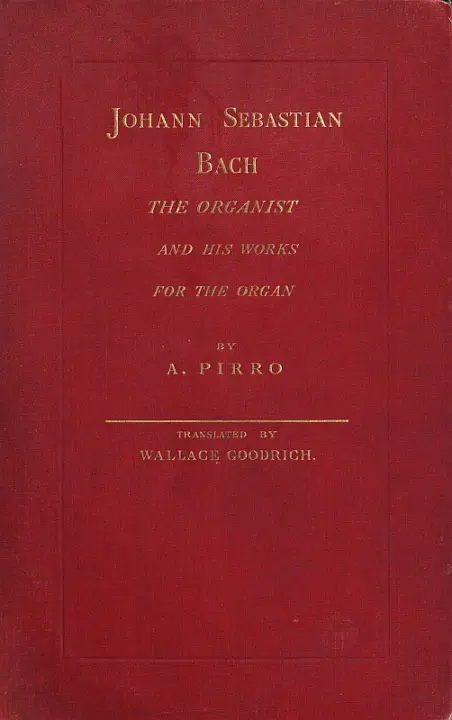
"Johann Sebastian Bach: The Organist and His Works for the Organ" by André Pirro is a historical account written in the late 19th century. The book delves into the life and compositions of Johann Sebastian Bach, particularly focusing on his work as an organist and the significance of his organ music. Through this exploration, it aims to provide insights into Bach’s musical contributions and his profound influence on the development of organ music. The opening of this work presents a preface that sets the tone for a deep analysis of Bach’s character and his musical genius. It portrays Bach as a humble and diligent figure who was dedicated to his craft, characterized by a combination of formidable talent and a commitment to his education and teaching. The narrative hints at Bach's intricate relationship with his predecessors, suggesting that his genius was informed by the works of notable composers before him, such as Frescobaldi and Buxtehude. By providing historical context and detailing the evolution of Bach's style, the introduction prepares readers for an in-depth study of his organ compositions, which will explore their structure and significance within the broader spectrum of classical music.
Introduction adapted from the source catalogue; source summaries may be automatically generated.
Free to read · English · 40,361 words · No account needed
MAKE TIME FOR A GOOD BOOK
On by default. Untick to stop anonymous reading totals. Each page counts after 10 seconds in view. How this works.
Anonymous counting is on unless you have switched it off.
No. 51. Jauchzet Gott in allen Landen.
" 52. Falsche Welt, dir trau' ich nicht.
" 53. Schlage doch, gewünschte Stunde.
" 54. Widerstehe doch der Sünde.
" 55. Ich armer Mensch, ich Sündenknecht.
" 56. Ich will den Kreuzstab gerne tragen.
" 57. Selig ist der Mann.
" 58. Ach Gott, wie manches Herzeleid. (Second Setting.)
" 59. Wer mich liebet, der wird mein Wort halten. (First Setting.)
" 60. O Ewigkeit, du Donnerwort. (Second Setting.)
First Issue:
Dem Gerechten muss das Licht.
Der Herr denket an uns.
Gott ist unsere Zuversicht.
Three Chorales.
Second Issue:
Six greater Suites, known as the "English."
Six lesser Suites, known as the "French."
Third Issue:
Funeral Ode upon the death of the wife of August the Strong, "Christiane Eberhardine," Queen of Poland and Electress of Saxony.
The Well-tempered Clavichord.
First Part, 1722.
Second Part, 1744.
Appendix. Supplementary Readings and Explanations.
Six Sonatas for 2 manuals and pedal.
Six Preludes and Fugues. First Series.
Six " " " Second "
Six " " " Third "
Three Toccatas.
Passacaglia.
No. 61. Nun komm, der Heiden Heiland. (First Setting.)
" 62. Nun komm, der Heiden Heiland. (Second Setting.)
" 63. Christen, ätzet diesen Tag.
" 64. Sehet, welch' eine Liebe hat uns der Vater erzeiget.
" 65. Sie werden aus Saba Alle kommen.
" 66. Erfreut euch, ihr Herzen.
" 67. Halt' im Gedächtniss Jesum Christ.
" 68. Also hat Gott die Welt geliebt.
" 69. Lobe den Herrn, meine Seele.
" 70. Wachet, betet, seid bereit allezeit.
Seven Concertos for Pianoforte with orchestral accompaniment:
No. 1, D minor; No. 2, E major; No. 3, D major; No. 4, A major; No. 5, F minor; No. 6, F major; No. 7, G minor.
Triple Concerto for Pianoforte, flute and violin, with orchestral
accompaniment.
Appendix.
No. 71. Gott ist mein König.
" 72. Alles nur nach Gottes Willen.
" 73. Herr, wie du willst, so schick's mit mir.
" 74. Wer mich liebet, der wird mein Wort halten. (Second and more
elaborate Setting.)
" 75. Die Elenden sollen essen.
" 76. Die Himmel erzählen die Ehre Gottes.
" 77. Du sollst Gott, deinen Herrn, lieben.
" 78. Jesu, der du meine Seele.
" 79. Gott der Herr ist Sonn' und Schild.
" 80. Ein' feste Burg ist unser Gott.
1. Concerto in F major for two horns, three oboes, bassoon,
obbligato Quart-Geige,[205] two violins, viola, violoncello, and
continuo.
[Footnote 205: A small-sized violin, tuned a fourth higher.]
2. Concerto in F major for obbligato trumpet, flute, oboe and violin, with accompaniment of two violins, viola and continuo.
3. Concerto in G major for three violins, three violas, three
violoncellos and continuo.
4. Concerto in G major for obbligato violin with accompaniment of two flutes (flûtes à bec), two violins, viola, violoncello and continuo.
Your reading position is saved on this browser. Take it to another device with a library code. Reading pages adapt to text, rather than matching a printed edition.
BEHIND THE BOOK
This eBook is for the use of anyone anywhere in the United States and most other parts of the world at no cost and with almost no restrictions whatsoever. You may copy it, give it away or re-use it under the terms of the Project Gutenberg License included with this eBook or online at www.gutenberg.org. If you are not located in the United States, you will have to check the laws of the country where you are located before using this eBook. Read the source licence.
The original source file, including credits and licence, is retained by this library. Request an original-format copy at no charge. Please include the book title and Project Gutenberg identifier #59085.
KEEP YOUR CURIOSITY GOING
Cécile Tormay

Moritz Busch
John L. Ransom
Frances Wright
Cécile Tormay

Mabel Potter Daggett