THE CLASSIC COLLECTION✦An outlaw’s diary: the CommuneCLASSIC FREE BOOKS
An outlaw’s diary: the Commune
Cécile Tormay
THE CLASSIC COLLECTION · 1902
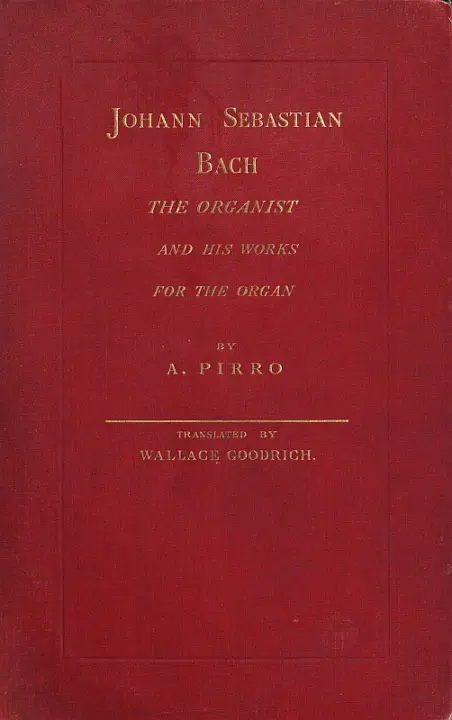
"Johann Sebastian Bach: The Organist and His Works for the Organ" by André Pirro is a historical account written in the late 19th century. The book delves into the life and compositions of Johann Sebastian Bach, particularly focusing on his work as an organist and the significance of his organ music. Through this exploration, it aims to provide insights into Bach’s musical contributions and his profound influence on the development of organ music. The opening of this work presents a preface that sets the tone for a deep analysis of Bach’s character and his musical genius. It portrays Bach as a humble and diligent figure who was dedicated to his craft, characterized by a combination of formidable talent and a commitment to his education and teaching. The narrative hints at Bach's intricate relationship with his predecessors, suggesting that his genius was informed by the works of notable composers before him, such as Frescobaldi and Buxtehude. By providing historical context and detailing the evolution of Bach's style, the introduction prepares readers for an in-depth study of his organ compositions, which will explore their structure and significance within the broader spectrum of classical music.
Introduction adapted from the source catalogue; source summaries may be automatically generated.
Free to read · English · 40,361 words · No account needed
MAKE TIME FOR A GOOD BOOK
On by default. Untick to stop anonymous reading totals. Each page counts after 10 seconds in view. How this works.
Anonymous counting is on unless you have switched it off.
[Footnote 46: Georg Muffat, born about 1635, was a pupil of Lully, and studied also in Rome and Vienna. For some time he was organist in Strassburg, and about 1667 entered the service of the Bishop of Salzburg. About 1687 he became organist and master of the pages at the court in Passau. He died there February 23, 1714. He published in 1690, at Augsburg, the "Apparatus musico-organisticus" (re-edited by S. de Lange, Leipzig, 1888), which contains twelve Toccatas, one in each of the Gregorian modes, and some pieces of lesser importance.
These Toccatas are a development of the older form of the same name, where brilliant passages, harmonic progressions, or fugal imitations, succeeded each other. From each of these elements Muffat made a whole, developed separately; a similar method suggested in certain Canzoni of Frescobaldi was extended in some of the Capricci of Froberger. Nothing but the too sparing use of the pedal prevents these works from being ranked among the most important.]
The developments, too, are more consistently polyphonic in nature; they are more extended, by the simple logic of musical speech, without having recourse to foreign devices.
In his Toccatas, Pachelbel generally presents to us passages in sixths or tenths for the hands, firmly sustained by pedal notes of long duration, sometimes with changes of rhythm of extremely happy effect. One among others[47] contains a pastoral theme; and this is not an isolated example, for Pachelbel seems to have been fond of popular melodies. Some of these subjects, with their 12/8 rhythm, express the good-nature and simplicity of rustic tunes.
[Footnote 47: J. Commer. Musica sacra, vol. i, No. 132.]
The greater part of Pachelbel's compositions may be found in the first volume of the Musica sacra. Others are published in various collections; we would mention in particular a Toccata and a Ciaccona, until now never published, which G.A. Ritter presents in his work Zur Geschichte des Orgelspiels.
Thanks to these publications, we may form an opinion of Pachelbel's music, always conservative and markedly religious in character.
Pachelbel had many pupils; so great was his fame that many organists, desirous of making a name for themselves, claimed to have been under his tutelage; but "every one cannot have been a pupil of Pachelbel," said Mattheson in the course of a celebrated discussion with one of them, the organist Buttstedt.[48]
[Footnote 48: Following the publication of the "neu eröffnetes Orchester" of Mattheson, Buttstedt had written an essay entitled:
Ut mi sol
re fa la
Tota musica (Erfurt, 1717),
in which he defended the old solmisation, or system of changes, the si, a changeable note, being disregarded. Mattheson answered it the same year by the "neu beschütztes Orchester" (defense of the new orchestra), with the epigraph:
Your reading position is saved on this browser. Take it to another device with a library code. Reading pages adapt to text, rather than matching a printed edition.
BEHIND THE BOOK
This eBook is for the use of anyone anywhere in the United States and most other parts of the world at no cost and with almost no restrictions whatsoever. You may copy it, give it away or re-use it under the terms of the Project Gutenberg License included with this eBook or online at www.gutenberg.org. If you are not located in the United States, you will have to check the laws of the country where you are located before using this eBook. Read the source licence.
The original source file, including credits and licence, is retained by this library. Request an original-format copy at no charge. Please include the book title and Project Gutenberg identifier #59085.
KEEP YOUR CURIOSITY GOING
Cécile Tormay

Moritz Busch
John L. Ransom
Frances Wright
Cécile Tormay

Mabel Potter Daggett