THE CLASSIC COLLECTION✦An outlaw’s diary: the CommuneCLASSIC FREE BOOKS
An outlaw’s diary: the Commune
Cécile Tormay
THE CLASSIC COLLECTION · 1902
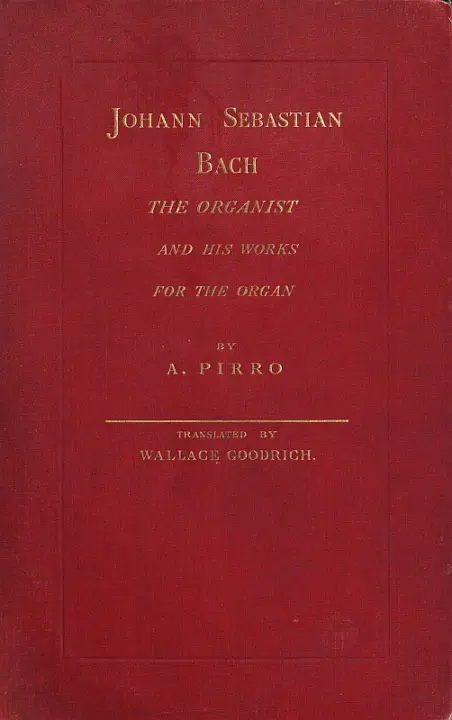
"Johann Sebastian Bach: The Organist and His Works for the Organ" by André Pirro is a historical account written in the late 19th century. The book delves into the life and compositions of Johann Sebastian Bach, particularly focusing on his work as an organist and the significance of his organ music. Through this exploration, it aims to provide insights into Bach’s musical contributions and his profound influence on the development of organ music. The opening of this work presents a preface that sets the tone for a deep analysis of Bach’s character and his musical genius. It portrays Bach as a humble and diligent figure who was dedicated to his craft, characterized by a combination of formidable talent and a commitment to his education and teaching. The narrative hints at Bach's intricate relationship with his predecessors, suggesting that his genius was informed by the works of notable composers before him, such as Frescobaldi and Buxtehude. By providing historical context and detailing the evolution of Bach's style, the introduction prepares readers for an in-depth study of his organ compositions, which will explore their structure and significance within the broader spectrum of classical music.
Introduction adapted from the source catalogue; source summaries may be automatically generated.
Free to read · English · 40,361 words · No account needed
MAKE TIME FOR A GOOD BOOK
On by default. Untick to stop anonymous reading totals. Each page counts after 10 seconds in view. How this works.
Anonymous counting is on unless you have switched it off.
The author of this study does not assume to have discovered Bach, of whom the world has already heard; but of such men there is always something to be learned; many new facts of interest concerning the great Cantor of Leipzig will be brought out by others after us. What we here wish to consider is the compositions of Bach for the organ.
If, perhaps, we have confined ourselves to æsthetic considerations of a nature which may appear general, we trust that we may be pardoned; a perusal of this little book will demonstrate that it is not the fault of the man who suddenly surpassed all that had been done before him, while at the same time anticipating all that was to be written in the future.
Bach was not without predecessors; we may not ascribe to him the honor of having invented an alphabet, but it must be recognized that he was the author of a grammar. This conclusion is apparent upon a study of "Johann Sebastian Bach, the Organist"; it would undoubtedly be no less convincing upon the consideration of all his works as a whole.
Since we must confine ourselves to observation from a particular point of view, we shall indeed be happy if our labor, based entirely upon recognized authorities, shall make easier to the student the task of playing Bach "in the Bach spirit."
WÜSTWEILER, September 27, 1894.
Page 6, second brace, meas. 2, upper part: First half-note d''
should be c''.
Page 8, meas. 3, upper part: Add tie between third and fourth notes
from end.
Page 16, second brace, meas. 2, upper part: Third 16th-note a'
should be c''[sharp].
Page 18, second brace, meas. 1: Add tie between last note (f) in third part and the following note.
Page 32, Example 2, last meas. et seq. should read thus:
[Music]
Page 43, Example 2, meas. 2, upper part: The sixth note (g'[sharp]) should be an eighth-note.
Page 44, Example 1, meas. 2, second part: Last note should be
g[natural].
Page 47, Example 1, meas. 2, upper part: First note, e'', should be
f''.
Page 47, Example 1, meas. 2: Add tie between last note in third part
and the following note.
Page 91, Example 2, second part: Third note from end should be
f'[sharp].
Johann Sebastian Bach, The Organist
Frescobaldi was born at Ferrara in 1583, and the same year at his baptism in the Cathedral received the Christian names Girolamo and Alessandro.
Your reading position is saved on this browser. Take it to another device with a library code. Reading pages adapt to text, rather than matching a printed edition.
BEHIND THE BOOK
This eBook is for the use of anyone anywhere in the United States and most other parts of the world at no cost and with almost no restrictions whatsoever. You may copy it, give it away or re-use it under the terms of the Project Gutenberg License included with this eBook or online at www.gutenberg.org. If you are not located in the United States, you will have to check the laws of the country where you are located before using this eBook. Read the source licence.
The original source file, including credits and licence, is retained by this library. Request an original-format copy at no charge. Please include the book title and Project Gutenberg identifier #59085.
KEEP YOUR CURIOSITY GOING
Cécile Tormay

Moritz Busch
John L. Ransom
Frances Wright
Cécile Tormay

Mabel Potter Daggett