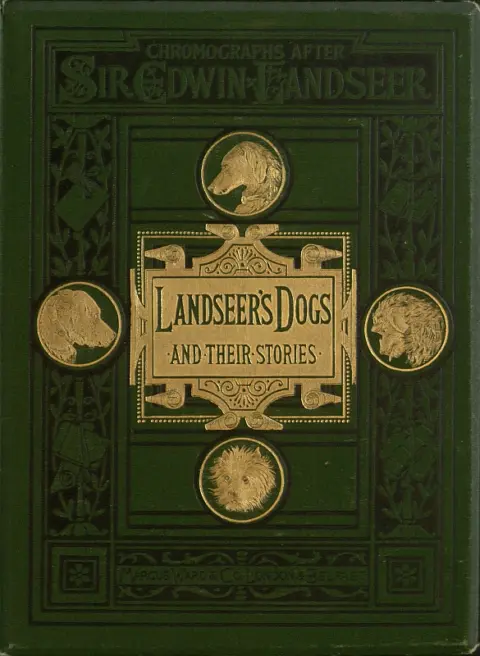
Landseer’s Dogs and Their Stories
Sarah Tytler
THE CLASSIC COLLECTION · 1880
"Jane Austen and Her Works" by Sarah Tytler is a biographical account written in the late 19th century. This work delves into the life and literary contributions of Jane Austen, highlighting her evolution as a writer. It likely discusses the themes and characters of her most renowned novels such as "Pride and Prejudice," "Emma," and "Sense and Sensibility," while also providing insights into the social context of her time. The opening of the book sets a reflective tone by establishing the significance of Jane Austen's literary achievements against the backdrop of her life. It portrays her as a remarkable woman whose early works foreshadowed her later masterpieces, while emphasizing her close relationship with her family and the supportive environment that nurtured her talent. Tytler emphasizes the importance of understanding the interplay between Austen's life and her novels, suggesting that their characteristics reflect enduring human nature. Thus, the initial chapters frame Austen as a writer of great sensitivity and insight, who captured the complexities of relationships and social manners in her works.
Introduction adapted from the source catalogue; source summaries may be automatically generated.
Free to read · English · 129,653 words · No account needed
MAKE TIME FOR A GOOD BOOK
On by default. Untick to stop anonymous reading totals. Each page counts after 10 seconds in view. How this works.
Anonymous counting is on unless you have switched it off.
Emma would be very happy to wait on Mrs. Bates; and they did at last move out of the shop, with no further delay from Miss Bates than “How do you do, Mrs. Ford? I beg your pardon; I did not see you before. I hear you have a charming collection of new ribands from town. Jane came back delighted yesterday. Thank ye! the gloves do very well, only a little too large about the wrist; but Jane is taking them in.”
“What was I talking of?” said she, beginning again when they were all
in the street.
Emma wondered on what, of all the medley, she would fix.
“I declare I cannot recollect what I was talking of. Oh, my mother’s spectacles! So very obliging of Mr. Frank Churchill! ‘Oh,’ said he, ‘I do think I can fasten the rivet; I like a job of this kind excessively;’ which, you know, showed him to be so very----Indeed, I must say, that much as I have heard of him before, and much as I had expected, he far exceeds anything--I do congratulate you, Mrs. Weston, most warmly. He seems everything the fondest parent could----‘Oh,’ said he, ‘I can fasten that rivet; I like a job of that kind excessively.’ I never shall forget his manner; and when I brought out the baked apples from the closet, and hoped our friends would be so very obliging as to take some, ‘Oh,’ said he directly, ‘there is nothing in the way of fruit half so good, and these are the finest-looking home-baked apples I ever saw in my life.’ That, you know, was so very----and I am sure, by his manner, it was no compliment. Indeed, they are very delightful apples, and Mrs. Wallis does them full justice, only we do not have them baked more than twice, and Mr. Woodhouse made us promise to have them done three times; but Miss Woodhouse will be so good as not to mention it. The apples themselves are the very finest sort for baking, beyond a doubt; all from Donwell--some of Mr. Knightley’s most liberal supply. He sends us a sack every year, and certainly there never was such a keeping apple anywhere as one of his trees--I believe there are two of them. My mother says the orchard was always famous in her younger days. But I was really quite struck the other day, for Mr. Knightley called one morning, and Jane was eating these apples, and we talked about them, and said how much she enjoyed them, and he asked whether we were not got to the end of our stock. ‘I am sure you must be,’ said he, ‘and I will send you another supply, for I have a great many more than I can ever use. William Larkins let me keep a larger quantity than usual this year. I will send you some more before they get good for nothing.’ So I begged he would not--for really, as to ours being gone, I could not absolutely say that we had a great many left--it was but half a dozen, indeed--but they should all be kept for Jane, and I could not at all bear that he should be sending us more, so liberal as he had been already, and Jane said the same; and when he was gone she almost quarrelled with me--no, I should not say quarrelled, for we never had a quarrel in our lives, but she was quite distressed that I had owned the apples were so nearly gone; she wished I had made him believe we had a great many left. ‘Oh,’ said I, ‘my dear, I did say as much as I could.’ However, the very same evening William Larkins came over with a large basket of apples, a bushel at least, and I was very much obliged, and went down and spoke to William Larkins, and said everything, as you may suppose. William Larkins is such an old acquaintance, I am always glad to see him. But, however, I found out afterwards from Patty that William said it was all the apples of that sort his master had; he had brought them all, and now his master had not one left to bake or boil. William did not seem to mind it himself, he was so pleased to think his master had sold so many--for William, you know, thinks more of his master’s profit than anything--but Mrs. Hodges, he said, was quite displeased at their being all sent away. She could not bear that her master should not be able to have another apple-tart this spring. He told Patty this, but bid her not mind it, and be sure not to say anything to us about it, for Mrs. Hodges would be cross sometimes, and as long as so many sacks were sold, it did not signify who ate the remainder; and so Patty told me, and I was exceedingly shocked indeed! I would not have Mr. Knightley know anything about it for the world! He would be so very----I wanted to keep it from Jane’s knowledge, but unluckily I had mentioned it before I was aware.”
Your reading position is saved on this browser. Take it to another device with a library code. Reading pages adapt to text, rather than matching a printed edition.
BEHIND THE BOOK
This eBook is for the use of anyone anywhere in the United States and most other parts of the world at no cost and with almost no restrictions whatsoever. You may copy it, give it away or re-use it under the terms of the Project Gutenberg License included with this eBook or online at www.gutenberg.org. If you are not located in the United States, you will have to check the laws of the country where you are located before using this eBook. Read the source licence.
The original source file, including credits and licence, is retained by this library. Request an original-format copy at no charge. Please include the book title and Project Gutenberg identifier #70809.
KEEP YOUR CURIOSITY GOING
Cécile Tormay

Moritz Busch
Coulson Kernahan
John L. Ransom

Maurice Baring
Frances Wright