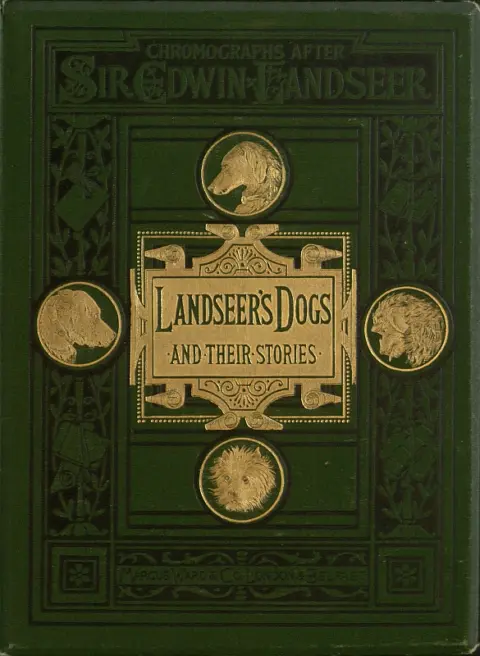
Landseer’s Dogs and Their Stories
Sarah Tytler
THE CLASSIC COLLECTION · 1880
"Jane Austen and Her Works" by Sarah Tytler is a biographical account written in the late 19th century. This work delves into the life and literary contributions of Jane Austen, highlighting her evolution as a writer. It likely discusses the themes and characters of her most renowned novels such as "Pride and Prejudice," "Emma," and "Sense and Sensibility," while also providing insights into the social context of her time. The opening of the book sets a reflective tone by establishing the significance of Jane Austen's literary achievements against the backdrop of her life. It portrays her as a remarkable woman whose early works foreshadowed her later masterpieces, while emphasizing her close relationship with her family and the supportive environment that nurtured her talent. Tytler emphasizes the importance of understanding the interplay between Austen's life and her novels, suggesting that their characteristics reflect enduring human nature. Thus, the initial chapters frame Austen as a writer of great sensitivity and insight, who captured the complexities of relationships and social manners in her works.
Introduction adapted from the source catalogue; source summaries may be automatically generated.
Free to read · English · 129,653 words · No account needed
MAKE TIME FOR A GOOD BOOK
On by default. Untick to stop anonymous reading totals. Each page counts after 10 seconds in view. How this works.
Anonymous counting is on unless you have switched it off.
“Perhaps it is as well,” said Frank Churchill, as he attended Emma to her carriage. “I must have asked Miss Fairfax, and her languid dancing would not have agreed with me, after yours.”
Emma had gone next day to shop with Harriet Smith at the Highbury linendraper’s. Shopping with Harriet was no easy matter, when it involved convincing Harriet that if she wanted a plain muslin it was of no use to look at a figured; and that a blue riband, be it ever so beautiful, would still never match her yellow pattern.
Already the young ladies have encountered Frank Churchill and Mrs. Weston at the door of the Bateses’ house, opposite. Mrs. Weston is there, in performance of a promise she had forgotten, but of which her stepson had reminded her, that she should go and hear the newly-imported “instrument.”
Frank Churchill has attempted to get off from accompanying Mrs. Weston after he met Emma, and she refused to be one of the party. The matter has ended in Mrs. Weston’s carrying off Frank Churchill, according to their original intention, and the girls making their purchases at Ford’s. But in a few moments Miss Bates and Mrs. Weston come over together, and entreat Miss Woodhouse and Miss Smith to join the others, and give their opinion of the piano.
Miss Bates pours forth one of the most amusing of her effusions.
“I hope Mrs. Bates and Miss Fairfax are----” began Emma.
“Very well, I am much obliged to you. My mother is delightfully well; and Jane caught no cold last night. How is Mr. Woodhouse? I am so glad to hear such a good account. Mrs. Weston told me you were here. ‘Oh, then,’ said I, ‘I must run across. I am sure Miss Woodhouse will allow me just to run across, and entreat her to come in. My mother will be so very happy to see her; and now we are such a nice party, she cannot refuse.’ ‘Aye, pray do,’ said Mr. Frank Churchill, ‘Miss Woodhouse’s opinion of the instrument will be worth having.’ ‘But,’ said I, ‘I shall be more sure of succeeding if one of you will go with me.’ ‘Oh!’ said he, ‘wait half a minute, till I have finished my job,’ for, would you believe it, Miss Woodhouse, there he is, in the most obliging manner in the world, fastening in the rivet of my mother’s spectacles. The rivet came out, you know, this morning; so very obliging!--for my mother had no use of her spectacles, could not put them on, and, by-the-bye, everybody ought to have two pair of spectacles; they should, indeed, Jane said so. I meant to take them over to John Saunders, the first thing I did, but something or other hindered me all the morning; first one thing, and then another, there is no saying what, you know. At one time, Patty came to say she thought the kitchen-chimney wanted sweeping. ‘Oh!’ said I, ‘Patty, do not come with your bad news to me. Here is the rivet of your mistress’s spectacles out.’ Then the baked apples came home. Mrs. Wallis sent them by her boy; they are extremely civil and obliging to us, the Wallises, always. I have heard some people say that Mrs. Wallis can be uncivil, and give a very rude answer; but we have never known anything but the greatest attention from them. And it cannot be for the value of our custom now, for what is our consumption of bread, you know? only three of us. Besides, dear Jane at present--and she really eats nothing--makes such a shocking breakfast, you would be quite frightened if you saw it. I dare not let my mother know how little she eats; so I say one thing, and then I say another, and it passes off. But about the middle of the day she gets hungry, and there is nothing she likes so well as these baked apples, and they are extremely wholesome, for I took the opportunity the other day of asking Mr. Perry; I happened to meet him in the street. Not that I had any doubt before. I have so often heard Mr. Woodhouse recommend a baked apple. I believe it is the only way Mr. Woodhouse thinks the fruit thoroughly wholesome. We have apple-dumplings, however, very often. Patty makes an excellent apple-dumpling. Well, Mrs. Weston, you have prevailed, I hope, and these ladies will oblige us.”
Your reading position is saved on this browser. Take it to another device with a library code. Reading pages adapt to text, rather than matching a printed edition.
BEHIND THE BOOK
This eBook is for the use of anyone anywhere in the United States and most other parts of the world at no cost and with almost no restrictions whatsoever. You may copy it, give it away or re-use it under the terms of the Project Gutenberg License included with this eBook or online at www.gutenberg.org. If you are not located in the United States, you will have to check the laws of the country where you are located before using this eBook. Read the source licence.
The original source file, including credits and licence, is retained by this library. Request an original-format copy at no charge. Please include the book title and Project Gutenberg identifier #70809.
KEEP YOUR CURIOSITY GOING
Cécile Tormay

Moritz Busch
Coulson Kernahan
John L. Ransom

Maurice Baring
Frances Wright