THE CLASSIC COLLECTION✦An outlaw’s diary: the CommuneCLASSIC FREE BOOKS
An outlaw’s diary: the Commune
Cécile Tormay
THE CLASSIC COLLECTION · 1895
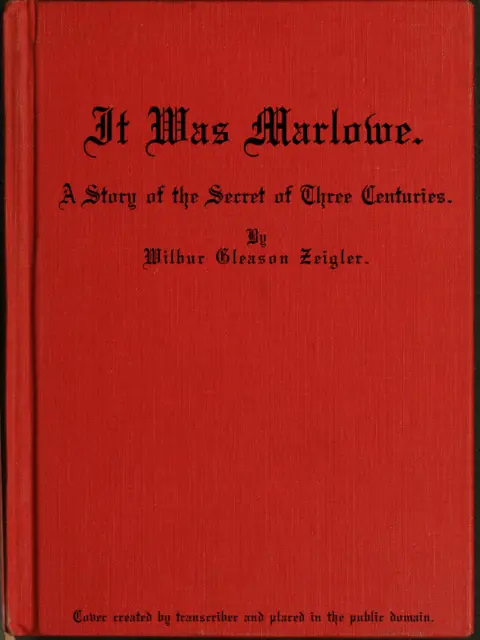
"It Was Marlowe: A Story of the Secret of Three Centuries" by Wilbur Gleason Zeigler is a historical novel written in the late 19th century. The narrative centers around the intriguing figure of Christopher Marlowe, a prominent playwright of the Elizabethan era, as it explores themes of authorship, scandal, and love, all set against the backdrop of the tumultuous societal changes of that time. At the start of the story, we meet Marlowe in the midst of the plague-stricken London of June 1593. A chance encounter with a youth named Tabbard leads to discussions regarding the Lady Anne and a potential romantic connection between them. Meanwhile, tensions brew as Marlowe navigates his professional life as a playwright and actor amid rumors of his controversial reputation and impending danger. Secrets unfold through Tabbard's news and Marlowe's upcoming clandestine meeting with Anne, setting the stage for a tale filled with intrigue, romance, and the shadow of Marlowe’s enigmatic past. This opening lays the groundwork for a plot that promises to delve into the complexities of Marlowe's life and the challenges he faces in a world rife with political and personal peril.
Introduction adapted from the source catalogue; source summaries may be automatically generated.
Free to read · English · 71,165 words · No account needed
MAKE TIME FOR A GOOD BOOK
On by default. Untick to stop anonymous reading totals. Each page counts after 10 seconds in view. How this works.
Anonymous counting is on unless you have switched it off.
--Dyce’s Marlowe, p. 55.
7 Raise cavalieros higher than the clouds,
And with the cannon break the frame of heaven;
Batter the shining palace of the sun,
And shiver all the starry firmament.
--Second Part Tamburlaine II, 4.
“Now pile your dust upon the quick and dead,
Till of this flat a mountain you have made,
To o’ertop old Pelion, or the skyish head
Of blue Olympus.”
--Hamlet III, 3.
“Streams of blood
As vast and deep as Euphrates or Nile.”
--Tamburlaine V, 2.
“Not tomb enough and continent
To hide the slain.”
--Hamlet IV, 4.
8 “Weep Powles, thy Tamburlaine voutsafes to dye.
* * * * * * * * *
He and the plague contended for the game.
* * * * * * * * *
The graund disease disdained his Toade Conceit And smiling at his Tamburlaine contempt Sternly struck home the peremptory stroke.”
--Harvey’s New Letter, September, 1593.
9 “It so fell out that in London streets, as he (Marlowe) proposed to stab one, whom he owed a grudge unto, with his dagger, * * * he stabbed his owne dagger into his owne head, etc.”
--Thomas Beard’s “Theater of God’s Judgments,” Edition First, 1597.
10 “As the poet Lycophron was shot to death by a certain rivall of his, so Christopher Marlow was stabbed to death by a bawdy servingman, a rivall of his in his lewde love.”
--Meres “Palladis Tamia,” etc., 1598.
11 “Not inferior to these was one Christopher Marlow, by profession a playmaker, who, as it is reported, about 14 years ago wrote a book against the Trinitie. It so happened that at Deptford, a little village about 3 miles from London, as he meant to stab with his ponyard one named Ingram, etc.”
--Vaughan’s Golden Grove, etc., 1600.
12 “As for the Worthies on his hoste’s wall, He knows three worthy drunkards pass them all; The first of them in many a tavern tried, At last subdued by Aquavitæ died.”
--Sam’l Rowland (published 1600).
13 “He (Ben Jonson) killed Mr. Marlow, ye poet, on Bunhill, coming from the Green Curtain play house.”
--Aubrey’s “Lives of Eminent Men,” citing Sr. Ed. Sherburne, p. 415.
14 “Christopher Marlow, slaine by Francis Frazer; sep. 1 of June, 1593.” This entry from the burial register of the church of St. Nicholas, Deptford, was kindly furnished me by the present pastor, Rev. William Chandler. The surname “Frazer” had been given to the world by Dyce and others as “Archer” and is so printed in the Encyclopedia Britannica, but such is a misreading.
--The Author.
15 “Idiote art masters that intrude themselves to our ears as the alcumists of eloquence; who (mounted on the stage of arrogance) think to outbrave better pens with the swelling bumbast of a bragging blank verse.”
--Nash’s Introduction to Greene’s Menaphon, 1587 (Grosart’s
Nashe I, XX).
Your reading position is saved on this browser. Take it to another device with a library code. Reading pages adapt to text, rather than matching a printed edition.
BEHIND THE BOOK
This eBook is for the use of anyone anywhere in the United States and most other parts of the world at no cost and with almost no restrictions whatsoever. You may copy it, give it away or re-use it under the terms of the Project Gutenberg License included with this eBook or online at www.gutenberg.org. If you are not located in the United States, you will have to check the laws of the country where you are located before using this eBook. Read the source licence.
The original source file, including credits and licence, is retained by this library. Request an original-format copy at no charge. Please include the book title and Project Gutenberg identifier #57810.
KEEP YOUR CURIOSITY GOING
Cécile Tormay

Moritz Busch
Coulson Kernahan
John L. Ransom

Maurice Baring
Frances Wright