
Last letters from the living dead man
David Patterson (Spirit) Hatch
THE CLASSIC COLLECTION · 1901
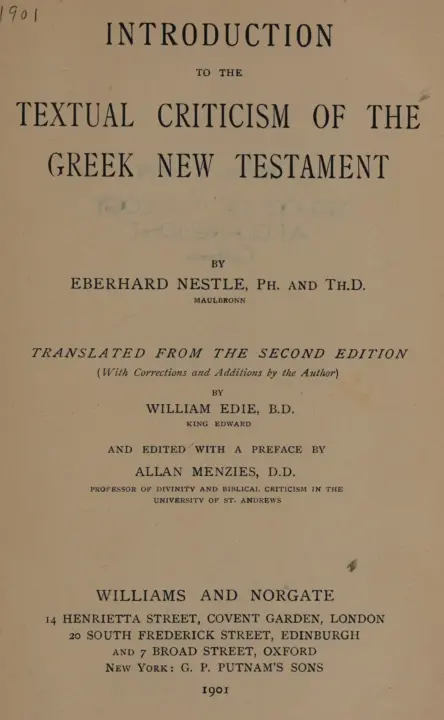
"Introduction to the textual criticism of the Greek New Testament" by Eberhard Nestle is a scholarly handbook written in the early 20th century. It explains how the Greek New Testament text has been transmitted and assessed, surveying the history of printed editions alongside the evidence of manuscripts, ancient versions, and patristic quotations. The work aims to equip students and general readers with clear methods and an impartial, philological approach to evaluating readings. The opening of the work presents an editor’s preface outlining Nestle’s linguistic expertise, broad contributions to biblical scholarship, and deliberate avoidance of theological bias, and notes that the English version is a corrected and expanded translation of a later German edition. A contents list and addenda signal the scope: the history of the printed text, the materials used for criticism, and the theory and practice of evaluating variants. Chapter I then sketches the development from the first printed Greek New Testament and the great Polyglots, through Erasmus, the verse-division of Robert Estienne, Beza, and the Elzevir “Textus Receptus,” to the major critical milestones of Mill, Bengel, Wettstein, Griesbach, Lachmann, Tischendorf, Tregelles, and Westcott and Hort, with notices of later editors and practical editions (including comparative and Catholic efforts). At the start of Chapter II, Nestle lays out the evidential base—no autographs survive, so scholars rely on Greek manuscripts, early translations, and patristic citations—and introduces the scale of the evidence and the basic distinction between uncial and cursive manuscripts.
Introduction adapted from the source catalogue; source summaries may be automatically generated.
Free to read · English · 118,829 words · No account needed
MAKE TIME FOR A GOOD BOOK
On by default. Untick to stop anonymous reading totals. Each page counts after 10 seconds in view. How this works.
Anonymous counting is on unless you have switched it off.
3. The Editio Princeps of the Lewis text is, of course, that of Bensly, Harris, and Burkitt, The Four Gospels in Syriac, transcribed from the Sinaitic Palimpsest ... Cambridge, 1894. To this must be added its complement by Mrs. Lewis, Some Pages of the Four Gospels retranscribed (with or without an English translation), London, 1896; further, Last Gleanings from the Sinai Palimpsest, Expositor, Aug. 1897, pp. 111-119; also, An Omission from the Text of the Sinai Palimpsest, Expositor, Dec. 1897, p. 472. On the discovery of the manuscript, see Mrs. Gibson, How the Codex was found, ... Cambridge, 1893, and Mrs. Lewis, In the shadow of Sinai, ... Cambridge, 1898; also Mrs. Bensly, Our Journey to Sinai, ... With a chapter on the Sinai Palimpsest. London, 1896. See also Mrs. Lewis, The Earlier Home of the Sinaitic Palimpsest, Expositor, June 1900, pp. 415-421. The text has been translated into German by Adalbert Merx, who has added a brief but valuable critical discussion. Berlin (Reimer), 1897. The second part, comprising the commentary, has not yet appeared. See also Gwilliam’s notice of the editio princeps in the Expository Times, Jan. 1895, p. 157 ff.
4. On Tatian, the latest and best is Zahn, Evangelienharmonie, PRE^3, v. (1898), 653 ff.; also his Forschungen, i. (1881), Tatian’s Diatessaron, ii. p. 286 ff. (1883), iv. (1891); Gesch. des Kanons, i. 387-414, ii. 530-556. J. H. Hill, The earliest Life of Christ ever compiled from the Four Gospels, being the Diatessaron of Tatian (c. A.D. 160), literally translated from the Arabic Version. Edinburgh, 1893. J. R. Harris, The Diatessaron of Tatian, a Preliminary Study. Cambridge, 1890. The Diatessaron, a Reply, in the Contemporary Review, Aug. 1895, in answer to W. R. Cassels, in the Nineteenth Century, April 1895; also by the same writer, Fragments of the Commentary of Ephrem Syrus upon the Diatessaron. London, 1895.... J. H. Hill, A Dissertation on the Gospel Commentary of S. Ephrem the Syrian ... Edinburgh, 1896. J. A. Robinson, Tatian’s Diatessaron and a Dutch Harmony, in the Academy, 24th March 1894. Hope W. Hogg, The Diatessaron of Tatian, with introduction and translation, in the Ante-Nicene Library. Additional Volume ... edited by Allan Menzies. Edinburgh, 1897, pp. 33-138. W. Elliott, Tatian’s Diatessaron and the Modern Critics. Plymouth, 1888. I. H. Hall, A Pair of Citations from the Diatessaron, in the Journal of Biblical Literature, x. 2 (1891), 153-155. J. Goussen, Pauca Fragmenta genuina Diatessaroniana, appended to the Apocalypsis S. Joannis Versio Sahidica, 1895. See also Bäumer in the Literarischer Handweiser, 1890, 153-169; the article Tatian in the Encyclopædia Britannica, and Hastings’ Bible Dictionary, vol. ii. p. 697 f.
Your reading position is saved on this browser. Take it to another device with a library code. Reading pages adapt to text, rather than matching a printed edition.
BEHIND THE BOOK
This eBook is for the use of anyone anywhere in the United States and most other parts of the world at no cost and with almost no restrictions whatsoever. You may copy it, give it away or re-use it under the terms of the Project Gutenberg License included with this eBook or online at www.gutenberg.org. If you are not located in the United States, you will have to check the laws of the country where you are located before using this eBook. Read the source licence.
The original source file, including credits and licence, is retained by this library. Request an original-format copy at no charge. Please include the book title and Project Gutenberg identifier #76224.
KEEP YOUR CURIOSITY GOING
David Patterson (Spirit) Hatch

David Patterson (Spirit) Hatch

David Patterson (Spirit) Hatch
Cécile Tormay

Moritz Busch
John L. Ransom