
Last letters from the living dead man
David Patterson (Spirit) Hatch
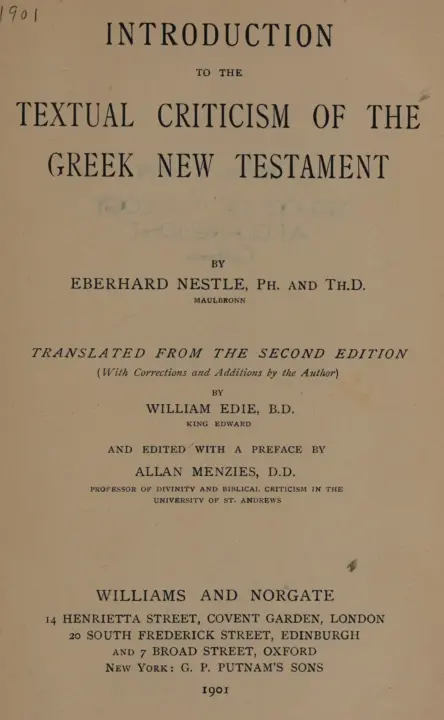
THE CLASSIC COLLECTION · 1901
"Introduction to the textual criticism of the Greek New Testament" by Eberhard Nestle is a scholarly handbook written in the early 20th century. It explains how the Greek New Testament text has been transmitted and assessed, surveying the history of printed editions alongside the evidence of manuscripts, ancient versions, and patristic quotations. The work aims to equip students and general readers with clear methods and an impartial, philological approach to evaluating readings. The opening of the work presents an editor’s preface outlining Nestle’s linguistic expertise, broad contributions to biblical scholarship, and deliberate avoidance of theological bias, and notes that the English version is a corrected and expanded translation of a later German edition. A contents list and addenda signal the scope: the history of the printed text, the materials used for criticism, and the theory and practice of evaluating variants. Chapter I then sketches the development from the first printed Greek New Testament and the great Polyglots, through Erasmus, the verse-division of Robert Estienne, Beza, and the Elzevir “Textus Receptus,” to the major critical milestones of Mill, Bengel, Wettstein, Griesbach, Lachmann, Tischendorf, Tregelles, and Westcott and Hort, with notices of later editors and practical editions (including comparative and Catholic efforts). At the start of Chapter II, Nestle lays out the evidential base—no autographs survive, so scholars rely on Greek manuscripts, early translations, and patristic citations—and introduces the scale of the evidence and the basic distinction between uncial and cursive manuscripts.
Introduction adapted from the source catalogue; source summaries may be automatically generated.
Free to read · English · 118,829 words · No account needed
MAKE TIME FOR A GOOD BOOK
On by default. Untick to stop anonymous reading totals. Each page counts after 10 seconds in view. How this works.
Anonymous counting is on unless you have switched it off.
In the year 1842 a Syriac manuscript containing considerable portions of the Gospels was brought from Egypt and deposited in the British Museum. It was afterwards published by Dr. Cureton in 1858 with the title “Remains of a very antient recension of the four Gospels in Syriac hitherto unknown in Europe.” Cureton himself thought he had discovered the original of St. Matthew’s Gospel in this version. While this was easily shown to be a mistake, the question as to the relationship between the Curetonian Syriac and the Peshitto, whether the two texts are independent of each other, or if not, which is the earlier and which the recension, is not yet decided.
[Sidenote: Lewis.]
It seemed as if the solution of the problem was in sight when fragments of a Syriac palimpsest were discovered on Mount Sinai in February 1892 by Mrs. Lewis and her sister, Mrs. Gibson. These they perceived to be part of a very old manuscript of the Gospels, and Professor Bensly of Cambridge recognised that their text was closely related to that of the Curetonian. (See Plate V.) A second expedition was made to Sinai in the spring of 1893, when the fragments were transcribed by Professor Bensly, F. C. Burkitt, and J. R. Harris. As Bensly died three days after their return, the manuscript was published by the others in 1894, with an introduction by Mrs. Lewis. On a third visit to Sinai this lady completed the work of the triumvirate, and also published an English translation of the whole. How, then, is this Sinai-Syriac or Lewis-Syriac, as it is called, related to the Curetonian and to the Peshitto? The problem becomes more complicated still by the introduction of a fourth factor, the most important of them all.
[Sidenote: Tatian.]
From early sources it was known that Tatian,[82] a Syrian and a pupil of Justin Martyr, composed a harmony of the Gospels called the =Diatessaron=—i.e. τὸ διὰ τεσσάρων εὐαγγέλιον, an expression which may be taken either as referring to the four Gospels or as a musical term equivalent to harmony or chord. This Harmony was in use among the Syrians till the fifth century. Theodoret, Bishop of Cyrus, informs us that he destroyed 200 copies of it in his semi-Syriac, semi-Greek diocese.[83] About the same time Bishop Rabbulas of Edessa (407-435) instructed his presbyters and deacons to see that all the churches possessed and read a copy of the Distinct Gospel—i.e. not mixed or harmonised. The Lewis-Syriac bears this very title, Gospel of the Distinct or Divided, which is found also as the title of Matthew’s Gospel in the Curetonian version. Tatian’s Harmony has not yet been discovered in Syriac, but a Latin Harmony of the Gospels derived from it has long been known, and in 1883 a Harmony in Arabic was published by Ciasca which proves to be a translation from the Syriac made by Ibn et-Tabib (d. 1043) or a recension of it. Again, in 1836 the Armenian version of a Syriac Commentary by Ephraem of Edessa (d. 373) was printed, and translated into Latin in 1876. [Evangelii concordantis expositio facta a S. Ephraemo doctore Syro. In Latinum translata a J. B. Aucher, ed. G. Moesinger. Venetiis.] Finally Theodor Zahn discovered in the works of the Syriac writer Aphraates, who wrote between 337 and 345, quotations which must be derived from this Harmony of Tatian; and isolated quotations from Tatian are also found in later Syriac authors. And so the materials are provided for deciding the question whether or not Tatian made use of an earlier Syriac version in the preparation of his Harmony, and how T^{(atian)}, Syr^{cu(reton)}, Syr^{sin} and Syr^{sch(aaf)}[84] are related to each other. The most probable view perhaps is that T is the earliest form in which the Gospel came to Syria, that in Syr^{cu} and Syr^{sin} we have two attempts to exhibit T in the form of a version of the separate Gospels which were not generally accepted, while Syr^{sch} actually succeeded and passed into general use.
Your reading position is saved on this browser. Take it to another device with a library code. Reading pages adapt to text, rather than matching a printed edition.
BEHIND THE BOOK
This eBook is for the use of anyone anywhere in the United States and most other parts of the world at no cost and with almost no restrictions whatsoever. You may copy it, give it away or re-use it under the terms of the Project Gutenberg License included with this eBook or online at www.gutenberg.org. If you are not located in the United States, you will have to check the laws of the country where you are located before using this eBook. Read the source licence.
The original source file, including credits and licence, is retained by this library. Request an original-format copy at no charge. Please include the book title and Project Gutenberg identifier #76224.
KEEP YOUR CURIOSITY GOING
David Patterson (Spirit) Hatch

David Patterson (Spirit) Hatch

David Patterson (Spirit) Hatch
Cécile Tormay

Moritz Busch
John L. Ransom