
Last letters from the living dead man
David Patterson (Spirit) Hatch
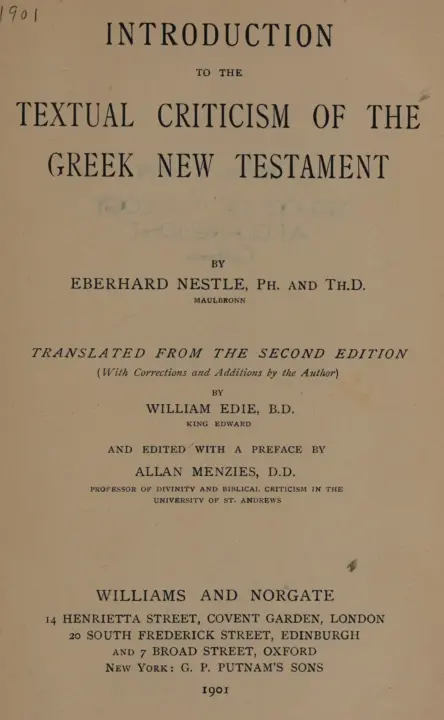
THE CLASSIC COLLECTION · 1901
"Introduction to the textual criticism of the Greek New Testament" by Eberhard Nestle is a scholarly handbook written in the early 20th century. It explains how the Greek New Testament text has been transmitted and assessed, surveying the history of printed editions alongside the evidence of manuscripts, ancient versions, and patristic quotations. The work aims to equip students and general readers with clear methods and an impartial, philological approach to evaluating readings. The opening of the work presents an editor’s preface outlining Nestle’s linguistic expertise, broad contributions to biblical scholarship, and deliberate avoidance of theological bias, and notes that the English version is a corrected and expanded translation of a later German edition. A contents list and addenda signal the scope: the history of the printed text, the materials used for criticism, and the theory and practice of evaluating variants. Chapter I then sketches the development from the first printed Greek New Testament and the great Polyglots, through Erasmus, the verse-division of Robert Estienne, Beza, and the Elzevir “Textus Receptus,” to the major critical milestones of Mill, Bengel, Wettstein, Griesbach, Lachmann, Tischendorf, Tregelles, and Westcott and Hort, with notices of later editors and practical editions (including comparative and Catholic efforts). At the start of Chapter II, Nestle lays out the evidential base—no autographs survive, so scholars rely on Greek manuscripts, early translations, and patristic citations—and introduces the scale of the evidence and the basic distinction between uncial and cursive manuscripts.
Introduction adapted from the source catalogue; source summaries may be automatically generated.
Free to read · English · 118,829 words · No account needed
MAKE TIME FOR A GOOD BOOK
On by default. Untick to stop anonymous reading totals. Each page counts after 10 seconds in view. How this works.
Anonymous counting is on unless you have switched it off.
On 13, see W. H. Ferrar, Collation of four important Manuscripts of the Gospels, edited by T. K. Abbott, Dublin, 1877. J. P. P. Martin, Quatre manuscrits du N. T., auxquels on peut ajouter un cinquième, Amiens, 1886. J. R. Harris, On the Origin of the Ferrar Group, London, 1894. K. Lake, “Some new members of the Ferrar Group of MSS. of the Gospels,” in the Journal of Theological Studies, I. i. pp. 117-120. The well-known manuscript of the pre-Lutheran German Bible, the Codex Teplensis, has the words from John viii. 2, “in the morning he came again into the temple,” after Luke xxi. 38, an arrangement similar to that which is characteristic of the Ferrar Group, in which John vii. 53-viii. 11 is found after Luke xxi. 38. See S. Berger, Bull. Crit., 1894, p. 390. See Addenda, p. xv.
On 561, Codex Algerinae Peckover, see J. R. Harris in the Journal of the Exegetical Society, 1886, 79-96.
On 892^{evv}, see Harris, “An Important Manuscript of the N. T.” in the Journal of Biblical Literature, ix., 1890, 31 ff.
On Minuscules of the Apocalypse, see Bousset, Textkritische
Studien in T. und U., xi. 4.
C. R. Gregory, “Die Kleinhandschriften des N. Testaments” (Theologische Studien für B. Weiss., Göttingen, 1897, 274-283).
E. J. Goodspeed, “A Twelfth Century Gospel Manuscript” (Biblical
World, x. 4).
(c.) LECTIONARIES.
[Sidenote: Lectionaries.]
Till quite recently the Lectionaries, or Books of Church Pericopae, were even more neglected than the minuscules. And yet they are reliable witnesses to the text of the Bible in the provinces to which they belong, on account of their official character and because their locality can be readily distinguished. The slight alterations of the text occurring at the beginning of the pericopae, and consisting usually in the insertion of the subject of the sentence or of an introductory clause, are easily recognisable as such, and deceive no one. It is not always easy to determine the date of such books, because the uncial hand was employed in this sort of manuscript much longer than in the others. Among the oldest, perhaps, is 135, a palimpsest (of which there is a considerable number among the Lectionaries), assigned by Tischendorf to the seventh century, and 968, written on papyrus and ascribed to the sixth century, which was found in Egypt in the year 1890. When these Lectionaries originated has not yet been clearly made out.[78] Up till the present 980 Evangeliaria—i.e. Lessons from the Gospels—have been catalogued, and 268 Apostoli or Praxapostoli—i.e. Lessons from the Acts and Epistles. Some of them are magnificently executed; some, alas, have been sadly mutilated. 117, in Florence, is a very beautiful codex; and 162, in Siena, is perhaps “one of the most splendid Service-books in the world.” 235 may have been written in part by the Emperor Alexius Comnenus (1081-1118). 286 is the Golden Evangeliarium on Mount Sinai, dating from the ninth to the eleventh century, though the tradition of the monks says that it was written by no less a personage than the Emperor Theodosius (d. 395). Tischendorf’s 352-360 are now in the National Library at Paris. 355 is printed in Omont’s Catalogue (see above, p. 71). 45^{evl} is a fragment of black parchment inscribed with gold letters preserved at Vienna.[79] 40 is kept in the Escorial along with the reliques of St. Chrysostom, and regarded as his autograph.[80] Bilingual Lectionaries are also found, in Greek and Arabic for example. The arrangement of these Service-books varies with the time and region in which they were composed. Several fragments which were formerly regarded as parts of manuscripts of the Gospels should perhaps be classed among the Evangeliaria—e.g. the solitary leaf of a Bible manuscript Württemberg is known to possess, and the Tübingen Fragment, formerly classed among the uncials as R of the Gospels, but now enumerated as 481^{evl}. An important Syriac Lectionary will fall to be considered under the head of the Versions.
Your reading position is saved on this browser. Take it to another device with a library code. Reading pages adapt to text, rather than matching a printed edition.
BEHIND THE BOOK
This eBook is for the use of anyone anywhere in the United States and most other parts of the world at no cost and with almost no restrictions whatsoever. You may copy it, give it away or re-use it under the terms of the Project Gutenberg License included with this eBook or online at www.gutenberg.org. If you are not located in the United States, you will have to check the laws of the country where you are located before using this eBook. Read the source licence.
The original source file, including credits and licence, is retained by this library. Request an original-format copy at no charge. Please include the book title and Project Gutenberg identifier #76224.
KEEP YOUR CURIOSITY GOING
David Patterson (Spirit) Hatch

David Patterson (Spirit) Hatch

David Patterson (Spirit) Hatch
Cécile Tormay

Moritz Busch
John L. Ransom