
Last letters from the living dead man
David Patterson (Spirit) Hatch
THE CLASSIC COLLECTION · 1901
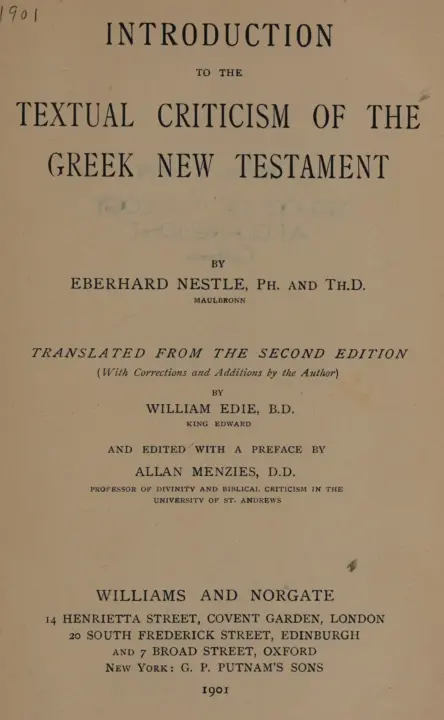
"Introduction to the textual criticism of the Greek New Testament" by Eberhard Nestle is a scholarly handbook written in the early 20th century. It explains how the Greek New Testament text has been transmitted and assessed, surveying the history of printed editions alongside the evidence of manuscripts, ancient versions, and patristic quotations. The work aims to equip students and general readers with clear methods and an impartial, philological approach to evaluating readings. The opening of the work presents an editor’s preface outlining Nestle’s linguistic expertise, broad contributions to biblical scholarship, and deliberate avoidance of theological bias, and notes that the English version is a corrected and expanded translation of a later German edition. A contents list and addenda signal the scope: the history of the printed text, the materials used for criticism, and the theory and practice of evaluating variants. Chapter I then sketches the development from the first printed Greek New Testament and the great Polyglots, through Erasmus, the verse-division of Robert Estienne, Beza, and the Elzevir “Textus Receptus,” to the major critical milestones of Mill, Bengel, Wettstein, Griesbach, Lachmann, Tischendorf, Tregelles, and Westcott and Hort, with notices of later editors and practical editions (including comparative and Catholic efforts). At the start of Chapter II, Nestle lays out the evidential base—no autographs survive, so scholars rely on Greek manuscripts, early translations, and patristic citations—and introduces the scale of the evidence and the basic distinction between uncial and cursive manuscripts.
Introduction adapted from the source catalogue; source summaries may be automatically generated.
Free to read · English · 118,829 words · No account needed
MAKE TIME FOR A GOOD BOOK
On by default. Untick to stop anonymous reading totals. Each page counts after 10 seconds in view. How this works.
Anonymous counting is on unless you have switched it off.
The N.T. makes no mention of the metal, wood, or bone stilus. By “the wild beast of the reeds” (Ps. lxviii. 31) the Rabbis understood the reed pen, which in Syriac also is commonly denoted by קנה, and they took it as referring to Rome and the Emperor, who decided the fate of nations with a single stroke of his pen.[42] Luther, moreover, was not without precedent in speaking of “governors with the pen” in Jud. v. 14, as the Syriac version renders it in the same way. In Ps. xlv. 2, the Hebrew עֵט is rendered κάλαμος (LXX), σχοῖνος (Aquila), and γραφεῖον (Symmachus). It is also rendered σχοῖνος by the translator of Jeremiah viii. 8, where Aquila has γραφεῖον. Σχοῖνος must therefore be added to the Bible names for pen. Γραφίς for γραφεῖον, mentioned alongside of ὄνυξ ἀδαμάντινος in Jer. xvii. 1, seems to belong to the Spanish-Greek of the Complutensian, but is really classic, as also its diminutive γραφίδιον. According to the Rabbis, pens were among the things God made in the evening of the last day of the creation. They were also venerated by the Egyptians and the Greeks as an invention of the Deity.[43] According to Antisthenes[44] or Democritus,[45] a young man, in order to enter the school of wisdom, requires to have a βιβλιαρίου καινου (= καὶ νοῦ) καὶ γραφείου καινου καὶ πινακιδίου καινου. In Cyprus, the stilus is called ἀλειπτήριον, and the γραμματοδιδάσκαλος in like manner διφθεράλοιφος.[46] In the recently discovered fragments of Diocletian’s List of Wares, the section περὶ πλούμου (goose, swan, and peacock feathers) is followed by that περὶ καλάμων καὶ μελανίου, and then by that περὶ ἐσθῆτος. Ink costs 12 drachmae the quart; Paphian and Alexandrian κάλαμοι[47] cost 4 drachmae; and κάλαμοι δευτ[έρας] φώρ[μης] the same. Baruch, the ἀναγνωστής, purchased ink and a pen in the market of the Gentiles, in order to write his letter to Jeremiah (ἀποστείλας εἰς τὴν ἀγορὰν [v. l. διασπορᾶς] τῶν ἐθνῶν ἤνεγκε χάρτην καὶ μέλανα [v. l. μελαν]).[48] Demosthenes was not the only possessor of a silver stilus. Boniface, e.g., had one of that sort sent him from England.
[Sidenote: Reading and writing.]
The following is a list of expressions relating to reading and writing taken from the Greek Versions of the O.T. It makes no claim to be complete. The passages will be found in Hatch and Redpath’s Concordance to the Septuagint.
ἀκριβόω, ἀναγιγνώσκω, ἀνάγνωσις, ἀναγνωστής, ἀντίγραφον, ἀποκαλύπτειν; βιβλιαφόρος (βιβλιο-), βίβλινος, βιβλιογράφος (Est. iii. 13, Complut.), βιβλιοθήκη, βιβλίον (βυ-), βιβλιοφυλάκιον, βίβλος (βυ-); γαζά, γράμμα, γραμματεία, γραμματεύειν, γραμματεύς, γραμματικός, γραμματοεισαγωγεύς, γραπτόν, γράφειν (ἀνα-, ἀπο-, ἐπι-, κατα-, συν-), γραφεῖον (σιδηροῦν), γραφεὺς (ταχινός), γραφή (ἀνα-, ἀπο-, συν-), γραφικός, γραφίς; διφθέρωμα, διώκειν; εἴλημα, εἰς- or ἐγχαράττειν, ἐπιστολή, ἑρμηνεύω, ἐπιστάμενος γράμματα; θησαυροφύλαξ; κάλαμος (καλαμάριον, vide Field’s Hexapla on Ezek. ix. 2) κάστυ, κεφαλίς; μαχθάμ, μέλαν, μελανοδοχεῖον, μίλτος, μνημόσυνον, μολίβος, μολίβδινος; ξυρός; ὄνυξ ἀδαμάντινος, ὀξυγράφος; πινακίς, πινακίδιον, πτύξ, πτυχή, πυξίον; σελίς, σμίλη, στηλογραφία, σφραγίζειν, σφραγίς, σχοῖνος; τόμος (χαρτοῦ καινοῦ μεγάλου, Isa. viii. 1; also 1 Esdras vi. 23 for τόπος), τεῦχος, τύπος; χάρτης, χαρτίον, χαρτηρία.
Diastole and hyphen.
Your reading position is saved on this browser. Take it to another device with a library code. Reading pages adapt to text, rather than matching a printed edition.
BEHIND THE BOOK
This eBook is for the use of anyone anywhere in the United States and most other parts of the world at no cost and with almost no restrictions whatsoever. You may copy it, give it away or re-use it under the terms of the Project Gutenberg License included with this eBook or online at www.gutenberg.org. If you are not located in the United States, you will have to check the laws of the country where you are located before using this eBook. Read the source licence.
The original source file, including credits and licence, is retained by this library. Request an original-format copy at no charge. Please include the book title and Project Gutenberg identifier #76224.
KEEP YOUR CURIOSITY GOING
David Patterson (Spirit) Hatch

David Patterson (Spirit) Hatch

David Patterson (Spirit) Hatch
Cécile Tormay

Moritz Busch
John L. Ransom