
Last letters from the living dead man
David Patterson (Spirit) Hatch
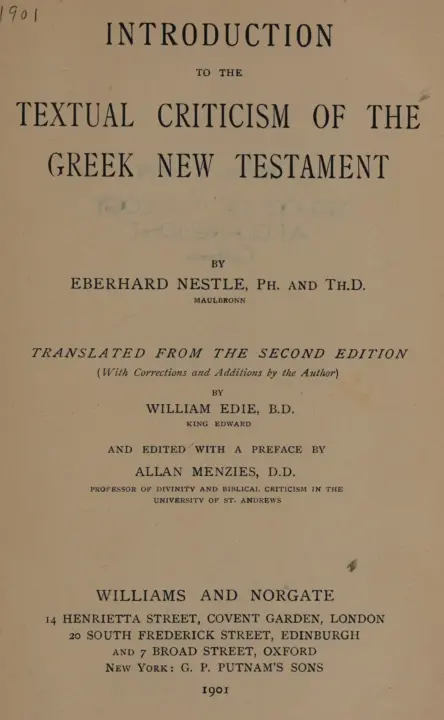
THE CLASSIC COLLECTION · 1901
"Introduction to the textual criticism of the Greek New Testament" by Eberhard Nestle is a scholarly handbook written in the early 20th century. It explains how the Greek New Testament text has been transmitted and assessed, surveying the history of printed editions alongside the evidence of manuscripts, ancient versions, and patristic quotations. The work aims to equip students and general readers with clear methods and an impartial, philological approach to evaluating readings. The opening of the work presents an editor’s preface outlining Nestle’s linguistic expertise, broad contributions to biblical scholarship, and deliberate avoidance of theological bias, and notes that the English version is a corrected and expanded translation of a later German edition. A contents list and addenda signal the scope: the history of the printed text, the materials used for criticism, and the theory and practice of evaluating variants. Chapter I then sketches the development from the first printed Greek New Testament and the great Polyglots, through Erasmus, the verse-division of Robert Estienne, Beza, and the Elzevir “Textus Receptus,” to the major critical milestones of Mill, Bengel, Wettstein, Griesbach, Lachmann, Tischendorf, Tregelles, and Westcott and Hort, with notices of later editors and practical editions (including comparative and Catholic efforts). At the start of Chapter II, Nestle lays out the evidential base—no autographs survive, so scholars rely on Greek manuscripts, early translations, and patristic citations—and introduces the scale of the evidence and the basic distinction between uncial and cursive manuscripts.
Introduction adapted from the source catalogue; source summaries may be automatically generated.
Free to read · English · 118,829 words · No account needed
MAKE TIME FOR A GOOD BOOK
On by default. Untick to stop anonymous reading totals. Each page counts after 10 seconds in view. How this works.
Anonymous counting is on unless you have switched it off.
Materials for writing, 40 ff.
Matthaei, 19.
Ματθαῖος, spelling of the name, 247.
Mazarin Bible, 126.
Melanchthon, 86, 140, 159.
Μεμβράναι, 36, 41.
Memphitic dialect, 133.
Mercator, 138.
Merx, 105, 106.
Mesrob, 141.
Michaelis, 104.
Middle Egyptian versions, 133, 135.
Mill, 15.
Miller, 6, 152, 159.
Mingarelli, 135.
Minuscules, 34, 82, 83 ff.
Moldenhauer, 19.
Montfortianus, 4, 86.
Morillon, 138.
Morin, 11.
Morrish, 170.
Müller, 139.
Münter, 135.
ν abbreviated at the end of a word, 315, 330.
Name of Dives, 342.
Names, importance of proper, 241.
of the two thieves, 266.
of prophets confused, 251, 258.
Negative liable to be omitted, see οὐ.
Nestle, 3, 17, 23, 26, 48, 65, 132.
Noetus, 203.
Northumbrian manuscripts, 125, 176.
Novatian, 155.
Number of words in the N.T., 48.
of manuscripts. See Manuscripts.
of Greek editions printed, 5.
of letters in the N.T., 48.
Obelus, 101, 186.
Oikonomos, 49 n., 189.
Old Latin version and manuscripts, 110 ff.
Order of the Gospels, 161 f.
of the Catholic Epistles, 321.
of the Pauline Epistles, 300 f.
Order of words, variation in the, 237.
Origen, 147, 149 ff., 185 ff.
Orthodox correctors, 192.
Osgan, 141.
οὐ, omission and insertion of, 310 ff.
Oxyrhynchus papyri, 74, 80.
Palæography, 32 f., 81 f., 181, 184.
Palestinian Syriac, 102.
Palimpsest, 37, 51, 63.
Pamphilus, 57, 78, 185 ff.
πανδέκτης, 39, 53.
Paper, 36, 44.
Papyrus, 36, 42.
Parchment, 36, 40.
Paris Polyglot, 11.
Correctoria, 126.
Patricius, 25.
Paul’s “Books,” 45.
Paul of Tella, 102.
Pens, 45.
Pericopæ, 39, 91, 239, 267, 277.
Pericope adulteræ, 68, 84, 112, 142, 177, 282 ff.
Peshitto version, 95, 103 f.
Philoxenian Syriac, 100.
Pickering, 7.
Pierius, 187.
Pius V., Pope, 127.
Plantin, 10 f.
Pococke, 100.
Polycarp the Chorepiscopus, 100.
Polyglots, 1, 10 ff.
Pott, his view of Acts, 294.
Praetorius, 140.
Praxapostolos, 40, 92.
Preuschen, 161, n. 1.
Printing of the N.T., earliest, 1, 3.
Primasius, 119, 148.
Priscillian, 119.
προ and προς, 237 n.
Prologues in Latin Gospels, 115 f.
Proper names, see Names.
Provençal New Testament, 117.
Psalters, 3, 68.
Pseudepigrapha, 26.
Punctuation in manuscripts, 38, 52.
importance of, 52, 201, 204, 261, 276, 297.
Quaternio, 41.
Quotations, 32, 144 ff.
Quotation, marks of, 38.
Rabbulas of Edessa, 98, 104.
Rahlfs, 35 n., 62, 183 ff.
Ranke, 113, 129.
Ravianus, 86.
Reading and writing, Greek terms for, 46.
Reed pen, 45.
Rehdiger, 114.
Reithmayer, 25.
Resch, 26, 280.
Resultant Greek Testament, 22.
Reuss, 6, 11, 159.
Richelieu, 11.
Ridley, 100.
Riegler, 130.
Rieu, 141.
Riggenbach, 190.
Robinson, 79, 106.
Rocchi, 60.
Roll, 36, 41, 43.
Rönsch, 118, 123, 131, 146.
Rooses, 11.
Rossini, 140.
Rüegg, 231. Addenda.
Rules of textual criticism, 234 ff.
Saalfeld, 131.
Sabatier, 111, 131.
Sachau, 282.
Sahak, 141,
Sahidic version, 134.
Salmon, 160, 170, 227.
Saubert, 14.
Schaaf, 104.
Schaff, 6.
Schjøtt, 24, 165.
Schmidt, 137.
Schmiedel, 56 n., 117.
Scholz, 19.
Schultze, 41 n., 51.
Schulz, 65.
Schwartze, 134.
Scriptio continua, 37, 47, 315, 330.
Script, various kinds of, 34 f., 81 ff.
Scrivener, 6, 8, 33, 58, 65, 77, 83.
Sections, 56, 61 n.
Seidel, 66.
Semler, 18.
Sergio, 60.
Simon of Cyrene, 203.
Simon Magus, 205, 324 n.
Simon, Richard, 15, 95.
Sinai Syriac, 97, 105.
Sionita, 11.
Sitterly, 33.
Sixtus V., Pope, 127.
Skeat, 140.
Speculum Augustini, 114.
Steindorff, 134.
Stephen, Henry, 7.
Robert, 7, 126.
Stichometry, 37, 48, 49.
Stilus, 45.
Strein, 138.
Stunica, 1.
Stuttgart New Testament, 23.
Subjective criticism, 157.
Subscriptions, 57, 69, 72, 78, 122, 188, 189, 260, etc.
Sulke, see Euthalius.
Swete, 26.
Syllables, division of, 48.
Synodos, 140.
Synonyms, interchange of, 236.
Syriac versions, 95 ff.
Syro-Latin, 216, 218, 223.
σωμάτιον, 41, 54 f.
Tatian, 97, 105, 212 ff.
his Diatessaron, 98, 105, 212 ff.
Tattam, 134.
ταχυγράφοι, 50.
Taylor, Isaac, 172 n.
Tertullian, 29, 119, 146, 147, 276.
τεῦχος, 53.
Textual criticism, literature of, 6, 159.
Textus brevior, 245.
Textus receptus, 13.
Thaddaeus, 96.
Thebaic dialect, 133.
Theile, 19.
Theodore of Tarsus, 75.
Theodoret, 98, 213.
Theodotus, 200 f.
Theodulf, 125.
Thomas of Heraclea, 100.
Thompson, E. M., 33, 59.
Timothy and Aquila, Dialogue of, 99 n.
Tischendorf, 19, 26, 53, 58, 63.
Title of the Gospels, 164, 247.
Tittmann, 19.
Toinard, 15.
Trabaud, 65.
Transcriptional errors, 234 ff.
Transposition of letters and words, 236 f.
Traube, 173.
Tregelles, 6, 20, 83, 141, 159.
Tremellius, 10.
Trent, Council of, 127.
Tuki, 135, 137.
Ubaldi, 60.
Ulfilas, 137.
Uncial script, 34, 81 f.
Uncial manuscripts, 53 ff.
number of, 81.
Valder, 7.
Valentinians, 198, 203.
Valla, Laurentius, 126.
Vercellone, 60 ff., 123.
Verse division, 8.
Versions:
Syriac, 95.
Latin, 107.
Egyptian, 132.
Gothic, 137.
Ethiopic, 140.
Armenian, 141.
Georgian, 142.
Arabic, 142.
other, 143.
Victor of Capua, 122, 308.
Vincent, 160.
Vogt, 139.
Vollert, 34 n., 35.
Voss, 138.
Vulgate, 25, 109, 122 ff., 127, 132.
Walton, 12.
Your reading position is saved on this browser. Take it to another device with a library code. Reading pages adapt to text, rather than matching a printed edition.
BEHIND THE BOOK
This eBook is for the use of anyone anywhere in the United States and most other parts of the world at no cost and with almost no restrictions whatsoever. You may copy it, give it away or re-use it under the terms of the Project Gutenberg License included with this eBook or online at www.gutenberg.org. If you are not located in the United States, you will have to check the laws of the country where you are located before using this eBook. Read the source licence.
The original source file, including credits and licence, is retained by this library. Request an original-format copy at no charge. Please include the book title and Project Gutenberg identifier #76224.
KEEP YOUR CURIOSITY GOING
David Patterson (Spirit) Hatch

David Patterson (Spirit) Hatch

David Patterson (Spirit) Hatch
Cécile Tormay

Moritz Busch
John L. Ransom