
Last letters from the living dead man
David Patterson (Spirit) Hatch
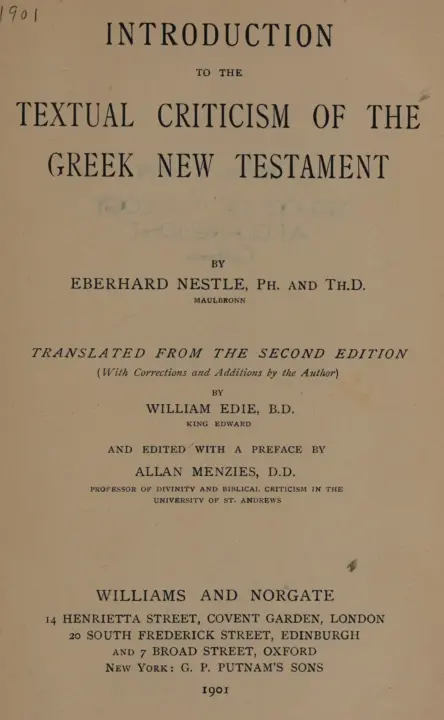
THE CLASSIC COLLECTION · 1901
"Introduction to the textual criticism of the Greek New Testament" by Eberhard Nestle is a scholarly handbook written in the early 20th century. It explains how the Greek New Testament text has been transmitted and assessed, surveying the history of printed editions alongside the evidence of manuscripts, ancient versions, and patristic quotations. The work aims to equip students and general readers with clear methods and an impartial, philological approach to evaluating readings. The opening of the work presents an editor’s preface outlining Nestle’s linguistic expertise, broad contributions to biblical scholarship, and deliberate avoidance of theological bias, and notes that the English version is a corrected and expanded translation of a later German edition. A contents list and addenda signal the scope: the history of the printed text, the materials used for criticism, and the theory and practice of evaluating variants. Chapter I then sketches the development from the first printed Greek New Testament and the great Polyglots, through Erasmus, the verse-division of Robert Estienne, Beza, and the Elzevir “Textus Receptus,” to the major critical milestones of Mill, Bengel, Wettstein, Griesbach, Lachmann, Tischendorf, Tregelles, and Westcott and Hort, with notices of later editors and practical editions (including comparative and Catholic efforts). At the start of Chapter II, Nestle lays out the evidential base—no autographs survive, so scholars rely on Greek manuscripts, early translations, and patristic citations—and introduces the scale of the evidence and the basic distinction between uncial and cursive manuscripts.
Introduction adapted from the source catalogue; source summaries may be automatically generated.
Free to read · English · 118,829 words · No account needed
MAKE TIME FOR A GOOD BOOK
On by default. Untick to stop anonymous reading totals. Each page counts after 10 seconds in view. How this works.
Anonymous counting is on unless you have switched it off.
Epiphanius, Matt. i. 8, ii. 11 (τὰς πήρας ἑαυτῶν, ἢ τοὺς θησαυρούς, ὡς ἔχει ἔνια τῶν ἀντιγράφων, i. 430, 1085). See Westcott and Hort, “Notes,” in loco; Matt. viii. 28; Luke viii. 26, xix. 41, (xxii. 43 f.); John i. 28; Ephes. i. 1.
Eusebius, Matt. xiii. 35, xxvii. 9; Mark i. 2, xvi. 3, 9 ff.; John
xix. 14.
Euthalius, Jude 25.
Euthymius, (Mark xvi. 9); John vii. 53.
Gregory of Nyssa (Pseudo-), Mark xvi. 2, 9.
Hermophilus, Eusebius, Eccles. Hist., v. 28.
Hesychius, Mark xvi. 2, 9.
Hieronymus (Jerome), Matt. xiii. 35, xxi. 31, xxiv. 17; Mark iii. 17, xvi. 9; Luke ii. 33, (xviii. 30), xxii. 43 f.; John vii. 53; Acts xv. 29; 1 Cor. ix. 5; Gal. ii. 5, iii. 1; Ephes. iii. 14; 1 Tim. v. 19; Heb. ii. 10.
Irenæus, Apoc. xiii. 18 (see above, in loco).
Isidore, Heb. ix. 17.
Macedonius (see Draeseke, ThStKr., 1890, 12), Rom. viii. 11.
Marcion, see Epiphanius, Ephes. i. 1.
Maximinus, 1 Cor. xv. 47.
Œcumenius, Acts xiv. 26.
Origen, Matt. ii. 18, viii. 28, xvi. 20, xviii. 1, (xix. 19), (xxi. 15), (xxvii. 9), xxvii. 16 ff. (see above, in loco); Mark ii. 14; Luke i. 46; John i. 28; Rom. iv. 3, xvi. 23 (see Zahn, Einleitung, i. 276, 285); Col. ii. 15.
Pierius, see Hieronymus.
Severus, Mark xvi. 9.
Socrates, 1 John iv. 3.
Theodoret, Rom. xvi. 3.
Theodore of Mopsuestia, Heb. ii. 10.
Theodotus, Eusebius, Eccles. Hist., v. 28.
Theophylact, 2 Thess. iii. 14; Heb. ii. 10, x. 1.
Victor, Mark xvi. 9.
Mention is made of ἀντίγραφα in anonymous scholia on Matt. ii. 18, xx. 28, (xxii. 12); Mark xi. 13; Luke xvi. 19 (giving the name of the Rich Man as Ninive, i.e., Phinees; see Rendel Harris in the Expositor, March 1900); Luke xxii. 43 f., xxiv. 13; John i. 29, vii. 53, xxi. 25; Rom. viii. 24.
INDEX I.
Subjects
Abbot, E., 9, 58.
Abbreviation, 48, 315, 317, 330.
Accentuation, 47, 61.
Achmim, dialect of, 133, 135.
Acts, text of, 224, 294.
Adamantius, 187.
Additions, 238.
Adler, 19, 103.
African Latin, 110, 119.
Aggaeus, 96.
Alcuin, 125, 176.
Aldus, 2.
Ambrose, 109, 205.
Ambrosiaster, 148, 205.
Amélineau, 70, 135, 137.
Amelli, 113.
Ammonian sections, 56.
Andreas, 191, 329.
Anselm, 7.
Antilegomena, 12, 95, 321.
Anthony, 135.
Antwerp Polyglot, 10.
Aphraates, 98, 216, 254, 293, 321.
Apocrypha, 26, 137.
Apollonides, 200 f.
Apollos, 242.
Apostolicum of Marcion, 207.
Arabic version, 142.
Aramaic, 93.
Arethas, 191, 329.
Arians, 205.
Arias Montanus, 10.
Aristion, 142, 295.
Armenian version, 141.
Artemonites, 200.
Article, importance of the, 258, 287, 288, 295, 328.
Asclepiades, 200 f.
Asterisks, 101, 186.
Athanasius, 62, 181, 183.
Dialogue of A. and Zacchaeus, 99 n.
Athos manuscripts, 90, 152, 190.
Augustine, 108, 120, 147.
Autographs, 29 f., 97.
Balg, 139.
Baljon, 24, 168.
Barabbas, prenomen of, 103, 244, 259.
Barnabas, 30, 54 f.
Barnard, 154 n.
Basil the Great, 277, 340.
Basilides, 203.
Bashmuric dialect, 133.
Bäthgen, 105.
Batiffol, 73, 75, 139.
Bebb, 95.
Bede, 75, 221.
Bellarmin, 127.
Belsheim, 112 ff.
Benedict, Rule of, 173.
Bengel, 3, 16, 30, 123, 221, 256.
Bensly, 79, 97, 102, 105.
Bentley, 16, 77, 83.
Berger, J. G., 30.
Berger, S., 111, 116 f., 123, 130.
Bernhardt, 139.
Bernoulli, 174.
Bernstein, 100.
Bertheau, 18.
Bessarion, 87.
Beurlier, 117.
Beza, 9, 64, 221.
Bibliotheca, 39, 53.
Bidez, 174.
Birch, 19.
Bianchini, 111 f., 131.
Blass, 32, 65, 163, 224, 260.
Bohairic version, 133.
Boniface, 46, 122.
Bonnet, 26.
Bonus, 105.
Boetticher, see Lagarde.
Bouriant, 135.
Bousset, 91, 158, 329.
Brandscheid, 26.
Breathings, 47.
Brightman, 66.
British and Foreign Bible Society, 4, 13.
Brugsch, 137.
Burgon, 83, 146, 159.
Burkitt, 97, 104 f., 109, 131, 139, 143, 229.
Byzantine Recension, 21, 180 ff.
Canons of Criticism, 16, 234, 239.
Eusebian, 56, 263.
Capitals, 34, 59, 261.
Cary, 160.
Caryophilus, 14.
Cassels, 106.
Cassiodorus, 50, 128, 175.
Castle, 12.
Catalogus Claromontanus, 76, 162.
Catenae, 147.
Celsus, 144, 204, 296.
Ceolfrid, 122.
Cephaleus, 7.
Ceriani, 116.
Ceugney, 135.
Chapter division, 8.
Charlemagne, 125.
Charles the Bald, 125.
Charles, R. H., 140.
Chase, 65, 216, 274.
Cheikho, 104.
Chronicon Paschale, 30.
Chrysostom, 92, 181.
Ciasca, 135.
Clay as writing material, 45.
Clement of Rome, 59, 110, 153.
of Alexandria, 147, 153, 204.
Clementine Vulgate, 127.
Codex, 41.
Cola and Commata, 49.
Colinæus, 7.
Columns, 37.
Comma Johanneum, 4, 26, 30, 86, 327.
Complutensian Polyglot, 1.
Conflate readings, 245.
Confusion of vowels and consonants, 168 ff., 236, 262.
Conjectural emendation, 167.
Constans, 181, 183.
Constantine, 54, 205.
Contents of manuscripts, 38, 52.
Conybeare, 79, 99, 142.
Copinger, 6.
Coptic dialect, 132.
Copying, mistakes in, 37, 170, 234 ff., 313, 330.
Corpus Scriptorum Ecclesiasticorum Latinorum, 146.
Corrections, intentional, 192, 209, 239.
Corrector (διορθωτής), 57.
Correctoria Bibliorum, 126.
Your reading position is saved on this browser. Take it to another device with a library code. Reading pages adapt to text, rather than matching a printed edition.
BEHIND THE BOOK
This eBook is for the use of anyone anywhere in the United States and most other parts of the world at no cost and with almost no restrictions whatsoever. You may copy it, give it away or re-use it under the terms of the Project Gutenberg License included with this eBook or online at www.gutenberg.org. If you are not located in the United States, you will have to check the laws of the country where you are located before using this eBook. Read the source licence.
The original source file, including credits and licence, is retained by this library. Request an original-format copy at no charge. Please include the book title and Project Gutenberg identifier #76224.
KEEP YOUR CURIOSITY GOING
David Patterson (Spirit) Hatch

David Patterson (Spirit) Hatch

David Patterson (Spirit) Hatch
Cécile Tormay

Moritz Busch
John L. Ransom