
Last letters from the living dead man
David Patterson (Spirit) Hatch
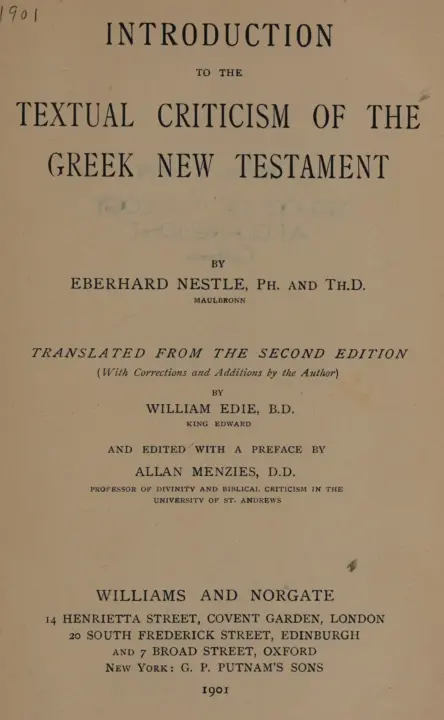
THE CLASSIC COLLECTION · 1901
"Introduction to the textual criticism of the Greek New Testament" by Eberhard Nestle is a scholarly handbook written in the early 20th century. It explains how the Greek New Testament text has been transmitted and assessed, surveying the history of printed editions alongside the evidence of manuscripts, ancient versions, and patristic quotations. The work aims to equip students and general readers with clear methods and an impartial, philological approach to evaluating readings. The opening of the work presents an editor’s preface outlining Nestle’s linguistic expertise, broad contributions to biblical scholarship, and deliberate avoidance of theological bias, and notes that the English version is a corrected and expanded translation of a later German edition. A contents list and addenda signal the scope: the history of the printed text, the materials used for criticism, and the theory and practice of evaluating variants. Chapter I then sketches the development from the first printed Greek New Testament and the great Polyglots, through Erasmus, the verse-division of Robert Estienne, Beza, and the Elzevir “Textus Receptus,” to the major critical milestones of Mill, Bengel, Wettstein, Griesbach, Lachmann, Tischendorf, Tregelles, and Westcott and Hort, with notices of later editors and practical editions (including comparative and Catholic efforts). At the start of Chapter II, Nestle lays out the evidential base—no autographs survive, so scholars rely on Greek manuscripts, early translations, and patristic citations—and introduces the scale of the evidence and the basic distinction between uncial and cursive manuscripts.
Introduction adapted from the source catalogue; source summaries may be automatically generated.
Free to read · English · 118,829 words · No account needed
MAKE TIME FOR A GOOD BOOK
On by default. Untick to stop anonymous reading totals. Each page counts after 10 seconds in view. How this works.
Anonymous counting is on unless you have switched it off.
Clement of Alexandria, fl. 194 Irenæi Interpres (according to
Tischendorf and Gregory, but
see below).
Hippolytus, fl. 220
Julius Africanus, fl. 220
Gregory Thaumaturgus, d. 265
Origen, d. 248 Cyprian, d. 258
Dionysius of Alexandria, d. Novatian, fl. 251
265
Porphyry, d. 304 Lactantius, fl. 306
Pamphilus, d. 308 Arnobius, d. 306
Methodius, d. 310 Victorinus of Pettau, d. 303
Didascalia, ?
Apostolic Constitutions
(and fourth century,
etc.).
Arius, fl. 325
Jacobus Nisibenus (Syrian), d. Juvencus, fl. 330
338
Eusebius of Cæsarea, d. 340 Irenæi Interpres (according
Aphraates (Syrian), fl. 340 to Westcott and Hort).
Eustathius, Bishop of
Antioch, fl. 350 Hilary of Poictiers, d. 368
Zeno, fl. 350 Victorinus of Rome, fl. 360
Athanasius, d. 373 Damasus, Pope, fl. 366
Ephraem (Syrian), d. 373 Lucifer, d. 371
Basil the Great, d. 379 Pacianus, fl. 370
Evagrius of Pontus, d. 380 Optatus, fl. 371
Cyril of Jerusalem, d. 386 Philastrius, fl. 380
Amphilochius, fl. 370 Gaudentius, fl. 387
Macarius Magnes, fl. 373 Rufinus, fl. 397
Gregory Nazianzen, d. 390 Ambrose, d. 397
Gregory of Nyssa, d. 394 Ambrosiaster, fl. 390
Diodorus of Tarsus, d. 394 Chromatius, fl. 390
Didymus of Alexandria, d. 394 Tyconius, fl. 390
Theophilus of Alexandria, fl. Jerome, d. 420
388
Epiphanius, d. 403 Priscillian, ca. fin.
Chrysostom, fl. 407 Auctor libri De Rebaptismate.
Isidore of Pelusium, fl. 412
Nonnus, fl. 400 Faustus, fl. 400
Theodore of Mopsuestia, d. 429 Hilary of Arles, d. 429
Victor of Antioch, d. 430 Augustine, d. 430
Cyril of Alexandria, d. 444 Prosper of Aquitania, fl. 431
Theodotus of Ancyra, fl. 431 Sedulius, fl. 431
Basil of Seleucia, fl. 440 Leo the Great, fl. 440
Socrates, fl. 440 Petrus Chrysologus, d. 455
Theodoret, Bishop of Gennadius, fl. 459
Cyrus, d. 457 Vigilius, fl. 484
Euthalius, d. 458 Auctor libri De Promissionibus.
Sozomen, fl. 440
Candidus Isaurus, fl. 500 Fulgentius, Bishop of Ruspe, d. 533
Severus of Antioch, fl. 512 Justinian, fl. 530
Theodorus Lector, fl. 525 Cæsarius of Arles, d. 543
Andreas, Bishop of Primasius, fl. 550
Cæsarea, ca. fin.
Maxentius, ? Victor, Bishop of Tunis, d. 565
Cosmas Indicopleustes, fl. 535 Cassiodorus, d. 575
Eutychius, fl. 553 Gregory the Great, d. 604
Chronicon Paschale.
Antiochus the Monk, fl. 614 Peter the Deacon, ?
Andreas of Crete, fl. 635?
Maximus Confessor, d. 662
Modestus of Jerusalem, ?
Damascenus, Johannes, fl. 730 Bede, d. 735
Nicephorus, fl. 787
Petrus Siculus, ?
Photius of Constantinople, d.
891
Arethas, ?
Symeon, ?
Œcumenius, ca. 950?
Suidas the Lexicographer, ca.
980
Theophylact, Bishop of
Bulgaria, fl. 1077
Euthymius Zigabenus, fl. 1116
Nicetas of Byzantium, d. 1206
APPENDIX II.
Ἀντίγραφα.
Your reading position is saved on this browser. Take it to another device with a library code. Reading pages adapt to text, rather than matching a printed edition.
BEHIND THE BOOK
This eBook is for the use of anyone anywhere in the United States and most other parts of the world at no cost and with almost no restrictions whatsoever. You may copy it, give it away or re-use it under the terms of the Project Gutenberg License included with this eBook or online at www.gutenberg.org. If you are not located in the United States, you will have to check the laws of the country where you are located before using this eBook. Read the source licence.
The original source file, including credits and licence, is retained by this library. Request an original-format copy at no charge. Please include the book title and Project Gutenberg identifier #76224.
KEEP YOUR CURIOSITY GOING
David Patterson (Spirit) Hatch

David Patterson (Spirit) Hatch

David Patterson (Spirit) Hatch
Cécile Tormay

Moritz Busch
John L. Ransom