
Last letters from the living dead man
David Patterson (Spirit) Hatch
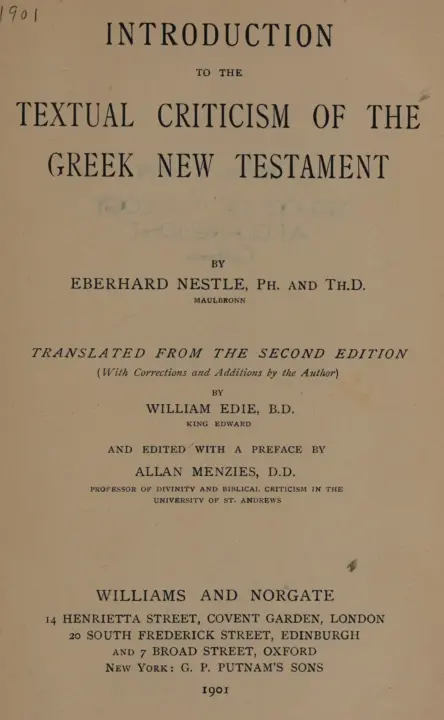
THE CLASSIC COLLECTION · 1901
"Introduction to the textual criticism of the Greek New Testament" by Eberhard Nestle is a scholarly handbook written in the early 20th century. It explains how the Greek New Testament text has been transmitted and assessed, surveying the history of printed editions alongside the evidence of manuscripts, ancient versions, and patristic quotations. The work aims to equip students and general readers with clear methods and an impartial, philological approach to evaluating readings. The opening of the work presents an editor’s preface outlining Nestle’s linguistic expertise, broad contributions to biblical scholarship, and deliberate avoidance of theological bias, and notes that the English version is a corrected and expanded translation of a later German edition. A contents list and addenda signal the scope: the history of the printed text, the materials used for criticism, and the theory and practice of evaluating variants. Chapter I then sketches the development from the first printed Greek New Testament and the great Polyglots, through Erasmus, the verse-division of Robert Estienne, Beza, and the Elzevir “Textus Receptus,” to the major critical milestones of Mill, Bengel, Wettstein, Griesbach, Lachmann, Tischendorf, Tregelles, and Westcott and Hort, with notices of later editors and practical editions (including comparative and Catholic efforts). At the start of Chapter II, Nestle lays out the evidential base—no autographs survive, so scholars rely on Greek manuscripts, early translations, and patristic citations—and introduces the scale of the evidence and the basic distinction between uncial and cursive manuscripts.
Introduction adapted from the source catalogue; source summaries may be automatically generated.
Free to read · English · 118,829 words · No account needed
MAKE TIME FOR A GOOD BOOK
On by default. Untick to stop anonymous reading totals. Each page counts after 10 seconds in view. How this works.
Anonymous counting is on unless you have switched it off.
It is not so difficult to understand how it is that the Epistle to the Hebrews, which, it is certain, was not written by Paul, varies so much with regard to its position in the collection. In the Syriac Bible, and in the majority of later Greek manuscripts, it comes after all the Pauline epistles, the reason being that the Syrian Church did not consider it to be really of the number of these. (See Westcott, Bible in the Church, p. 233 f.). In the earlier Greek manuscripts, however, it occupies the tenth place, standing between the epistles of Paul to the churches and the Pastoral Epistles. In the early Sahidic version, and in the Commentaries of Theodore of Mopsuestia, it is found between 2 Corinthians and Galatians; in the parent manuscript of Codex B it stood between Galatians and Ephesians. In his Histoire de la Vulgate, p. 539 f., Berger gives seventeen different ways in which the Pauline epistles are arranged in Latin Bibles—viz., Col., Thess., 1 Tim.; Thess., Col., 1 Tim.; Phil., Laod., Col.; Col., Laod., Thess.; Col., Thess., Laod.; Thess., Col., 1, 2 Tim., Tit., Laod.; Thess., Col., Laod.; Phil., Laod., Heb.; Heb., Laod.; Heb., 1, 2 Tim., Tit., Phil.; Apoc., Laod.; Ephes., Col.; Gal., Laod., Ephes.; Ephes., 1, 2, 3 Cor., Laod.; Phil., Thess., 1 Tim.; Apoc., 3 Cor.; Col., Phil.
Romans.
With regard to the very name and introduction of the Epistle to the Romans, it is worth observing, that while the words ἐν Ῥώμῃ are read in verses 7 and 15 by all our manuscripts, with the sole exception of G, their omission by Origen is attested by the critical work discovered by von der Goltz on Mount Athos (vide supra, pp. 90, 190), which says that Origen takes no notice of the words: οὔτε ἐν τῇ ἐξηγήσει οὔτε ἐν τῷ ῥητῷ μνημονεύει. The Latin commentary has them, and presupposes them in the exposition. Our editions of Origen have hitherto given them once in the Greek as well (iv. 287), but we must wait for the new edition before we can say with certainty that this is correct. The matter is not devoid of importance. If the omission is original, then it is possible to think that Romans, like Hebrews, was originally a circular letter; while on the other hand, if the words are an integral part of the epistle, we may suppose with von der Goltz that they were afterwards dropped when the epistle began to be read in church, so as to make it applicable to all Christians. See Jacques Simon, Revue d’Histoire et de Littérature religieuses, iv. 2 (1899), 177; Zahn, Einleitung, i. 278; ThLbl., 1899, 179.
i. 3. On the Syriac reading “of the house of David,” see Vetter, Der apokryphe dritte Korintherbrief, 1894, p. 25, and my Note in the Lectionary published in Studia Sinaitica, vi. (see above, p. 106).
Your reading position is saved on this browser. Take it to another device with a library code. Reading pages adapt to text, rather than matching a printed edition.
BEHIND THE BOOK
This eBook is for the use of anyone anywhere in the United States and most other parts of the world at no cost and with almost no restrictions whatsoever. You may copy it, give it away or re-use it under the terms of the Project Gutenberg License included with this eBook or online at www.gutenberg.org. If you are not located in the United States, you will have to check the laws of the country where you are located before using this eBook. Read the source licence.
The original source file, including credits and licence, is retained by this library. Request an original-format copy at no charge. Please include the book title and Project Gutenberg identifier #76224.
KEEP YOUR CURIOSITY GOING
David Patterson (Spirit) Hatch

David Patterson (Spirit) Hatch

David Patterson (Spirit) Hatch
Cécile Tormay

Moritz Busch
John L. Ransom