
Last letters from the living dead man
David Patterson (Spirit) Hatch
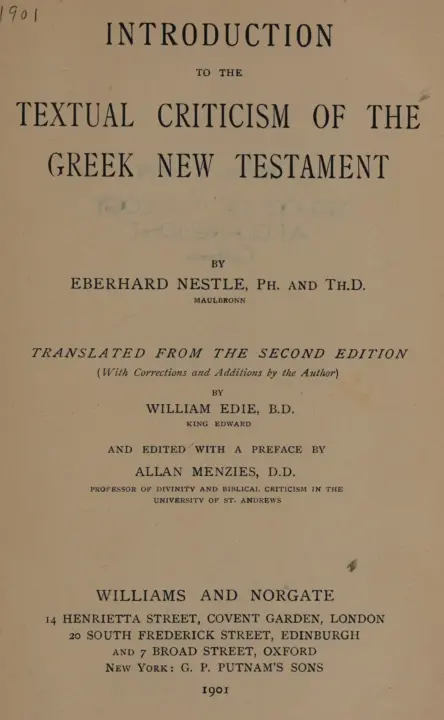
THE CLASSIC COLLECTION · 1901
"Introduction to the textual criticism of the Greek New Testament" by Eberhard Nestle is a scholarly handbook written in the early 20th century. It explains how the Greek New Testament text has been transmitted and assessed, surveying the history of printed editions alongside the evidence of manuscripts, ancient versions, and patristic quotations. The work aims to equip students and general readers with clear methods and an impartial, philological approach to evaluating readings. The opening of the work presents an editor’s preface outlining Nestle’s linguistic expertise, broad contributions to biblical scholarship, and deliberate avoidance of theological bias, and notes that the English version is a corrected and expanded translation of a later German edition. A contents list and addenda signal the scope: the history of the printed text, the materials used for criticism, and the theory and practice of evaluating variants. Chapter I then sketches the development from the first printed Greek New Testament and the great Polyglots, through Erasmus, the verse-division of Robert Estienne, Beza, and the Elzevir “Textus Receptus,” to the major critical milestones of Mill, Bengel, Wettstein, Griesbach, Lachmann, Tischendorf, Tregelles, and Westcott and Hort, with notices of later editors and practical editions (including comparative and Catholic efforts). At the start of Chapter II, Nestle lays out the evidential base—no autographs survive, so scholars rely on Greek manuscripts, early translations, and patristic citations—and introduces the scale of the evidence and the basic distinction between uncial and cursive manuscripts.
Introduction adapted from the source catalogue; source summaries may be automatically generated.
Free to read · English · 118,829 words · No account needed
MAKE TIME FOR A GOOD BOOK
On by default. Untick to stop anonymous reading totals. Each page counts after 10 seconds in view. How this works.
Anonymous counting is on unless you have switched it off.
In the opening sentence of his examination of Marcion’s New Testament, Zahn avers that no church teacher of the second century occupies such an important position in the history of the ecclesiastical canon as does that early writer. If this is really so, it becomes all the more important for us to inquire whether traces of his influence may not be discoverable also in our witnesses to the text of the New Testament.
[Sidenote: His New Testament.]
Marcion’s New Testament, which was at the same time his entire Bible, consisted of two books of moderate compass—viz. a Gospel-Book, which he seems to have called Εὐαγγέλιον simply, and a collection of ten Pauline Epistles called, probably by himself, τὸ Ἀποστολικὸν (sc. βιβλίον). The Epistles were arranged in an order which was evidently thought to correspond to that of their composition—viz., Gal., 1 and 2 Cor., Rom., 1 and 2 Thess., Laodicenos (= Ephes.), Col., Phil., Phm. He was unanimously accused by the Church teachers of having mutilated the ecclesiastical Bible in the manufacture of his own, and also of having corrupted the text here and there by means of interpolations, particularly in the case of Luke, which was the only Gospel he admitted. They complained that he used not the pen but the knife (only he used it for a purpose the opposite of that for which the scissors are employed nowadays), and the sponge, and also that he deleted not words merely but whole pages. They compared his work upon the manuscripts to that of a mouse.[206] And as for his disciples! Every day they were improving their Gospel. Seeing that he himself had not gone so far as to erase the writings of Paul altogether, his disciples continued his work, and removed whatever did not concur with their views.[207] But according to testimony extending over a long stretch of time, their text of the Scriptures seems to have undergone fewer alterations during that period than that of the Catholic Church (Zahn, GK. i. 613). In comparing the text of these two collections “it should be clearly understood that the Church’s text, whose treatment by Marcion is in question, is not to be identified with that of our Bible Societies, or of Tischendorf, or of Epiphanius, but was such a text as Marcion found in the Catholic Church or in the Roman community about the year 150. The text of the ecclesiastical exemplar on which Marcion based his labours can no longer be restored in every word, but sufficient means are at our command to give us a general idea of the form which the text of the Pauline Epistles presented in the second century, and at the same time to ascertain in many separate instances what text Marcion had before him. It turns out in many cases that what seems strange in Marcion’s text to one who compares it with the textus receptus, or with one of our modern critical editions, without knowing much about the history of the text, is by no means peculiar to Marcion, but was pretty common in the West in early times. Now it is quite inconceivable, in view of the implacable hostility of the Church to Marcion, that his text, condemned as it was unceasingly as being heretical and spurious, should have exerted any positive influence on that of the Church.[208] It follows, accordingly, that all those things in Marcion’s Bible that seem to the uninitiated to be peculiar to it alone, but which are attested by Catholic manuscripts, versions, and Patristic writers, were not invented by Marcion, but taken by him from the Church’s Bible of that time, or from one such Bible at all events, and were only gradually ousted from the text used by the Church.”[209] All this, which is taken word for word, with the exception of a slight change in the last sentence, from Zahn’s dissertation of the year 1889 (p. 636), should even at that time have been self-evident, but, like Zahn’s further statements in the same place, has not yet been sufficiently attended to, especially in our commentaries on Luke and the Pauline Epistles. He points out, e.g., that Tertullian, in speaking of the change of the address “ad Ephesios” to “Laodicenos,” credits Marcion with the intention of being “et in isto diligentissimus explorator,” so that it is possible that he compared several manuscripts in order to discover the original wording.[210] In such cases, therefore, the question may be asked whether Marcion may not really have preserved the original text, and whether his text, so far as it is corroborated by any independent tradition, should not be estimated much higher than it is by the textual critics of the present.[211] Zahn deserves all the more credit for giving such careful attention to questions relating to the text, seeing that the subject of his investigation was merely the history of the canon. He has dealt chiefly with those passages in which Marcion’s intentional alterations have been preserved. [Sidenote: His “Emendations.”] Reference may be made, e.g., to the pages in the first volume of his History, entitled Minor Emendations, wherein it is shown how Marcion, in his hostility to the Old Testament with its God of Righteousness, omitted the quotations from the Old Testament altogether, or dropped the introductory formula of quotation in Rom. i. 17, xii. 19, 2 Cor. iv. 13; excluded all the references to Abraham in Galatians except in iv. 22; altered ἀγνοοῦντες τὴν τοῦ θεοῦ δικαιοσύνην in Rom. x. 3 to ἀγνοοῦντες τὸν θεόν; removed the words γενόμενον ἐκ γυναικὸς, γενόμενον ὑπὸ νόμον from Gal. iv. 4; changed the active construction into the passive in 1 Cor. iii. 17; and elsewhere strove after greater condensation, lucidity, and brevity of expression. Marcion, says Zahn, had good grounds for believing that the text of the Scriptures had not remained unchanged during the century that had elapsed since their composition, though that might be said with more truth of the Gospels and the Acts than of the Epistles; but to attempt to rid the Apostle’s text of all supposed corruptions with no regard to any sort of critical material whatever, but depending simply and solely on his own instinctive sense of what was genuinely Christian and apostolic, was the undertaking of a giant, as Irenæus calls Marcion. And his disciples, in a blind veneration of his authority, seem to have exceeded the intention of the master and editor, “just as many Lutherans at the present day look upon Luther’s translation, with all its faults, as the very word of God, and hardly capable of improvement.”
Your reading position is saved on this browser. Take it to another device with a library code. Reading pages adapt to text, rather than matching a printed edition.
BEHIND THE BOOK
This eBook is for the use of anyone anywhere in the United States and most other parts of the world at no cost and with almost no restrictions whatsoever. You may copy it, give it away or re-use it under the terms of the Project Gutenberg License included with this eBook or online at www.gutenberg.org. If you are not located in the United States, you will have to check the laws of the country where you are located before using this eBook. Read the source licence.
The original source file, including credits and licence, is retained by this library. Request an original-format copy at no charge. Please include the book title and Project Gutenberg identifier #76224.
KEEP YOUR CURIOSITY GOING
David Patterson (Spirit) Hatch

David Patterson (Spirit) Hatch

David Patterson (Spirit) Hatch
Cécile Tormay

Moritz Busch
John L. Ransom