
Last letters from the living dead man
David Patterson (Spirit) Hatch
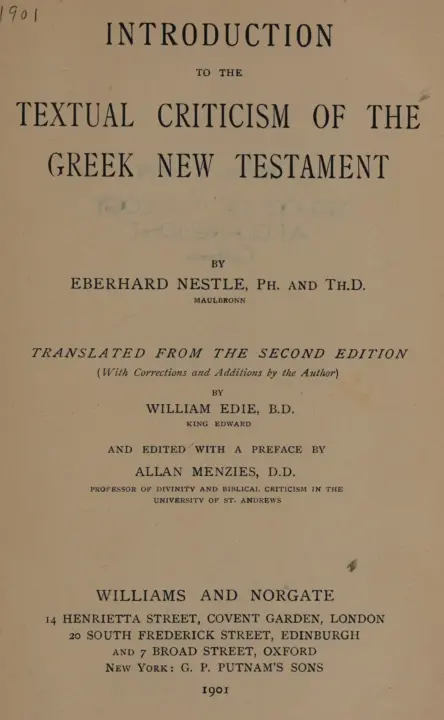
THE CLASSIC COLLECTION · 1901
"Introduction to the textual criticism of the Greek New Testament" by Eberhard Nestle is a scholarly handbook written in the early 20th century. It explains how the Greek New Testament text has been transmitted and assessed, surveying the history of printed editions alongside the evidence of manuscripts, ancient versions, and patristic quotations. The work aims to equip students and general readers with clear methods and an impartial, philological approach to evaluating readings. The opening of the work presents an editor’s preface outlining Nestle’s linguistic expertise, broad contributions to biblical scholarship, and deliberate avoidance of theological bias, and notes that the English version is a corrected and expanded translation of a later German edition. A contents list and addenda signal the scope: the history of the printed text, the materials used for criticism, and the theory and practice of evaluating variants. Chapter I then sketches the development from the first printed Greek New Testament and the great Polyglots, through Erasmus, the verse-division of Robert Estienne, Beza, and the Elzevir “Textus Receptus,” to the major critical milestones of Mill, Bengel, Wettstein, Griesbach, Lachmann, Tischendorf, Tregelles, and Westcott and Hort, with notices of later editors and practical editions (including comparative and Catholic efforts). At the start of Chapter II, Nestle lays out the evidential base—no autographs survive, so scholars rely on Greek manuscripts, early translations, and patristic citations—and introduces the scale of the evidence and the basic distinction between uncial and cursive manuscripts.
Introduction adapted from the source catalogue; source summaries may be automatically generated.
Free to read · English · 118,829 words · No account needed
MAKE TIME FOR A GOOD BOOK
On by default. Untick to stop anonymous reading totals. Each page counts after 10 seconds in view. How this works.
Anonymous counting is on unless you have switched it off.
(1) On a certain Sunday[194] in the year 170 or thereabouts, Dionysius, Bishop of Corinth, wrote a letter to the Church at Rome through their Bishop Soter, of which Eusebius has preserved the following among other passages (Eccl. Hist., iv. 23):—Ἐπιστολὰς γὰρ ἀδελφῶν ἀξιωσάντων με γράψαι ἔγραψα. Καὶ ταύτας οἱ τοῦ διαβόλου ἀπόστολοι[195] ζιζανίων γεγέμικαν, ἃ μὲν ἐξαιροῦντες, ἃ δὲ προστιθέντες. Οἷς τὸ οὐαὶ κεῖται.[196] Οὐ θαυμαστὸν ἄρα,[197] εἰ καὶ τῶν Κυριακῶν ῥᾳδιουργῆσαί τινες ἐπιβέβληνται γραφῶν, ὁπότε καὶ ταῖς οὐ τοιαύταις ἐπιβεβουλεύκασι. The κυριακαὶ γραφαὶ are in all likelihood the Gospels (the Syriac renders “the writings of our Lord”), but may also include the Pauline Epistles and the O.T. If we are to take the words of Dionysius in their strict sense, it would appear that these writings, like his own letters, had been corrupted by means of “additions” and “omissions.” The last sentence, if it is put correctly, and if it has been faithfully transmitted, leads us to infer that in his letter to Corinth Soter had expressed his surprise that the writings of the Lord should have been falsified. To which Dionysius replies that certain letters of his own had been falsified also, and that it was therefore no wonder if they did the same to the writings of the Lord, seeing they tampered also (or, even) with those that were inferior to them. The simplest explanation of the words is, undoubtedly, that Dionysius sought to console himself over the fate that had befallen his letters, by reflecting that it was not surprising that they had falsified his letters of less importance, seeing they had presumed to do the same even to the writings of the Lord. On the first interpretation, one would certainly expect Dionysius to use a stronger expression to describe his feelings at the manipulation of the sacred writings than the mere οὐ θαυμαστόν. Who are meant by τινές? One most naturally thinks of Marcion. According to a later account, Soter, whom Jerome does not mention among the writers, composed a book against the Montanists.
[Sidenote: Artemonites.]
(2) In the last chapter of the Fifth Book of his Ecclesiastical History (c. xxviii.), entitled Περὶ τῶν τὴν Ἀρτέμωνος αἵρεσιν ἐξαρχῆς προβεβλημένων· οἷοί τε τὸν τρόπον γεγόνασι καὶ ὅπως τὰς ἁγίας γραφὰς διαφθεῖραι τετολμήκασιν, Eusebius quotes the following complaint from an earlier source, entitled the Little Labyrinth (± 235):—Γραφὰς μὲν θείας ἀφόβως ῥερᾳδιουργήκασιν, πίστεως δὲ ἀρχαίας κανόνα ἠθετήκασι, Χριστὸν δὲ ἠγνοήκασιν, οὐ τί αἱ θεῖαι λέγουσι γραφαὶ ζητοῦντες, but occupying themselves with Logic, Geometry, Euclid, Aristotle, Theophrastus, and Galen, ταῖς τῶν ἀπίστων τέχναις, τὴν ἁπλῆν τῶν θείων γραφῶν πίστιν καπηλεύοντες ... διὰ τοῦτο ταῖς θείαις γραφαῖς ἀφόβως ἐπέβαλον τὰς χεῖρας, λέγοντες αὐτὰς διωρθωκέναι. Καὶ ὅτι τοῦτο μὴ καταψευδόμενος αὐτῶν λέγω, ὁ βουλόμενος δύναται μαθεῖν. Εἰ γάρ τις θελήσει συγκομίσας αὐτῶν ἑκάστου τὰ ἀντίγραφα ἐξετάζειν πρὸς ἄλληλα, κατὰ πολὺ ἂν εὕροι διαφωνοῦντα. Ἀσύμφωνα γοῦν ἔσται τὰ Ἀσκληπιάδου τοῖς Θεοδότου· Πολλῶν δὲ ἔστιν εὐπορῆσαι διὰ τὸ φιλοτίμως ἐγγεγράφθαι τοὺς μαθητὰς αὐτῶν τὰ ὑφ’ ἑκάστου αὐτῶν, ὡς αὐτοὶ καλοῦσι κατωρθωμένα τουτέστιν ἠφανισμένα. Πάλιν δὲ τούτοις τὰ Ἑρμοφίλου οὐ συνᾴδει. Τὰ γὰρ Ἀπολλωνίδου οὐδὲ αὐτὰ ἑαυτοῖς ἐστι σύμφωνα. Ἔνεστι γὰρ συγκρῖναι τὰ πρότερον ὑπ’ αὐτῶν[198] κατασκευασθέντα τοῖς ὕστερον πάλιν ἐπιδιαστραφεῖσι, καὶ εὑρεῖν κατὰ πολὺ ἀπᾴδοντα. Ὅσης δὲ τόλμης ἐστὶ τοῦτο τὸ ἁμάρτημα, εἰκὸς μηδὲ ἐκείνους ἀγνοεῖν. Ἢ γὰρ οὐ πιστεύουσιν Ἁγίῳ Πνεύματι λελέχθαι τὰς θείας γραφὰς, καί εἰσιν ἄπιστοι· ἢ ἑαυτοὺς ἡγοῦνται σοφωτέρους τοῦ Ἁγίου Πνεύματος ὑπάρχειν, καὶ τί ἕτερον ἢ δαιμονῶσιν; Οὐδὲ γὰρ ἀρνήσασθαι δύνανται ἑαυτῶν εἶναι τὸ τόλμημα, ὁπόταν καὶ τῇ αὐτῶν χειρὶ ᾖ γεγραμμένα, καὶ παρ’ ὧν κατηχήθησαν μὴ τοιαύτας παρέλαβον τὰς γραφάς· καὶ δεῖξαι ἀντίγραφα, ὅθεν αὐτὰ μετεγράψαντο, μὴ ἔχωσιν. Ἔνιοι δὲ αὐτῶν οὐδὲ παραχαράσσειν ἠξίωσαν αὐτὰς, ἀλλ’ ἁπλῶς ἀρνησάμενοι τόν τε νόμον καὶ τοὺς προφήτας ἀνόμου καὶ ἀθέου διδασκαλίας προφάσει χάριτος, εἰς ἔσχατον ἀπωλείας ὄλεθρον κατωλίσθησαν.
Your reading position is saved on this browser. Take it to another device with a library code. Reading pages adapt to text, rather than matching a printed edition.
BEHIND THE BOOK
This eBook is for the use of anyone anywhere in the United States and most other parts of the world at no cost and with almost no restrictions whatsoever. You may copy it, give it away or re-use it under the terms of the Project Gutenberg License included with this eBook or online at www.gutenberg.org. If you are not located in the United States, you will have to check the laws of the country where you are located before using this eBook. Read the source licence.
The original source file, including credits and licence, is retained by this library. Request an original-format copy at no charge. Please include the book title and Project Gutenberg identifier #76224.
KEEP YOUR CURIOSITY GOING
David Patterson (Spirit) Hatch

David Patterson (Spirit) Hatch

David Patterson (Spirit) Hatch
Cécile Tormay

Moritz Busch
John L. Ransom