
Last letters from the living dead man
David Patterson (Spirit) Hatch
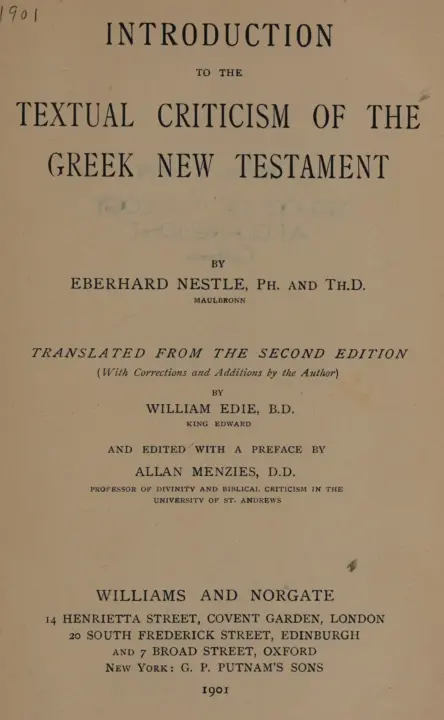
THE CLASSIC COLLECTION · 1901
"Introduction to the textual criticism of the Greek New Testament" by Eberhard Nestle is a scholarly handbook written in the early 20th century. It explains how the Greek New Testament text has been transmitted and assessed, surveying the history of printed editions alongside the evidence of manuscripts, ancient versions, and patristic quotations. The work aims to equip students and general readers with clear methods and an impartial, philological approach to evaluating readings. The opening of the work presents an editor’s preface outlining Nestle’s linguistic expertise, broad contributions to biblical scholarship, and deliberate avoidance of theological bias, and notes that the English version is a corrected and expanded translation of a later German edition. A contents list and addenda signal the scope: the history of the printed text, the materials used for criticism, and the theory and practice of evaluating variants. Chapter I then sketches the development from the first printed Greek New Testament and the great Polyglots, through Erasmus, the verse-division of Robert Estienne, Beza, and the Elzevir “Textus Receptus,” to the major critical milestones of Mill, Bengel, Wettstein, Griesbach, Lachmann, Tischendorf, Tregelles, and Westcott and Hort, with notices of later editors and practical editions (including comparative and Catholic efforts). At the start of Chapter II, Nestle lays out the evidential base—no autographs survive, so scholars rely on Greek manuscripts, early translations, and patristic citations—and introduces the scale of the evidence and the basic distinction between uncial and cursive manuscripts.
Introduction adapted from the source catalogue; source summaries may be automatically generated.
Free to read · English · 118,829 words · No account needed
MAKE TIME FOR A GOOD BOOK
On by default. Untick to stop anonymous reading totals. Each page counts after 10 seconds in view. How this works.
Anonymous counting is on unless you have switched it off.
[Sidenote: Later revisers.]
(d) As we are now dealing with the question how to arrive at the oldest form of the Greek text, it is unnecessary to take account of the labours of any later individuals in the formation of the Greek New Testament. Among these were Emperors and Empresses like Constantine and Constans, who exerted themselves in the dissemination of the Scriptures, and perhaps even made copies of them with their own hands, but these we may disregard.[184] The work of Andreas and Arethas on the Apocalypse will be noticed when we come to speak of that book. One naturally turns here to Krumbacher’s History of Byzantine Literature, but the index to the first edition of that work contains only two references to the New Testament, neither of them bearing on our present subject. The matter is one which may be commended to those who have the time and the opportunity and the willingness to investigate it, and considering the ardour with which the study of Byzantine antiquities is being prosecuted at present, it may suffice merely to throw out this hint.
[Sidenote: Pre-Origenic texts.]
(e) So far as we have gone, therefore, it appears that much uncertainty prevails regarding the text formations we have already considered—those of Lucian, Hesychius, Pamphilus, and the Ferrar Group. Considering the amount of evidence at our command—how the external testimony points in the same direction as the manuscripts themselves, and, indeed, how probable is the whole nature of the operation in question—one would expect these to be the most easily distinguishable of all. Indeed, even so cautious an enquirer as Zahn speaks without any hesitation of “the official recensions originating subsequent to the time of Origen” (ThLbl., 1899, 180). The vagueness of our conclusions with respect to these recensions does not look very promising for the result of our investigation of the text prior to the time of Origen, when activity in this field was more disconnected and might be said to run wild and unrestrained. And there is this further difficulty that some of the writers who fall to be considered in this period came in later times more or less justly under the imputation of heresy, with the consequence that the results of their labours were less widely disseminated, if not deliberately suppressed. In circumstances like these any attempted revision of the text must have been equally mischievous, whether it proceeded from the orthodox side or from the opposite. That there were διορθωταί who were supposed to correct the text in the interests of orthodoxy we have already learned from Epiphanius. Indeed, from our point of view the action of the orthodox correctors must be thought the more regrettable of the two, since the books without a doubt parted at their hands with many vivid, strange, and even fantastic traits of language. Even in the matter of style it seems to me incontestable that it was at their hands that the Gospels received that reserved and solemn tone which we would not now willingly part with, and which can be compared to nothing so much as to those solemn pictures of Christ that we see painted on a golden background in Byzantine churches. For myself, at least, I have not the slightest doubt that the Gospel, and the Gospel particularly, was originally narrated in a much more vivacious style. Just consider this, for example. In all our present authorities—Greek manuscripts, ancient versions, Syriac, Egyptian, and so forth, and in all the Church Fathers without exception, so far as I am aware—we read the beautiful words: “your Father knoweth what things ye have need of before ye ask Him,” πρὸ τοῦ ὑμᾶς αἰτῆσαι αὐτόν (Matt. vi. 8). Compare with this what we find singly and solely in Codex D and the Old Latin h, πρὸ τοῦ ἀνοῖξαι τὸ στόμα, antequam os aperiatis, “before ever you open your mouth.” To me it is a striking indication to what an extent the instinctive sense of originality is wanting, that a reading like this is not inserted by Westcott and Hort among their Noteworthy Rejected Readings, nor even cited by Baljon in his critical apparatus, and that our commentators have not a single syllable about it, so that our students and preachers know nothing whatever of this form of the words of Jesus. If my edition of the New Testament did no more than bring such things to the notice of those who previously were unacquainted with them, I should consider it had done no small service. But take another illustration from the parable of the Barren Fig Tree. “Cut it down, why cumbereth it the ground,”—that is how our ordinary texts give the commandment of the justly indignant husbandman in Luke xiii. 7: ἔκκοψον αὐτήν· ἱνατί καὶ τὴν γῆν καταργεῖ. Here again, the great majority of our witnesses of every sort exhibit no variation worth mentioning, except that a good many (A L T etc.) insert a very prosy οὖν after the imperative, while B 80 read τὸν τόπον for τὴν γῆν. And in the answer of the vine-dresser (verse 8), “till I shall dig about it and dung it,” there is again no various reading in our ordinary witnesses of all kinds except the insignificant interchange of (βάλω) κόπρια, κοπρίαν, and κόπρον. What a difference do we find here also in the text of D: “bring the axe,” φέρε τὴν ἀξίνην, adfers securem; and, “I will throw in a basket of dung,” βάλω κόφινον κοπρίων, mittam qualum (= squalum) stercoris d, or cophinum stercoris a b c f ff^2 i l q, from which it was taken into the Codex of Marmoutier, a copy of the Alcuinian recension of the Vulgate written in gold.[185] Here again, our editors and commentators for the most part take no notice. “Bring the axe” is omitted by Weiss, father and son, Westcott-Hort, Tregelles, and also by Baljon, while Holtzmann ignores both variants. It stands to reason, of course, that greater vivacity of style is not of itself an actual proof of greater originality. But the whole question is raised as to the principles by which we are to be guided in estimating the comparative value of the witnesses. One might be inclined to regard such peculiarities as due to the caprice of some scribe by whom D or its parent manuscript was written. As a matter of fact, Westcott and Hort, and most recent editors with them, do so regard them, seeing they cite the reading of D neither in Matt. vi. 8 nor in Luke xiii. 7. In the latter passage one might be inclined to take that view of the case, because as yet we have no other testimony to φέρε τὴν ἀξίνην than D d. But it is not so likely in the case of Matt. vi. 8, seeing that here the testimony of D is supported by that of h. To justify our neglect of these witnesses, we should require to prove either that h is derived from D or D from h.[186] So far as my knowledge goes, no one has yet maintained the latter view. The derivation of h from D is an impossibility, for this reason alone that h belongs either to the fourth, or, what is perhaps more likely, to the fifth century (see p. 113).[187] The truth is, rather, that we have in h a second and independent witness to the fact that at a very early date the text of Matt. vi. 8 read, “before you open your mouth.” But it is quite impossible to ignore the evidence of D in Luke xiii. 8 (κόφινον κοπρίων). Here too, of course, one might take exception and say that as D is bilingual, its Greek text might be derived from the Latin. Fortunately, however, it happens that the Latin of D, that is, d, differs from all the other eight Latin witnesses in reading not cophinus but qualus, and it is cophinus that is a loan word from the Greek[188]; so that this objection, actually raised against D in the case of other readings, does not apply to this one. There is this to be observed, moreover—a point not given in Tischendorf, but noticed in Westcott and Hort—viz., that Origen also seems to have read “basket.” The passage is again one that is extant only in the Latin translation of Rufinus, and Tischendorf cites Or. 3, 452 among the witnesses supporting κόπρια; but Westcott and Hort expressly mention that Origen’s context appears to support the reading κόφινον (“Lev. lat. Ruf., 190, apparently with context”).
Your reading position is saved on this browser. Take it to another device with a library code. Reading pages adapt to text, rather than matching a printed edition.
BEHIND THE BOOK
This eBook is for the use of anyone anywhere in the United States and most other parts of the world at no cost and with almost no restrictions whatsoever. You may copy it, give it away or re-use it under the terms of the Project Gutenberg License included with this eBook or online at www.gutenberg.org. If you are not located in the United States, you will have to check the laws of the country where you are located before using this eBook. Read the source licence.
The original source file, including credits and licence, is retained by this library. Request an original-format copy at no charge. Please include the book title and Project Gutenberg identifier #76224.
KEEP YOUR CURIOSITY GOING
David Patterson (Spirit) Hatch

David Patterson (Spirit) Hatch

David Patterson (Spirit) Hatch
Cécile Tormay

Moritz Busch
John L. Ransom