
Last letters from the living dead man
David Patterson (Spirit) Hatch
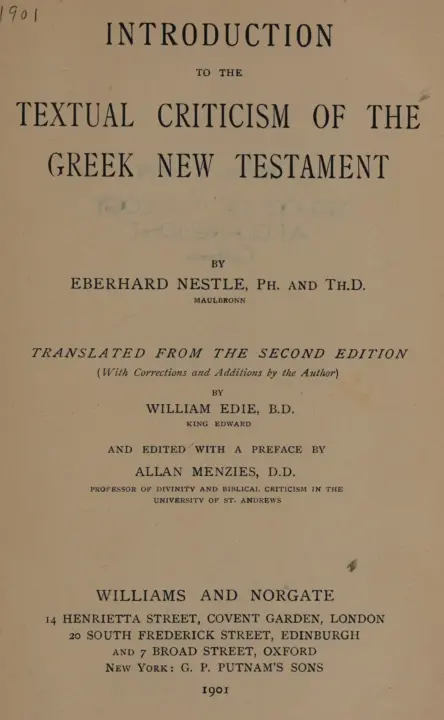
THE CLASSIC COLLECTION · 1901
"Introduction to the textual criticism of the Greek New Testament" by Eberhard Nestle is a scholarly handbook written in the early 20th century. It explains how the Greek New Testament text has been transmitted and assessed, surveying the history of printed editions alongside the evidence of manuscripts, ancient versions, and patristic quotations. The work aims to equip students and general readers with clear methods and an impartial, philological approach to evaluating readings. The opening of the work presents an editor’s preface outlining Nestle’s linguistic expertise, broad contributions to biblical scholarship, and deliberate avoidance of theological bias, and notes that the English version is a corrected and expanded translation of a later German edition. A contents list and addenda signal the scope: the history of the printed text, the materials used for criticism, and the theory and practice of evaluating variants. Chapter I then sketches the development from the first printed Greek New Testament and the great Polyglots, through Erasmus, the verse-division of Robert Estienne, Beza, and the Elzevir “Textus Receptus,” to the major critical milestones of Mill, Bengel, Wettstein, Griesbach, Lachmann, Tischendorf, Tregelles, and Westcott and Hort, with notices of later editors and practical editions (including comparative and Catholic efforts). At the start of Chapter II, Nestle lays out the evidential base—no autographs survive, so scholars rely on Greek manuscripts, early translations, and patristic citations—and introduces the scale of the evidence and the basic distinction between uncial and cursive manuscripts.
Introduction adapted from the source catalogue; source summaries may be automatically generated.
Free to read · English · 118,829 words · No account needed
MAKE TIME FOR A GOOD BOOK
On by default. Untick to stop anonymous reading totals. Each page counts after 10 seconds in view. How this works.
Anonymous counting is on unless you have switched it off.
[Sidenote: Eusebius-Pamphilus.]
(c) We have nearly as little certain information regarding the third, and perhaps most important, of the recensions mentioned by Jerome in connection with the Old Testament, that of =Eusebius= and =Pamphilus=, which goes back to Origen.[173] [Sidenote: Origen.] So far as I know, the references which Origen makes in his extant writings to his own labours in the field of textual criticism, relate only to the Old Testament. At the same time his complaint as to the evil condition of the manuscripts of his day refers to the New Testament, and to the Gospels in particular. Νυνὶ δὲ δηλονότι, he says, in his Commentary on Matthew, Bk. xv. 14, πολλὴ γέγονεν ἡ τῶν ἀντιγράφων διαφορά, εἴτε ἀπὸ ῥᾳθυμίας τινῶν γραφέων, εἴτε ἀπὸ τόλμης τινῶν μοχθηρᾶς τῆς διορθώσεως τῶν γραφομένων, εἴτε καὶ ἀπὸ τῶν τὰ ἑαυτοῖς δοκοῦντα ἐν τῇ διορθώσει προστιθέντων ἢ ἀφαιρούντων.[174] He tells us in the same place how, θεοῦ διδόντος, he found ways and means of remedying the evil by the employment of the critical symbols of Homeric commentators, the obelus and asterisk, τὴν μὲν οὖν ἐν τοῖς ἀντιγράφοις τῆς παλαιᾶς διαθήκης διαφωνίαν, θεοῦ διδόντος, εὕρομεν ἰάσασθαι. According to his own express declaration, supposing it to have been correctly preserved, for it is only extant in Latin, his work in textual criticism at that time at least was confined to the Old Testament: in exemplaribus autem Novi Testamenti hoc ipsum me posse facere sine periculo non putavi. Von Gebhardt consequently says (Urt., 25) that this statement from Origen’s own mouth should have kept anyone from ascribing a formal recension of the New Testament text to him, alluding to Hug’s system of recensions; but at the same time he will not deny that the works of Origen, who was a man of conspicuous critical accuracy, are of the highest importance for the criticism of the text of the New Testament. As a matter of fact, later church teachers appeal chiefly to Origen’s manuscripts of the Old Testament, but several references are also found to his New Testament manuscripts. On Gal. iii. 1, Jerome remarks (ii. 418): legitur in quibusdam codicibus, Quis vos fascinavit non credere veritati? Sed hoc (meaning, of course, the last three words only) quia in exemplaribus Adamantii non habetur, omisimus. The words are a gloss interpolated from ch. v. 7, but they are also found in Origen, though only in the Latin translation of Rufinus, and they appear, among our Greek manuscripts, in C D^c E K L P, and likewise in most codices of the Vulgate (see Wordsworth and White, p. 659). The same writer says on Matthew xxiv. 36 (ii. 199): in quibusdam latinis exemplaribus additum est “neque filius,” quum in Graecis et maxime Adamantii et Pierii exemplaribus hoc non habeatur additum; sed quia in nonnullis legitur, disserendum videtur (W. and W., p. 658). Pierius is no doubt the Presbyter of Alexandria who lived at Rome after the Diocletian persecution. He was styled “the younger Origen” on account of his learning, and was perhaps the teacher of Pamphilus (Jerome, Viri Ill., 76; Eusebius, Eccl. Hist., vii. 32). Adamantius, like Chalkenteros, is a surname of honour given to Origen. Here again, it is a strange fact that the words which Jerome says were omitted in Origen’s exemplar are found in a certain passage of his works also extant only in Latin, and there expounded so fully that there cannot be the slightest doubt that he had them in his text, and, moreover, had no conception of their omission in other copies. What explanation, if any, can be given of this fact we need not pause to enquire. Nor need we take up the question where Jerome obtained access to the exemplars of Pierius. I suppose it would be in Caesarea, where he also saw the (Bible?) volumes of Origen transcribed by Pamphilus with his own hand, and actually obtained possession of his copy of the commentary on the Minor Prophets.[175] Even supposing that what is meant by exemplaria Adamantii is not really a recension of the text of the Bible but simply the copy that Origen used most or used last, that copy might have been authoritative for Pamphilus if not for Eusebius, and so far, therefore, it becomes necessary for us to try and discover the Origenic text in the New Testament as well as in the Old. At all events a good many of our manuscripts go back to Pamphilus, and particularly H of the Pauline Epistles. In addition to a very practical suggestion as to the lending of books,[176] and a notice of its preparation and of the original writer, this manuscript has also the following note: ἀντεβλήθη δὲ ἡ βίβλος πρὸς τὸ ἐν Καισαρίᾳ ἀντίγραφον τῆς βιβλιοθήκης τοῦ ἁγίου Παμφίλου χειρὶ γεγραμμένον (αὐτοῦ). From this subscription Field (Hexapla, i. p. xcix) has concluded that the library of Pamphilus was still in existence in the sixth century, but it is doubtful whether the subscription may not have been found in the original of H and copied into it along with the text, as is the case with a similar note copied into the minuscules 15, 83, 173. [Sidenote: Euthalius.] In any case this manuscript is our principal witness for the recension of Pamphilus, or, as it used to be called, the recension of =Euthalius=.[177] I have no intention of discussing the question whether it should be Euthalius or Evagrius: Von Dobschütz (Euthaliusstudien, p. 152 n. 1) has promised to give us further particulars as to the Syriac texts relating to the subject. I would merely call attention to two facts, viz.—
Your reading position is saved on this browser. Take it to another device with a library code. Reading pages adapt to text, rather than matching a printed edition.
BEHIND THE BOOK
This eBook is for the use of anyone anywhere in the United States and most other parts of the world at no cost and with almost no restrictions whatsoever. You may copy it, give it away or re-use it under the terms of the Project Gutenberg License included with this eBook or online at www.gutenberg.org. If you are not located in the United States, you will have to check the laws of the country where you are located before using this eBook. Read the source licence.
The original source file, including credits and licence, is retained by this library. Request an original-format copy at no charge. Please include the book title and Project Gutenberg identifier #76224.
KEEP YOUR CURIOSITY GOING
David Patterson (Spirit) Hatch

David Patterson (Spirit) Hatch

David Patterson (Spirit) Hatch
Cécile Tormay

Moritz Busch
John L. Ransom