
Last letters from the living dead man
David Patterson (Spirit) Hatch
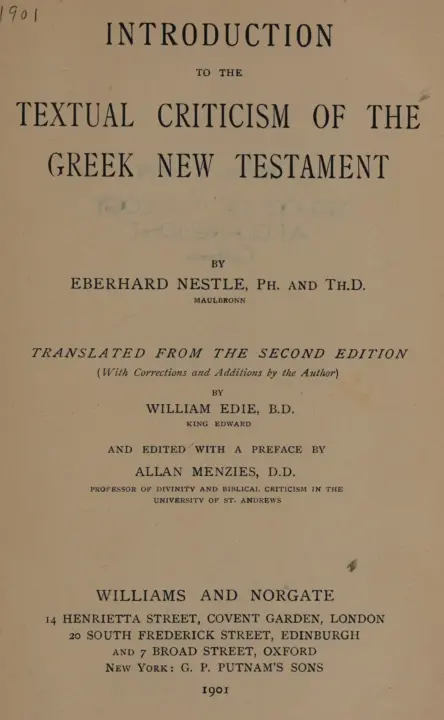
THE CLASSIC COLLECTION · 1901
"Introduction to the textual criticism of the Greek New Testament" by Eberhard Nestle is a scholarly handbook written in the early 20th century. It explains how the Greek New Testament text has been transmitted and assessed, surveying the history of printed editions alongside the evidence of manuscripts, ancient versions, and patristic quotations. The work aims to equip students and general readers with clear methods and an impartial, philological approach to evaluating readings. The opening of the work presents an editor’s preface outlining Nestle’s linguistic expertise, broad contributions to biblical scholarship, and deliberate avoidance of theological bias, and notes that the English version is a corrected and expanded translation of a later German edition. A contents list and addenda signal the scope: the history of the printed text, the materials used for criticism, and the theory and practice of evaluating variants. Chapter I then sketches the development from the first printed Greek New Testament and the great Polyglots, through Erasmus, the verse-division of Robert Estienne, Beza, and the Elzevir “Textus Receptus,” to the major critical milestones of Mill, Bengel, Wettstein, Griesbach, Lachmann, Tischendorf, Tregelles, and Westcott and Hort, with notices of later editors and practical editions (including comparative and Catholic efforts). At the start of Chapter II, Nestle lays out the evidential base—no autographs survive, so scholars rely on Greek manuscripts, early translations, and patristic citations—and introduces the scale of the evidence and the basic distinction between uncial and cursive manuscripts.
Introduction adapted from the source catalogue; source summaries may be automatically generated.
Free to read · English · 118,829 words · No account needed
MAKE TIME FOR A GOOD BOOK
On by default. Untick to stop anonymous reading totals. Each page counts after 10 seconds in view. How this works.
Anonymous counting is on unless you have switched it off.
This is the view of Zahn. Others, however, have no doubt that Tertullian made use of a Latin version. Hoppe, in his treatise, De sermone Tertullianeo Quaestiones Selectae (1897), p. 6 (de Graecismis Tertulliani) says, “Permultas enim (constructiones) T. mutuatus est vel ex scriptoribus graecis, quibus assidue studuit, vel ex librorum sacrorum translatione latina graecismis abundante, qua utebatur.” And to this he adds, “Quam multa vocabula graeca in Tertullianeum sermonem ex Itala quae vocatur translatione redundaverint, discas ex Roenschii libro cum impigritate conscripto, qui inscribitur, Itala und Vulgata, ed. sec., p. 238.” The Itala is cited for sciant quia (p. 18), absque (p. 44), and for the use of the superlative for the positive (p. 49). On this last the writer refers to Rönsch, p. 415, and adds, “ex Itala T. hunc usum aliquotiens assumpsisse videtur, quamquam in universum vitat.” Cf. Westcott, Canon, Part I., c. iii. p. 251 ff.
Footnote 101:
Thus we have, following the numbers given above, in verse 4 (1) απορεισθαι and διαπορεισθαι (or διαπορειν), (2) περι τουτου and περι αυτου, (3) ιδου and και ιδου, (4) ανδρες δυο and δυο ανδρες, (5) επεστησαν and παρειστηκεισαν, (7) εν εσθητι αστραπτουση (or λαμπρα) and εν εσθησεσιν αστραπτουσαις (or λευκαις), (8) εμφοβων (or εν φοβω) δε γενομενων και κλινουσων and ενφοβοι δε γενομεναι εκλειναν, (9) τα προσωπα and το προσωπον (αυτων); in verse 11, (10) ενωπιον αυτων and its omission; in verse 13, (14) εξηκοντα and εκατον εξηκοντα, (15) ᾗ ονομα and ονοματι, (16) Εμμαους and ουλαμμαους. Of these (8), (15), and (16) are found only in D. In the case of (15) the very same variation is found at Tob. vi. 10 in the two recensions represented by Codex Vaticanus and Codex Sinaiticus.
Footnote 102:
1889, 91, 93, 95, 98; cited in the sequel as W.-W.
Footnote 103:
On the Epilogus to the first volume of their Oxford edition, see especially S. Berger in the Revue Critique, 1889, pp. 141-144; and on the whole, Burkitt, The Vulgate Gospels and the Codex Brixianus, in the Journal of Theological Studies, I. i. (Oct. 1899) pp. 129-134.
Footnote 104:
Compare E. Maugenot, Les manuscrits grecs des évangiles employés par Saint Jerôme, in the Revue des sciences ecclésiastiques, January 1900.
Footnote 105:
The New Testament is contained in vol. iii. The copy I use has the date 1743 on the title-pages of three volumes, but there is a note at the end, p. 1115, which says, “E prelo exiit hic tomus anno 1749.” Romæ, 1713-19, in TiGr., p. 1350, is a misprint. The imprimaturs of the first volume are dated 1737. The work was reprinted with new title-pages at Paris by Fr. Didot, 1751. Copies now cost from £15 to £25.
Footnote 106:
The word Coptic is not derived from the town in Upper Egypt called Coptos, but is a modification of the Greek word Αἰγύπτιος.
Footnote 107:
The spelling Bahiric is due to a wrong vocalisation of the word.
Footnote 108:
On the Middle Egyptian, see W. E. Crum in the Journal of Theological Studies, I. 3 (April 1900), pp. 416 ff.
Footnote 109:
Westcott, Canon, Part II., chapter ii., § 1 sub finem.
Footnote 110:
Your reading position is saved on this browser. Take it to another device with a library code. Reading pages adapt to text, rather than matching a printed edition.
BEHIND THE BOOK
This eBook is for the use of anyone anywhere in the United States and most other parts of the world at no cost and with almost no restrictions whatsoever. You may copy it, give it away or re-use it under the terms of the Project Gutenberg License included with this eBook or online at www.gutenberg.org. If you are not located in the United States, you will have to check the laws of the country where you are located before using this eBook. Read the source licence.
The original source file, including credits and licence, is retained by this library. Request an original-format copy at no charge. Please include the book title and Project Gutenberg identifier #76224.
KEEP YOUR CURIOSITY GOING
David Patterson (Spirit) Hatch

David Patterson (Spirit) Hatch

David Patterson (Spirit) Hatch
Cécile Tormay

Moritz Busch
John L. Ransom