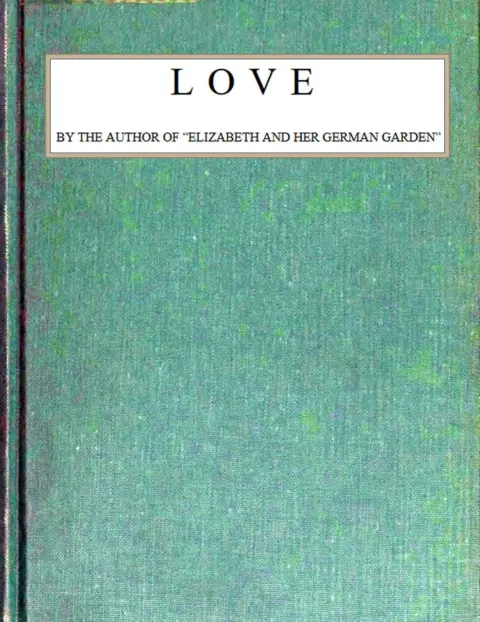
Love
Elizabeth Von Arnim

THE CLASSIC COLLECTION · 1926
"Introduction to Sally" by Elizabeth Von Arnim is a novel likely written in the early 20th century. The story centers around the characters Mr. and Mrs. Pinner and their daughter, Sally, exploring themes of beauty, anxiety, and familial dynamics. As Mr. Pinner grapples with his daughter’s extraordinary beauty and the complications it brings, we witness the unfolding of Sally’s life as she navigates her emerging identity amidst parental concerns and societal expectations. The opening portion introduces us to Mr. Pinner, a man driven by respectability and fear, who struggles with the challenges of his marriage and the beauty of his daughter, Sally. Despite initial hopes for parental stability, Mrs. Pinner's death thrusts the responsibility of raising Sally onto Mr. Pinner, who reacts by attempting to shield her from unwanted male attention that her beauty attracts. As Sally grows into a stunning young woman, her parents' fears intensify, leading to their decision to relocate in hope of achieving a quieter life. However, their troubles are exacerbated by the inevitable consequences of Sally's beauty, ultimately leading us to the exploration of familial love, anxiety, and the desire for autonomy.
Introduction adapted from the source catalogue; source summaries may be automatically generated.
Free to read · English · 92,350 words · No account needed
MAKE TIME FOR A GOOD BOOK
On by default. Untick to stop anonymous reading totals. Each page counts after 10 seconds in view. How this works.
Anonymous counting is on unless you have switched it off.
Speaking of this time later on, Mrs. Luke was accustomed to say, ‘It was a mauvais quart d’heure,’ and to smile; but in her heart, when she thought of it, there was no smile.
She never forgot that coming down to breakfast on the morning of Sally’s flight, so unconscious of anything having happened, pleased that it was a fine day for her party, pleased with the pretty frock she had had sent from Harrods for the child to wear, excited at the prospect of presenting her to a dazzled South Winch, confident, somehow, with that curiously cloudless confidence that seems to lay hold of those about to be smitten by fate, that her beautiful daughter-in-law would behave perfectly, and the whole thing be a great success. Fate was about to smite her; and with more than the disappearance of a daughter-in-law, for that disappearance was but the first step to having to give up, renounce entirely and for always, her son.
Jocelyn came down to breakfast in a good humour too. He had slept like a log, after his series of interrupted nights.
‘Sally’s late,’ he said presently.
‘She is, isn’t she,’ said his mother. ‘You won’t call her Sally this afternoon, will you, dearest,’ she added, giving him his coffee.
‘Sorry, Mother. No. I’ll remember.’
And soon after that they made their discovery.
‘Now what,’ Mrs. Luke asked herself, pressing her cold hands together, when an hour or two later it became evident beyond doubt that Sally hadn’t merely gone, unaccountably, for an early walk, but had gone altogether, ‘now what, what have I done to deserve this?’
And the period of torment began, the period of distress and anxiety, of anger at first which soon flickered out, and of ever-growing, sickening fear, which she afterwards spoke of quietly as a mauvais quart d’heure.
It took some time before she and Jocelyn could be convinced that this wasn’t just a before breakfast walk. They clung to the hope that it was, in spite of their knowledge of Sally’s lack of initiative. Yet how much more initiative would be needed, they thought, looking at each other with frightened eyes, to do that which it became every moment more and more apparent that she had done.
‘But why? But why?’ Mrs. Luke kept on asking, pressing her cold hands
together.
Jocelyn said nothing.
At eleven o’clock, when it was plain she wasn’t coming back, he went out and fetched his car.
‘She’s gone to her father,’ he said.
‘But why? Oh, Jocelyn--why?’
‘We’ve made her unhappy,’ he said, pulling on his gloves, his face set.
‘Unhappy?’
Your reading position is saved on this browser. Take it to another device with a library code. Reading pages adapt to text, rather than matching a printed edition.
Elizabeth Von Arnim
Elizabeth Von Arnim
Elizabeth Von Arnim
Elizabeth Von Arnim
BEHIND THE BOOK
This eBook is for the use of anyone anywhere in the United States and most other parts of the world at no cost and with almost no restrictions whatsoever. You may copy it, give it away or re-use it under the terms of the Project Gutenberg License included with this eBook or online at www.gutenberg.org. If you are not located in the United States, you will have to check the laws of the country where you are located before using this eBook. Read the source licence.
The original source file, including credits and licence, is retained by this library. Request an original-format copy at no charge. Please include the book title and Project Gutenberg identifier #72979.
KEEP YOUR CURIOSITY GOING
Coulson Kernahan

Maurice Baring
Frances Wright
Cécile Tormay

Frederic Jesup Stimson

W. H. P. (William Henry Pope) Jarvis