
Ninth Avenue
Maxwell Bodenheim
THE CLASSIC COLLECTION · 1922
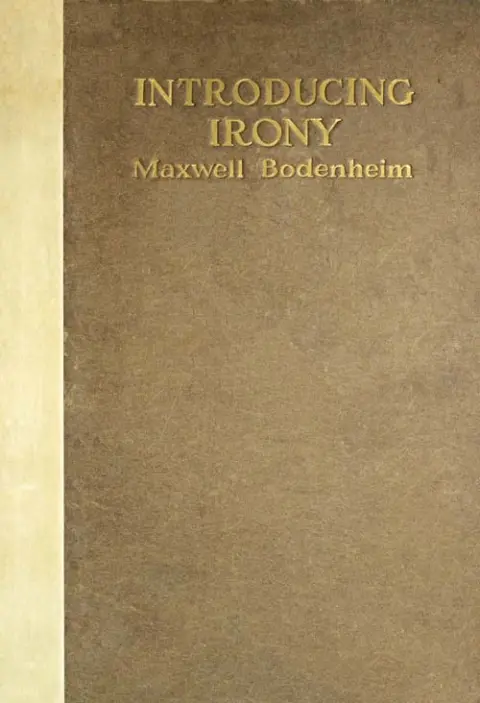
"Introducing Irony: A Book of Poetic Short Stories and Poems" by Maxwell Bodenheim is a collection of poetic narratives crafted in the early 20th century. The book delves into themes of human emotion and experience, often wrapped in irony and complex social commentary. Through varied characters like Jack Rose, a heroin peddler, and others, it explores the intricacies of life, love, and existential musings, intertwining poetry with short stories. At the start of the collection, readers are introduced to Jack Rose, a character steeped in melancholy and irony as he navigates the dark alleys of life as a heroin dealer. His encounter with May Bulger, who pawns her body to cope with grief, unravels the complex interplay of desire, suffering, and emotional connection. This opening sets a tone of introspection and poignancy, hinting at Bodenheim's exploration of the human condition, contrasting moments of harsh reality with fleeting beauty, and criticizing societal norms. The piece serves as a compelling invitation to explore the deeper narratives woven throughout the collection.
Introduction adapted from the source catalogue; source summaries may be automatically generated.
Free to read · English · 18,749 words · No account needed
MAKE TIME FOR A GOOD BOOK
On by default. Untick to stop anonymous reading totals. Each page counts after 10 seconds in view. How this works.
Anonymous counting is on unless you have switched it off.
We do not love and hate in Mars.
These earthly cries are flashing bars
Of sound from which our minds are free.
They stand in our mythology:
Legends elusive and weird,
Acrid Gods that once were feared.
They vanished imperceptibly
And none among us can agree
Upon the tangled way in which they fled.
Starlit symbols of dread,
They slowly exhausted themselves and died
In striding heralds of a wilder bride.
We have no emotions in Mars.
They are like long-healed wounds
Whose scars are softened by the gleam of our minds.
We approach them with clearer kinds
Of sound from deeply resting thought.
Our youths and maidens have not caught
The treacherous and tightly bound
Confusion of your loving sound,
For sex to us is but the ring
Of different shades of thought in Spring
When men recline upon the breast
Of women, dissolving into thoughtful rest.
In Autumn sex is left behind.
Men and women no longer lined
By different bodies raise their dins
Above the screaming violins.
Negro,
Chinaman,
White servant-girl,
Russian woman,
Are learning how to be dead,
Aided by the impersonal boredom
Of a morgue at evening.
The morgue divides its whole
Of dead mens’ contacts into four
Parts, and places one in each
Of these four bodies waiting for the carts.
The frankness of their decay
Breaks into contradictory symbols
And sits erect upon the wooden tables,
Thus cancelling the validity of time.
In a voice as passive as slime
The negro speaks.
“Killed a woman: ripped her skin.
Saw her heart floating in a tumbler of gin.
Had to drink her heart because it wouldn’t leave the gin.
Because I wanted to reach all of her
They ripped my flesh.
They wanted to reach all of me
And their excuse was better than mine.”
Cowed baby painted black,
The negro sits upon fundamentals
And troubles them a little with his hands.
The beautiful insanity
Of his eyes rebukes
The common void of his face.
Then the Chinaman speaks
In a voice whose tones are brass
From which emotion has been extracted.
“Loved a woman: she was white.
Her man blew my brains out into the night.
Hatred is afraid of color.
Color is the holiday
Given to moods of understanding:
Hatred does not understand.
When stillness ends the fever of ideas
Hatred will be a scarcely remembered spark.”
Manikin at peace
With the matchless deceit of a planet,
The Chinaman fashions his placid immensity.
The Chinaman chides his insignificance
With a more impressive rapture
Than that of western midgets.
His rapture provides an excellent light
For the silhouette of the negro’s curse.
Then the white servant-girl
Speaks in a voice whose syllables
Fall like dripping flower-juice and offal,
Both producing a similar sound.
“I made a neat rug for a man.
He cleaned his feet on me and I liked
The tired, scheming way in which he did it.
When he finished he decided
That he needed a smoother texture,
And found another lady.
I killed myself because I couldn’t rub out
The cunning marks that he left behind.”
Impulsive doll made of rubbish
On which a spark descended and ended,
The white servant-girl, without question or answer,
Accepts the jest of a universe.
Then the Russian woman
Speaks in a voice that is heat
Ill-at-ease upon its couch of sound.
“I married a man because
His lips tormented my melancholy
And made it long to be meek,
And because, when he walked to his office each morning,
He thought himself a kindled devil
Enduring the smaller figures around him.
He abandoned me for German intrigue
And I chased him in other men,
Never quite designing him.
Death, a better megalomaniac,
Relieved me of the pursuit.”
Symbol of earth delighted
With the vibration of its nerves,
The Russian woman sunders life
Into amusing deities of emotion
And bestows a hurried worship.
Then the morgue, attended by a whim,
Slays the intonations of their trance
And slips these people back to life.
The air is cut by transformation.
The white servant-girl retreats to a corner
With a shriek, while the negro advances,
And the Russian woman
Nervously objects to the Chinaman’s question.
The morgue, weary housewife for speechless decay,
Spends its helplessness in gay revenge:
Revenge of earth upon four manikins
Who straightened up on wooden tables
And betrayed her.
Your reading position is saved on this browser. Take it to another device with a library code. Reading pages adapt to text, rather than matching a printed edition.
Maxwell Bodenheim
Maxwell Bodenheim
Maxwell Bodenheim
Maxwell Bodenheim
BEHIND THE BOOK
This eBook is for the use of anyone anywhere in the United States and most other parts of the world at no cost and with almost no restrictions whatsoever. You may copy it, give it away or re-use it under the terms of the Project Gutenberg License included with this eBook or online at www.gutenberg.org. If you are not located in the United States, you will have to check the laws of the country where you are located before using this eBook. Read the source licence.
The original source file, including credits and licence, is retained by this library. Request an original-format copy at no charge. Please include the book title and Project Gutenberg identifier #60427.
KEEP YOUR CURIOSITY GOING
Coulson Kernahan

Maurice Baring
Frances Wright
Cécile Tormay

Frederic Jesup Stimson

W. H. P. (William Henry Pope) Jarvis