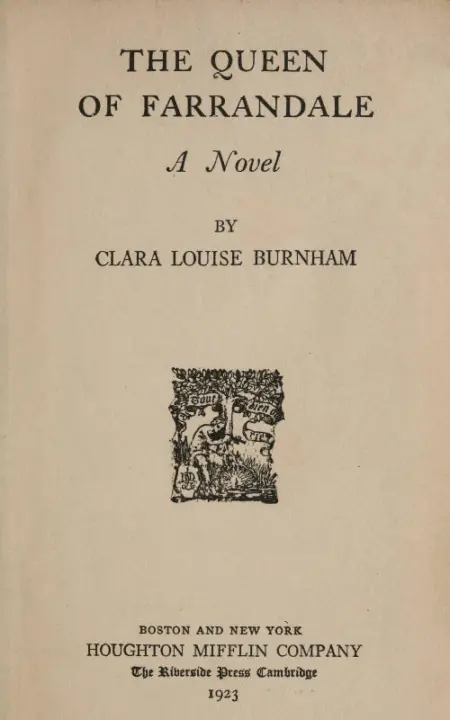
The Queen of Farrandale: A Novel
Clara Louise Burnham

THE CLASSIC COLLECTION · 1916
"Instead of the Thorn: A Novel" by Clara Louise Burnham is a fictional work written in the early 20th century. The story is set in the backdrop of early 1916, primarily revolving around the lives of Chicago socialites and their interactions. The narrative introduces us to key characters like Linda Barry, an athletic and confident young woman, her parents, and their friends, capturing the nuances of their relationships, desires, and social expectations during this era. The opening of the novel unfolds with a dinner gathering at the South Shore Club, where Mr. and Mrs. Radcliffe are hosting their New York friends, the Lindsays. The space provides a picturesque view of Lake Michigan, creating a vibrant ambiance as the couples engage in conversation that hints at their lives and social standings. The character of Linda Barry is introduced through the Her family dynamics, particularly her relationships with her parents and potential suitors, including the serious Bertram King, who seems to have deeper feelings for her, contrasting with her carefree spirit and rebelliousness against traditional expectations. Throughout the initial chapters, the novel hints at themes of social class, personal aspirations, and the impact of familial ties on individual choices.
Introduction adapted from the source catalogue; source summaries may be automatically generated.
Free to read · English · 67,945 words · No account needed
MAKE TIME FOR A GOOD BOOK
On by default. Untick to stop anonymous reading totals. Each page counts after 10 seconds in view. How this works.
Anonymous counting is on unless you have switched it off.
During the monotonous days following the funeral, Miss Barry and her niece dwelt alone in the big, echoing house. Harriet had gone home to her husband and child. The papers still resounded with the Barry tragedy, but it was not difficult to keep them from Linda, whose stormy grief had changed to utter listlessness.
One morning Miss Barry sat by the window in her niece's room with some mending, while Linda, in her white négligée, dragged herself about the apartment as if all the spring in her supple young body had grown flaccid. Occasionally the older woman glanced over the rim of her glasses at the girl's expressionless face. Miss Belinda herself felt numbed by shock, but there was present with her the instinctive necessity which all had felt, of standing between Linda and a complete understanding of the situation.
Ever since the girl's breakfast tray had been removed that morning they had remained here in silence.
"There's one way I can't make any mistake," thought the aunt, "and that's by holding my tongue. She knows I'm here, and that if I can do anything for her I want to do it."
The housekeeper had answered her appeal for something to keep her hands busy, and so she worked while Linda moved languidly about, apparently forgetful of her presence.
While they still remained thus, a card was brought up.
Miss Barry took it from the maid.
"Bertram King, Linda," she said. "Will you see him?"
She was surprised by the life which sprang for a moment into the girl's
eyes.
"No," answered Linda clearly.
Her aunt stood undecidedly, the linen in one hand and the card in the
other.
"Shall I see him, then?" she asked.
"I don't care, Aunt Belinda."
The maid waited, casting curious glances from one to the other.
"Henry says Mr. King's been wonderful," said Miss Barry, after a moment of waiting. "The greatest help in the world: always kept his head, and thought of the right thing to do, though he was suffering so."
"I'm not--" Linda tried to reply, but her lips quivered, and she bit them. "I can't see him," she ended abruptly.
Miss Barry nodded comprehension. The associations would naturally be
overwhelming.
"I'll go down, then," she said, sighing, and laying down her work. "I suppose I shall tell him you thank him for all he has done, and for the flowers every day."
"No." Linda faced her aunt, and again life leaped in her eyes. "I'm not sending any message. Remember that."
Miss Barry frowned in perplexity, thinking of Mrs. Porter's confidences
concerning King.
"Oh, law," she thought wearily, "I suppose she's refused him."
Your reading position is saved on this browser. Take it to another device with a library code. Reading pages adapt to text, rather than matching a printed edition.
Clara Louise Burnham
Clara Louise Burnham
Clara Louise Burnham

Clara Louise Burnham
BEHIND THE BOOK
This eBook is for the use of anyone anywhere in the United States and most other parts of the world at no cost and with almost no restrictions whatsoever. You may copy it, give it away or re-use it under the terms of the Project Gutenberg License included with this eBook or online at www.gutenberg.org. If you are not located in the United States, you will have to check the laws of the country where you are located before using this eBook. Read the source licence.
The original source file, including credits and licence, is retained by this library. Request an original-format copy at no charge. Please include the book title and Project Gutenberg identifier #53049.
KEEP YOUR CURIOSITY GOING
Coulson Kernahan

Maurice Baring
Frances Wright
Cécile Tormay

Frederic Jesup Stimson

W. H. P. (William Henry Pope) Jarvis