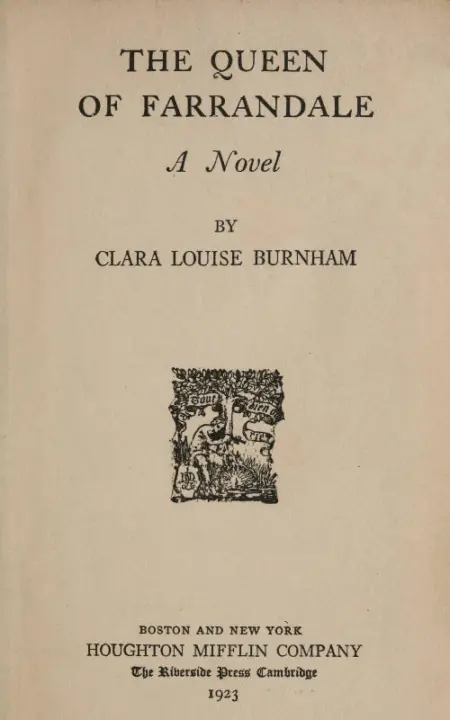
The Queen of Farrandale: A Novel
Clara Louise Burnham

THE CLASSIC COLLECTION · 1916
"Instead of the Thorn: A Novel" by Clara Louise Burnham is a fictional work written in the early 20th century. The story is set in the backdrop of early 1916, primarily revolving around the lives of Chicago socialites and their interactions. The narrative introduces us to key characters like Linda Barry, an athletic and confident young woman, her parents, and their friends, capturing the nuances of their relationships, desires, and social expectations during this era. The opening of the novel unfolds with a dinner gathering at the South Shore Club, where Mr. and Mrs. Radcliffe are hosting their New York friends, the Lindsays. The space provides a picturesque view of Lake Michigan, creating a vibrant ambiance as the couples engage in conversation that hints at their lives and social standings. The character of Linda Barry is introduced through the Her family dynamics, particularly her relationships with her parents and potential suitors, including the serious Bertram King, who seems to have deeper feelings for her, contrasting with her carefree spirit and rebelliousness against traditional expectations. Throughout the initial chapters, the novel hints at themes of social class, personal aspirations, and the impact of familial ties on individual choices.
Introduction adapted from the source catalogue; source summaries may be automatically generated.
Free to read · English · 67,945 words · No account needed
MAKE TIME FOR A GOOD BOOK
On by default. Untick to stop anonymous reading totals. Each page counts after 10 seconds in view. How this works.
Anonymous counting is on unless you have switched it off.
Next morning, as soon as breakfast was over, she made her inquiries and took her train. It was one that stopped at every station, and when, after three quarters of an hour of this sauntering, she alighted on a desolate and unpromising platform, her first thought was to inquire in the small depot for the first train back. The little house seemed to be deserted for the moment, however, and she observed an elderly man with a short white beard, who, with trousers tucked into his boots and thumbs hooked in his armholes, stood at a little distance, regarding speculatively the lady in the gray suit and floating gray veil. Near where he was standing a carryall was waiting by the platform.
In Mrs. Porter's indecision she looked again within the weather-beaten station, then across at the motionless, weather-beaten face.
"There doesn't seem to be any one in here," she said.
"I cal'late Joe's out in the shed luggin' wood," responded the man. His pleasant tone, his drawl, the sea-blue of his eyes, caused her to move toward him as the needle to the magnet. She knew the type. All the suspended Maine exhilaration rushed back upon her. How clean he was! How rough! How adorable!
"I've come," she said, gazing up into the eyes regarding her steadily,
and said no more.
"Want me to haul ye?" he asked kindly, not changing his position.
"Yes."
"Where to?"
"I don't know." The sunlight of her smile evoked a grin from him.
"Come on a chance, have ye?"
"Yes, So did you, I should think. Nobody but little me getting off
here."
"No, 't ain't time for 'em really to come yet."
"Who? Summer people, do you mean?"
"Yes. Folks is beginnin' to think they like it down here; but we don't take summer boarders to the Cape, ye'll have to know that."
A prodigious wink enveloped one sea-blue eye.
"Oh, I'm so sorry." Mrs. Porter's smile vanished in her earnestness. "Wouldn't--wouldn't your wife, perhaps--"
"Haven't got none."
"Oh, I'm sorry."
"I ain't. Ben glad on't always. Hain't ever repented."
"Then you mean you never were married."
"That's what I mean." The speaker nodded as if to emphasize a triumph.
"But isn't there some one in your--your village--I suppose it's a
village, isn't it?"
"Shouldn't wonder if 'twas."
The visitor tasted that "'t wa-a-as" with appetite, and echoed it
mentally.
"Some one who would take a boarder if--if I want to stay?" The monotonous landscape was not inviting.
"Wall, for accawmodation's sake I cal'late they would; but it's only for accawmodation's sake, ye understand." The speaker winked again. "The Cape don't take boarders."
Your reading position is saved on this browser. Take it to another device with a library code. Reading pages adapt to text, rather than matching a printed edition.
Clara Louise Burnham
Clara Louise Burnham
Clara Louise Burnham

Clara Louise Burnham
BEHIND THE BOOK
This eBook is for the use of anyone anywhere in the United States and most other parts of the world at no cost and with almost no restrictions whatsoever. You may copy it, give it away or re-use it under the terms of the Project Gutenberg License included with this eBook or online at www.gutenberg.org. If you are not located in the United States, you will have to check the laws of the country where you are located before using this eBook. Read the source licence.
The original source file, including credits and licence, is retained by this library. Request an original-format copy at no charge. Please include the book title and Project Gutenberg identifier #53049.
KEEP YOUR CURIOSITY GOING
Coulson Kernahan

Maurice Baring
Frances Wright
Cécile Tormay

Frederic Jesup Stimson

W. H. P. (William Henry Pope) Jarvis