
Letters to a Friend, Written to Mrs. Ezra S. Carr, 1866-1879
John Muir
THE CLASSIC COLLECTION · 1914
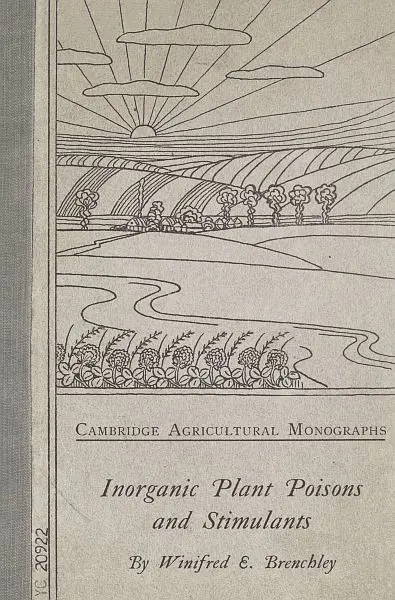
"Inorganic Plant Poisons and Stimulants" by Winifred Elsie Brenchley is a scientific publication written in the early 20th century. The work investigates the effects of various inorganic substances, specifically focusing on their toxic and stimulating actions on plant growth and development. It aims to provide a comprehensive analysis and correlation of existing research related to these substances, delving into their applicability in agricultural practices. The opening of the work begins with a preface outlining the significant changes in agricultural practices over the previous century, highlighting the use of artificial fertilizers and the conflicting evidence surrounding inorganic substances as potential plant nutrients. Brenchley sets the stage for further exploration by discussing the historical context of plant nutrition and the classification of substances based on their effects on plant growth. In particular, she emphasizes the complexity of understanding how certain inorganic compounds can exhibit both toxic and beneficial effects, depending on their concentrations and combinations with other nutrients, thereby inviting future investigation into the nuanced interactions between plants and these chemicals.
Introduction adapted from the source catalogue; source summaries may be automatically generated.
Free to read · English · 41,390 words · No account needed
MAKE TIME FOR A GOOD BOOK
On by default. Untick to stop anonymous reading totals. Each page counts after 10 seconds in view. How this works.
Anonymous counting is on unless you have switched it off.
PELIGOT, E. De l’action que l’acide borique et les borates exercent sur les végétaux. Compt. rend. LXXXIII, 686–88. (1876) 71
PHILLIPS, F. C. The absorption of metallic oxides by plants. Chem. News, XLVI, 224–6. (1882) 24, 42, 51, 58
PHILLIPS. Effets du cuivre sur la végétation. Ann. Chim. Phys. XIX, 76. (1821) 15
RAULIN, J. Études chimiques sur la végétation. Ann. Sci. Nat. XI, 139–40. (1869) 48
RICCIARDI, L. Sulla diffusione dell’allumina nei vegetali. Gaz. chim. Ital. XIX, 150–9. (1889) 79
RICHARDS, H. M. Die Beeinflussung des Wachstums einiger Pilze durch chemische Reize. Jahrb. wiss. Bot. XXX, 665–88. (1897) 50, 90
RICHTER, A. Zur Frage der chemischen Reizmittel. Die Rolle des Zinc und Kupfer bei der Ernährung von Aspergillus niger. Centr. Bakt. Par. Abt. 2, VII, 417–29. (1901) 34, 49
RISSE, H. Quoted in Sachs “Experimental-Physiologie der Pflanzen.” 153–4. (1865) 36
ROXAS, M. The effect of some stimulants upon rice. Philippine Agric. and Forester, I, No. 5, 89–97 47, 86
SALM HORSTMAR, Prince de. Recherches sur la nutrition de l’avoine, particulièrement en ce qui concerne les matières inorganiques qui sont nécessaires à cette nutrition. Ann. Chim. Phys. XXXII, 461–507. (1851) 82
SCHLAGDENHAUFFEN et REEB. Sur les combinaisons organiques des métaux dans les plantes. Compt. rend. CXXXIX, 980–3. (1904) 79
SCHREINER, O. and REED, H. S. Power of Sodium Nitrate and Calcium Carbonate to decrease toxicity in conjunction with plants growing in solution cultures. Journ. Amer. Chem. Soc. XXX, 85–97. (1908) 4
SCHRÖDER, J. etc. Chemische Zusammensetzung der Pflanze. A. Anorganische Bestandtheile. Jahresber. Agrik. Chem. 105 et seq. (1878) 80
SEGALE, M. Untersuchungen über das Vorhandensein von Arsen in den normalen Geweben vermittelst der biologischen Methode. Zeitschr. physiol. Chem. XLII, 175–80. (1904) 63
SEYNES, M. J. de. Résultats de la culture du Penicillium cupricum Trabut. Bot. Soc. France, XLII, 451–5. (1895) 34
STOKLASA, J. Ueber die Bedeutung des Arsens in der Pflanzenproduction. Casopis pro prumysl chemicky, 5, 311, 379, 407 (1895). 6, 182 (1896). Abst. in Jahresb. Agrik. Chem. XIX, 246–7. (1896) 53, 60
STOKLASA, J. Ueber die physiologische Bedeutung des Arsens im Pflanzenorganismus. Zeitschr. landw. Versuchswes. Oesterreich, I, 155–93. (1898) 53, 57, 58, 60
STORP, F. Ueber den Einfluss von Kochsalz- und Zincsulfathaltigen Wasser auf Boden und Pflanzen. Landw. Jahrb. XII, 795–844. (1883) 40, 42, 43, 44
STRAMPELLI, N. Azione del diversi composti di manganese ed in particolare del minerale manganesifero del Monte Argentario, usati nella concimazione delle piante. 6º Cong. internat. Chim. appl. Roma, IV, 14–7. (1907) 87
SWAIN, R. E. and HARKINS, W. D. Arsenic in vegetation exposed to smelter smoke. Journ. Amer. Chem. Soc. XXX, 915–28. (1908) 52
TAKEUCHI, T. On differences of susceptibility of plants to stimulation. Journ. Coll. Agric. Tokyo, I, No. 2, 207–10. (1909) 89
TRABUT, M. L. Sur un Penicillium végétant dans des solutions concentrées de sulfate de cuivre. Bull. Soc. Bot. France, XLII, 33–4. (1895) 34
TREBOUX, O. Einige stoffliche Einflüsse auf die Kohlensäureassimilation bei submersen Pflanzen. Flora, XCII, 56–8. (1903) 32, 48
TRUE, R. H. and GIES, W. J. On the physiological action of some of the heavy metals in mixed solutions. Bull. Torr. Bot. Club, XXX, 390–402. (1903) 20, 40, 45
Your reading position is saved on this browser. Take it to another device with a library code. Reading pages adapt to text, rather than matching a printed edition.
BEHIND THE BOOK
This eBook is for the use of anyone anywhere in the United States and most other parts of the world at no cost and with almost no restrictions whatsoever. You may copy it, give it away or re-use it under the terms of the Project Gutenberg License included with this eBook or online at www.gutenberg.org. If you are not located in the United States, you will have to check the laws of the country where you are located before using this eBook. Read the source licence.
The original source file, including credits and licence, is retained by this library. Request an original-format copy at no charge. Please include the book title and Project Gutenberg identifier #48008.
KEEP YOUR CURIOSITY GOING
John Muir

Asa Gray
Asa Gray

Florence Nightingale
Elizabeth Robins Pennell
Denison Olmsted