Through the Desert
Henryk Sienkiewicz
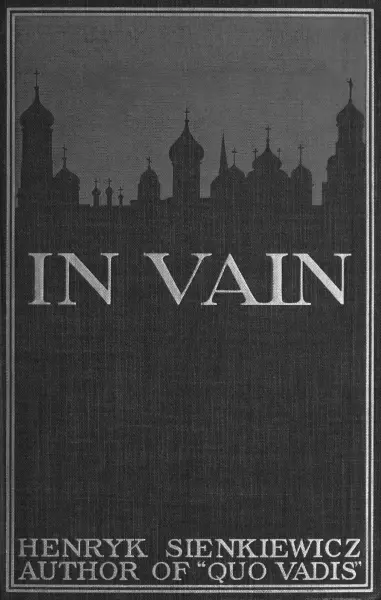
THE CLASSIC COLLECTION · 1899
"In Vain" by Henryk Sienkiewicz is a novel written in the late 19th century. The story revolves around the experiences of a young Jewish student named Yosef Shvarts as he navigates university life in Kieff, where ambition, friendships, love, and sacrifice intertwine in his quest for knowledge. Central to the narrative is the character of Helena, a widow with a tragic past, whose presence profoundly affects both Yosef and his friend Gustav. The opening of "In Vain" introduces Yosef as he arrives in Kieff, filled with excitement and idealism about the vast world of knowledge awaiting him at the university. He soon reconnects with his friend Gustav, who reveals the harsh realities of student life and the challenges they face, including poverty and emotional turmoil. As the narrative unfolds, existential themes emerge, particularly through Gustav's relationship with the widow, Helena. The complexity of their feelings lays the groundwork for future conflict and character development, foreshadowing the struggles of love and sacrifice that will unfold throughout the novel.
Introduction adapted from the source catalogue; source summaries may be automatically generated.
Free to read · English · 46,847 words · No account needed
MAKE TIME FOR A GOOD BOOK
On by default. Untick to stop anonymous reading totals. Each page counts after 10 seconds in view. How this works.
Anonymous counting is on unless you have switched it off.
A few days later Augustinovich was sitting in Yosef's lodgings; he was working vigorously in view of the approaching examination. Loving effect in all things, he had shaded the windows, and in the middle of the room had placed a table, before which he was standing at that moment. Evidently he was occupied with some experiment, for on the table was a multitude of old glass vessels and pots full of powders and fluids, and in the centre was burning a spirit lamp, which surrounded with a blue flame the stupid head of a retort which was quivering under the influence of boiling liquid contained in it.
Work burned, as they said, in the hands of Augustinovich; no one could labor so quickly as he. With a glad smile on his face he moved really with enthusiasm, frequently entertaining himself with a song or a dialogue with the first vessel he took up, or with a pious remark on the fleeting nature of this world.
Sometimes he left his work for a moment, and raising his eyes and his hands declaimed in tones which were very tragic,--
"Ah, Eurydice! before thy beauty
I passed the rounds of success,
And the sentence of Delphi was undoubted,
That on earth I am the only one blest."
Then again in a hundred trills and cadences he sang,--
"O piano! piano!--Zitto! pia-ha-ha-no!"
Or similar creations of his own mind on a sudden,--
"And if thou fill a pipe, O Youth,
And pressing the bowl with thy finger, put fire on it."
"By Mohammed! If Yosef should come, this work would go on more quickly; but he is marrying Helena at present--Ei! and as innocence is dear to me, I would fix it this way! Dear Helena, permit--And what farther? Oh, the farther the better--"
All at once some one pulled the bell.
Augustinovich turned toward the door and extending his hand intoned,--
"Road-weary traveller,
Cross thou my threshold."
The door opened; a man young and elegantly dressed entered the room.
Augustinovich did not know him.
The most important notable trait of the newly arrived was a velvet sack-coat and light-colored trousers; besides, he was washed, shaven, and combed. His face was neither stupid nor clever, neither beautiful nor ugly, neither kind nor malicious, moreover he was neither tall nor of low stature. His nose, mouth, chin, and forehead were medium; special marks he had none.
"Does Pan Yosef Shvarts live here?"
"It is certain that he lives here."
"Is it possible to see him?"
"It is possible at this time; but in the night, when it is very dark,
the case is different."
Your reading position is saved on this browser. Take it to another device with a library code. Reading pages adapt to text, rather than matching a printed edition.
Henryk Sienkiewicz
Henryk Sienkiewicz
Henryk Sienkiewicz
Henryk Sienkiewicz
BEHIND THE BOOK
This eBook is for the use of anyone anywhere in the United States and most other parts of the world at no cost and with almost no restrictions whatsoever. You may copy it, give it away or re-use it under the terms of the Project Gutenberg License included with this eBook or online at www.gutenberg.org. If you are not located in the United States, you will have to check the laws of the country where you are located before using this eBook. Read the source licence.
The original source file, including credits and licence, is retained by this library. Request an original-format copy at no charge. Please include the book title and Project Gutenberg identifier #46454.
KEEP YOUR CURIOSITY GOING
Coulson Kernahan

Maurice Baring
Frances Wright
Cécile Tormay

Frederic Jesup Stimson

W. H. P. (William Henry Pope) Jarvis