
The story of Betty
Carolyn Wells
THE CLASSIC COLLECTION · 1920
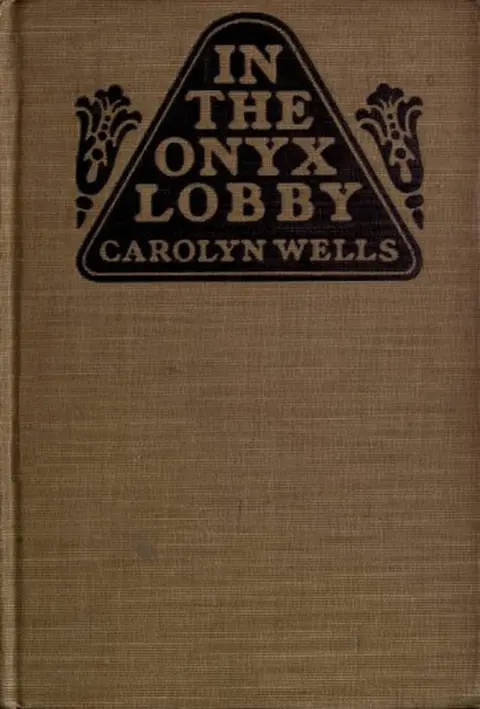
"In the Onyx Lobby" by Carolyn Wells is a novel written in the early 20th century. The narrative intertwines themes of love, ambition, and rivalry primarily surrounding two feuding women, Miss Letitia Prall and Mrs. Everett, who share a long-standing animosity. At the heart of this drama is Richard Bates, a young inventor caught between his ambitions and familial loyalty, as he navigates his feelings for Dorcas Everett amidst the backdrop of their mothers' feud. At the start of "In the Onyx Lobby," we are introduced to the fraught dynamics between Miss Prall and Mrs. Everett, residents of The Campanile, who have maintained their rivalry for several decades. Richard Bates, Miss Prall's nephew, is reluctant to take up his Uncle Binney's offer to join a bakery business, preferring to pursue his inventive ideas. However, when Bates and Dorcas Everett's romantic feelings emerge, the tension escalates as both young lovers grapple with their mothers' opposition and the pressures stemming from their families’ feud. This complex beginning sets the stage for a murder mystery that intertwines personal relationships with deeper themes of social class and gender roles, as well as the potential consequences of long-held grudges.
Introduction adapted from the source catalogue; source summaries may be automatically generated.
Free to read · English · 65,246 words · No account needed
MAKE TIME FOR A GOOD BOOK
On by default. Untick to stop anonymous reading totals. Each page counts after 10 seconds in view. How this works.
Anonymous counting is on unless you have switched it off.
“Nonsense, Uncle Bin, I passed through that stage long ago. I used to girl around in my callow days, but I got fed up with it, and now life holds more worthwhile temptations. It’s an old story to auntie, too. Why she used to chaperon my giddiest parties,—bless her!”
Sir Herbert’s sharp eyes looked from one of his companions to the other.
“You’re a pair,” he opined, “both tarred with the same brush.”
“And the brush?” asked Miss Prall, belligerently.
“Modern sophistication and the present-day fad of belittling everything that is interesting or pleasurable.”
“That mental phase is the inevitable result of worldly experience,” said the lady, with a cynical smile. “How is it that you preserve such youthful interest?”
“Well—” and the Englishman looked a little quizzical, “you see, the girls are still young.”
“Very young,” assented Bates, gravely. “There’s a new bunch of Squabs at the Gaynight Revue that’ll do you up! Better buy that place out, Unkie!”
“Perhaps; but now, young Richard, let’s discuss some more imminent, if not more important, questions. Say, Buns, for instance.”
“Nothing doing. I’ve said my last word on the Bun subject, and if you persist in recurring to it, you’ll only get that last word over again,—repeated, reiterated, recapitulated and,—if necessary,—reënforced!”
“With some good, strong epithets, I suppose,” remarked his uncle, calmly. “I don’t blame you, Rick, for being bored by my persistency, but you see I haven’t yet given up all hope of making you see reason. Why I do——”
“Well, when you do—what?”
“Time enough to answer that question when it’s time to ask it. Instead, let me recount the advantages I can offer you——”
“Oh, Lord!—pardon my interrupting,—but that recounting is an old story, you know. Those advantages are as familiar to my wearied mind as my own name,—or at least as yours,—and your precious Buns——”
“Stop, sir! Don’t you speak slightingly of Binney’s Buns! They were eaten before you were born and will be eaten after you are dead and forgotten.”
“Not forgotten if I put my invention over!”
“You’ll never do it. Your success is problematical. The Buns are an assured fact. They were eaten before the war,—they will be eaten again now that the war is over. They are eaten in England,—they will be eaten in America. If not with the help of your interest and energy, then with that of some one else. Think well, my boy, before you throw away fame and fortune——”
“To acquire fame and fortune!”
Your reading position is saved on this browser. Take it to another device with a library code. Reading pages adapt to text, rather than matching a printed edition.
Carolyn Wells

Carolyn Wells & Harry Persons Taber

Carolyn Wells

Carolyn Wells
BEHIND THE BOOK
This eBook is for the use of anyone anywhere in the United States and most other parts of the world at no cost and with almost no restrictions whatsoever. You may copy it, give it away or re-use it under the terms of the Project Gutenberg License included with this eBook or online at www.gutenberg.org. If you are not located in the United States, you will have to check the laws of the country where you are located before using this eBook. Read the source licence.
The original source file, including credits and licence, is retained by this library. Request an original-format copy at no charge. Please include the book title and Project Gutenberg identifier #35254.
KEEP YOUR CURIOSITY GOING
Coulson Kernahan

Maurice Baring
Frances Wright
Cécile Tormay

Frederic Jesup Stimson

W. H. P. (William Henry Pope) Jarvis