
The story of Betty
Carolyn Wells
THE CLASSIC COLLECTION · 1920
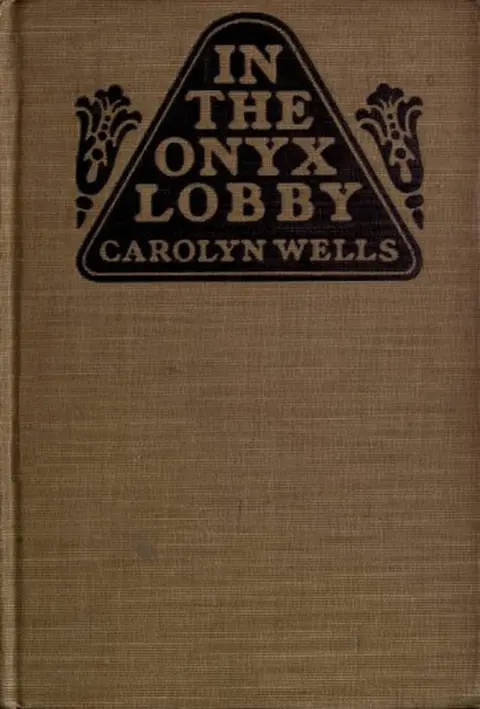
"In the Onyx Lobby" by Carolyn Wells is a novel written in the early 20th century. The narrative intertwines themes of love, ambition, and rivalry primarily surrounding two feuding women, Miss Letitia Prall and Mrs. Everett, who share a long-standing animosity. At the heart of this drama is Richard Bates, a young inventor caught between his ambitions and familial loyalty, as he navigates his feelings for Dorcas Everett amidst the backdrop of their mothers' feud. At the start of "In the Onyx Lobby," we are introduced to the fraught dynamics between Miss Prall and Mrs. Everett, residents of The Campanile, who have maintained their rivalry for several decades. Richard Bates, Miss Prall's nephew, is reluctant to take up his Uncle Binney's offer to join a bakery business, preferring to pursue his inventive ideas. However, when Bates and Dorcas Everett's romantic feelings emerge, the tension escalates as both young lovers grapple with their mothers' opposition and the pressures stemming from their families’ feud. This complex beginning sets the stage for a murder mystery that intertwines personal relationships with deeper themes of social class and gender roles, as well as the potential consequences of long-held grudges.
Introduction adapted from the source catalogue; source summaries may be automatically generated.
Free to read · English · 65,246 words · No account needed
MAKE TIME FOR A GOOD BOOK
On by default. Untick to stop anonymous reading totals. Each page counts after 10 seconds in view. How this works.
Anonymous counting is on unless you have switched it off.
“Now as to the ‘women,’” Corson went on. “You know Sir Herbert left a paper stating that women killed him. This is a most peculiar message for a dying man to leave.”
“Why so, if it is true?” and Letitia Prall’s eyes gave him a curious
look.
“Yes,—that’s just it,—if it is true.”
“It’s got to be true,” burst out Bates, impulsively. “No man is going to write a thing like that with his last ounce of dying strength unless it’s true!”
“I agree to that,” and Corson nodded, “if he did write it.”
“What?” Miss Prall started up in amazement. “Who says he didn’t write
it?”
“Nobody says so, I only say it might be so. Suppose the murderer himself wrote it to turn suspicion toward some one else,—some woman.”
“I never thought of that!” and Miss Prall fell into a brown study, as if the new thought moved her profoundly.
“Nor I,” said Bates, looking intently at the detective. “But, I say, that writing looked to me amazingly like my uncle’s.”
“And the porter,—Bob Moore, you know,” broke in Eliza,—“he said, the pencil dropped from Sir Herbert’s fingers just as he fell back dead——”
“Oh, no, he didn’t say that! That’s the way stories get repeated. There’s no such thing as direct, undistorted evidence! Moore didn’t see the pencil in Sir Herbert’s fingers at all. He saw it lying on the floor beside the dead man’s hand,—or, he says he did.”
“Good Heavens! You don’t suspect Moore!” cried Richard. “Why, he’s the best chap going!”
“I don’t say he isn’t, and I don’t say I suspect him, but I want you people to understand that he might have done it all,—might have committed the murder and might have written the scribbled paper to turn suspicion away from himself. As for the handwriting, that trembling, shaky scrawl can’t be identified with anybody’s ordinary writing.”
“Oh, I can’t think it,” Richard objected. “Why, Bob Moore couldn’t do such a thing, and, besides, what would be his motive?”
“We haven’t come to motive yet. We’re finding out who had opportunity.”
“Any passer-by had that,” Miss Prall said, positively; “while Moore was up in the elevator, what was to prevent any pedestrian going by from stepping in and killing Sir Herbert?”
“Nothing; but there are few pedestrians at two o’clock in the morning, and fewer still who have a reason for a murder.”
Your reading position is saved on this browser. Take it to another device with a library code. Reading pages adapt to text, rather than matching a printed edition.
Carolyn Wells

Carolyn Wells & Harry Persons Taber

Carolyn Wells

Carolyn Wells
BEHIND THE BOOK
This eBook is for the use of anyone anywhere in the United States and most other parts of the world at no cost and with almost no restrictions whatsoever. You may copy it, give it away or re-use it under the terms of the Project Gutenberg License included with this eBook or online at www.gutenberg.org. If you are not located in the United States, you will have to check the laws of the country where you are located before using this eBook. Read the source licence.
The original source file, including credits and licence, is retained by this library. Request an original-format copy at no charge. Please include the book title and Project Gutenberg identifier #35254.
KEEP YOUR CURIOSITY GOING
Coulson Kernahan

Maurice Baring
Frances Wright
Cécile Tormay

Frederic Jesup Stimson

W. H. P. (William Henry Pope) Jarvis