
The story of Betty
Carolyn Wells
THE CLASSIC COLLECTION · 1920
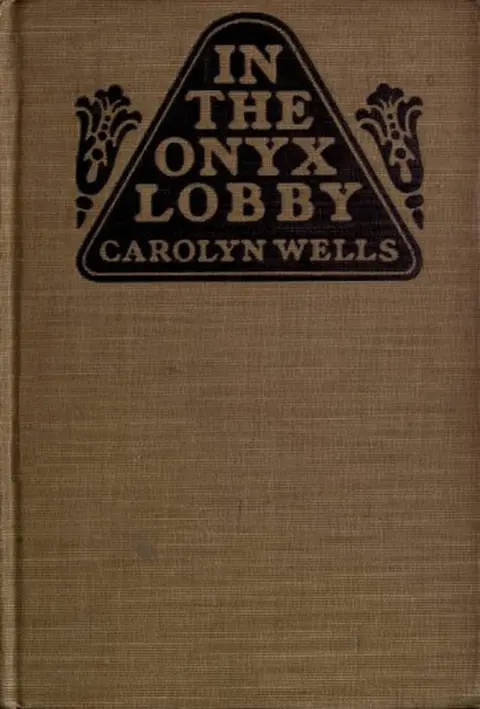
"In the Onyx Lobby" by Carolyn Wells is a novel written in the early 20th century. The narrative intertwines themes of love, ambition, and rivalry primarily surrounding two feuding women, Miss Letitia Prall and Mrs. Everett, who share a long-standing animosity. At the heart of this drama is Richard Bates, a young inventor caught between his ambitions and familial loyalty, as he navigates his feelings for Dorcas Everett amidst the backdrop of their mothers' feud. At the start of "In the Onyx Lobby," we are introduced to the fraught dynamics between Miss Prall and Mrs. Everett, residents of The Campanile, who have maintained their rivalry for several decades. Richard Bates, Miss Prall's nephew, is reluctant to take up his Uncle Binney's offer to join a bakery business, preferring to pursue his inventive ideas. However, when Bates and Dorcas Everett's romantic feelings emerge, the tension escalates as both young lovers grapple with their mothers' opposition and the pressures stemming from their families’ feud. This complex beginning sets the stage for a murder mystery that intertwines personal relationships with deeper themes of social class and gender roles, as well as the potential consequences of long-held grudges.
Introduction adapted from the source catalogue; source summaries may be automatically generated.
Free to read · English · 65,246 words · No account needed
MAKE TIME FOR A GOOD BOOK
On by default. Untick to stop anonymous reading totals. Each page counts after 10 seconds in view. How this works.
Anonymous counting is on unless you have switched it off.
Further statistics were ascertained and then the police began actual investigation. The detective was the smallest and least conspicuous man of the three, and his unassuming air and somewhat stupid-looking face would have carried a conviction of his utter incompetency, save for his alert, darting black eyes, that seemed to look in several directions at once, so rapidly did they roll about.
Corson was his name, and he asked questions so quickly and so continuously that he scarce waited for answers.
“Where had he been?” he flung out. “Who saw him come in? Who was on door duty? What’s your name? Moore? Well, did you admit this man?”
“No,” said Bob Moore, “I was up in the elevator taking one of the tenants to his floor. There’s only me on, late at night.”
But Corson seemed unheeding. Already he had turned to Miss Prall.
“Does this man live with you? Did he, I mean. Where did he set out for when he left home? What time did he go?”
“Now you look here!” said Miss Letitia, angrily. “I can’t answer forty-seven questions at once! Nor other people can’t, either. You talk more slowly, sir, and more rationally.”
But Corson heeded her not at all. He turned to Bates.
“Your uncle, eh? You his heir?”
“Yes, he is!” Miss Prall answered for him, and Corson’s roving glance took her in and returned to Bates. “Where were you when he was killed?”
“In bed,” replied Richard, shortly.
“Oh; all right. Now, I’ll take charge of this paper, for there’s little doubt but it’s mighty important.” He folded it carefully into his pocket-book. “Was this gentleman—er, addicted to ladies’ society?”
“That he was,” Moore spoke up, involuntarily.
“I didn’t ask you,” said Corson. “I asked Mr Bates.”
“Why, yes,” said Richard, “he did like the society of ladies,—but most
men do.”
“We’re not discussing the matter, Mr Bates,” and for once Corson looked steadily at him, “we’re just looking into it. And—” he paused, impressively, “and these immediate, right-away-quick questions are pretty good first aid, as a rule.”
“Go ahead, then,” and Richard folded his arms, in a resigned manner.
Doctor Pagett motioned the two ladies to take seats on the red velvet sofa and seated himself also.
“There’s no doubt,” Corson went on, “that this writing is the true explanation. Dying men don’t leave anything but truth as a last message. It seems pretty steep to believe that women managed this affair, but that’s the very reason he made such a desperate effort to let it be known.”
Your reading position is saved on this browser. Take it to another device with a library code. Reading pages adapt to text, rather than matching a printed edition.
Carolyn Wells

Carolyn Wells & Harry Persons Taber

Carolyn Wells

Carolyn Wells
BEHIND THE BOOK
This eBook is for the use of anyone anywhere in the United States and most other parts of the world at no cost and with almost no restrictions whatsoever. You may copy it, give it away or re-use it under the terms of the Project Gutenberg License included with this eBook or online at www.gutenberg.org. If you are not located in the United States, you will have to check the laws of the country where you are located before using this eBook. Read the source licence.
The original source file, including credits and licence, is retained by this library. Request an original-format copy at no charge. Please include the book title and Project Gutenberg identifier #35254.
KEEP YOUR CURIOSITY GOING
Coulson Kernahan

Maurice Baring
Frances Wright
Cécile Tormay

Frederic Jesup Stimson

W. H. P. (William Henry Pope) Jarvis