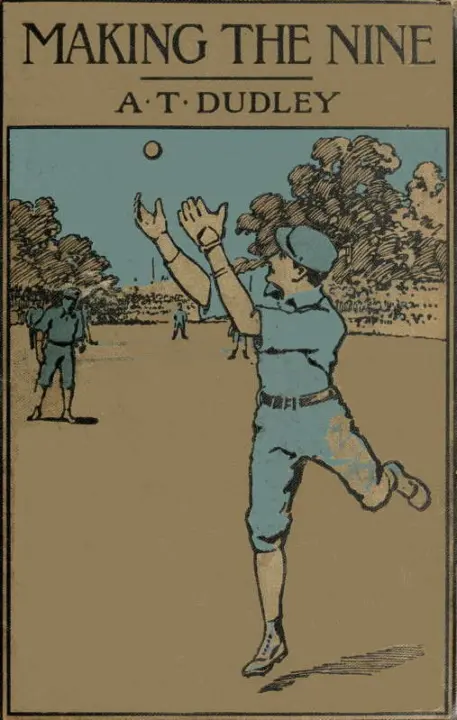
Making the Nine
Albertus T. (Albertus True) Dudley
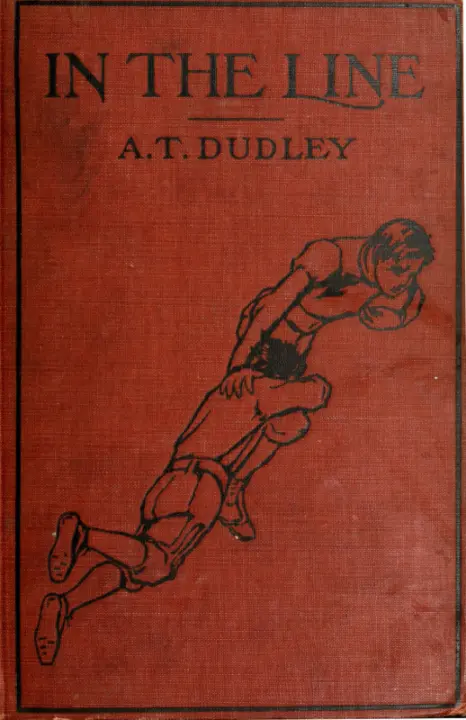
THE CLASSIC COLLECTION · 1905
"In the Line" by Albertus T. Dudley is a novel written in the early 20th century. The story revolves around Wolcott Lindsay, a young boy navigating the challenges of school life and football at Seaton, an elite boarding school. The novel explores themes of friendship, sportsmanship, and the social dynamics within a school environment, against the background of American rugby football. The opening of "In the Line" introduces Wolcott Lindsay Senior and Junior as they arrive in Boston after a long voyage. The narrative focuses on Junior, an overgrown but energetic boy who is eager to acclimate to his new American school life. His parents discuss his education options, highlighting differing family viewpoints about schooling. The story begins to unfold as the Lindsays get settled, hinting at the challenges Wolcott will face while trying to fit in amongst his peers and the expectations set upon him in both academics and athletics. This initial setup leads to an exploration of friendships, rivalries, and personal growth as the characters and their dynamics are established.
Introduction adapted from the source catalogue; source summaries may be automatically generated.
Free to read · English · 54,146 words · No account needed
MAKE TIME FOR A GOOD BOOK
On by default. Untick to stop anonymous reading totals. Each page counts after 10 seconds in view. How this works.
Anonymous counting is on unless you have switched it off.
“Had a hot time at your class meeting, I understand,” said Tompkins, who was killing a quarter of an hour in Wolcott’s room. “I wish I’d been there. Which side were you on, the kickers or the kicked?”
“I voted for Butler,” replied Wolcott, with dignity.
“Oh, you belong to that bunch! What’s the matter with Laughlin? Isn’t he good enough for you?”
“He’s all right in his place. I don’t think he ought to be president of the class. He isn’t enough of a gentleman.”
“Oh, isn’t he? Who is, then? Marchmont?”
“Yes, or at least he looks like one and acts like one,” returned
Wolcott, warmly.
Tompkins stared. “Laughlin’s no dude, I’ll admit,” he said after some deliberation. “He’s never been able to get money at a bank just by signing a check, and I don’t suppose he’d feel entirely at home in a Fifth Avenue ballroom. But he’s worth as many Marchmonts as you can pile in that bedroom there—and a pile of Marchmonts would settle a good bit; they’d be pretty flabby.”
“Please remember that Marchmont’s a friend of mine,” said Wolcott,
haughtily.
“Is he?” said Tompkins, coolly. “I’m not so sure of that.”
This remark Wolcott received with chilling silence.
“There’s one thing Marchmont can do all right,” went on Tompkins.
“What’s that?”
“Play the mandolin. He’s ’most as good as a nigger minstrel.”
“There’s another thing he can do,” replied Wolcott, quickly, “write poetry. You’re mighty glad to get it for the Lit.”
“Yes, there was some verse in the last number over his name,—rather streaky, I called it. Four stanzas were good and one was bum. The fellow who did the four good ones wasn’t a bad fist at writing rhymes.”
“Well, Marchmont wrote them, didn’t he?”
“Have I said he didn’t?” responded Tompkins, with an exasperating grin.
“And he had a prose article in the January number.”
“That horse business? Yes, that wasn’t bad. He wrote it as a theme and had to rewrite it twice afterward before Bain would accept it. By the time it got to us it was fairly readable.”
“It’s better than the stuff you write,” declared the indignant Lindsay.
Tompkins smiled and nodded. “Quite likely; I’m not the only paying mine in the cañon. Going to Eastham with the band to-morrow night?”
“Yes,” replied Wolcott, sullenly, “the Glee and Mandolin clubs are both
going.”
Your reading position is saved on this browser. Take it to another device with a library code. Reading pages adapt to text, rather than matching a printed edition.
Albertus T. (Albertus True) Dudley
Albertus T. (Albertus True) Dudley
Albertus T. (Albertus True) Dudley
Albertus T. (Albertus True) Dudley
BEHIND THE BOOK
This eBook is for the use of anyone anywhere in the United States and most other parts of the world at no cost and with almost no restrictions whatsoever. You may copy it, give it away or re-use it under the terms of the Project Gutenberg License included with this eBook or online at www.gutenberg.org. If you are not located in the United States, you will have to check the laws of the country where you are located before using this eBook. Read the source licence.
The original source file, including credits and licence, is retained by this library. Request an original-format copy at no charge. Please include the book title and Project Gutenberg identifier #56259.
KEEP YOUR CURIOSITY GOING
Coulson Kernahan

Maurice Baring
Frances Wright
Cécile Tormay

Frederic Jesup Stimson

W. H. P. (William Henry Pope) Jarvis